Updated November 2026
If you own a rental in Auburn or Opelika and you've been going back and forth on keeping it or selling it, here's the honest answer: the decision lives in your property's own numbers. Your rent ledger, your expense bills, your loan payoff, your tax basis, and your lease. Not a citywide average, and not what the neighbor's duplex supposedly brings in.
So let's work through it the way I'd do it across a kitchen table with you. How to run the hold math yourself, what the September 2026 housing-market numbers say about the selling side, and where taxes and your tenant's lease can flip the answer.
The Bottom Line
- Holding makes sense when its projected after-tax outcome compares favorably with selling and reinvesting the net proceeds over the same period. Cash-flow yield is only one part of that comparison.
- Run the math on your own rent, expenses, and payoff. Public rent and sales figures are context, not inputs.
- Per the Lee County Association of REALTORS®, more houses sold in both Auburn and Opelika in September 2026 than in September 2025, and more houses were sitting on the market too.
- Taxes can change the answer. A 1031 exchange defers tax; it doesn't erase it.
- A sale doesn't end your tenant's lease on its own. Plan the sale around the lease.
Start with what your rental actually earns
Your lease and your rent ledger are the real starting point. Pull a full year of what actually came in: rent collected, any concessions you gave, late or unpaid rent, and which utilities you cover. Scheduled rent and collected rent are two different numbers, and the gap between them belongs in your math.
For context only, the U.S. Census Bureau's 2020-2024 American Community Survey five-year estimates put median gross rent at $1,098 in the city of Auburn and $950 in the city of Opelika. By bedroom count, Auburn's medians were $952 for a one-bedroom, $1,121 for a two-bedroom, $1,217 for a three-bedroom, and $1,801 for a four-bedroom. Opelika's ran $712, $937, and $1,119 for one through three bedrooms.
Those are period estimates covering 2020 through 2024 of what occupied rentals paid, with utilities folded in when the renter pays them. They aren't today's asking rents, and they aren't an appraisal of your unit. If your lease says something different, your lease wins.
The same Census survey counts 14,161 renter-occupied homes out of 30,174 occupied homes in Auburn, and 4,167 out of 13,467 in Opelika. It also counts 1,533 vacant units for rent in Auburn and 362 in Opelika. That's a big renter base, but it isn't a vacancy rate, and it can't tell you how fast your particular unit will lease. Your own leasing and renewal history is better evidence than any citywide count.
Run the hold math on your own property
In my guide to Auburn cap rates and rent yields, I define cap rate as "A property's yearly net operating income divided by its price or value." Cash-on-cash is "A year of pre-tax cash flow after mortgage payments divided by the cash you put in." For a hold-or-sell decision, though, the question shifts from what you put in years ago to what you have in it right now.
Here's the worksheet. Every input comes from your own records:
- Start with a full year of scheduled rent.
- Subtract your own vacancy and credit loss, based on your history with this property.
- Subtract operating costs: property taxes, insurance, HOA dues, management, repairs, and any utilities you pay. Keep replacement reserves separate from operating costs.
- What's left is your net operating income (NOI).
- Divide NOI by what the property would likely sell for today. That's your cap rate on current value.
- Subtract a year of mortgage payments and your planned replacement reserve from NOI. That's your pre-tax cash flow after reserves.
- Divide that cash flow by your gross current equity (likely sale price minus your loan payoff). That's your annual pre-tax cash-flow yield on gross current equity, not your total holding return. It excludes principal reduction, appreciation or depreciation, and tax effects; the denominator does not deduct selling costs or sale taxes.
That last line is a cash-flow screen, not the whole answer. There's no single Auburn cap rate that settles this for you. Two rentals on the same street can pencil out completely differently depending on the loan, the tax bill, and how old the roof is.
The lazy equity question
Say you bought years ago, the house has gone up in value, and the loan's mostly paid down. Your cash flow might look great against what you originally put in and pretty thin against what the house is worth today. That gap is what people call lazy equity.
My read: compare both choices over the same period and on an after-tax basis, not this pre-tax yield against an after-tax alternative. With your CPA and financial advisor, choose an end date. For holding, add projected after-tax rental cash flows after debt service and actual replacement spending to projected sale proceeds at that date, net of payoff, selling costs, and taxes. Reserve transfers aren't expenses in this calculation; don't also deduct them from cash flows. Principal reduction is reflected in the ending payoff, and appreciation or depreciation in the ending sale price. For selling now, start with today's proceeds after payoff, selling costs, and taxes, then project the alternative's ending value after fees and taxes plus any after-tax distributions. Use the same reinvestment assumption for interim cash flows on both sides. Compare the resulting ending wealth, and test different assumptions rather than treating either projection as guaranteed. What "somewhere else" means is a conversation for you and your financial advisor, not a market report.
Stress-test it before you decide
Run the hold math a second time with scenarios you pick from your own bills and quotes:
- One extra vacant month between tenants.
- A roof or HVAC replacement, priced from an actual quote.
- An insurance renewal increase. Ask your agent for the renewal number instead of guessing.
- A higher tax bill if an exemption you had as an owner-occupant no longer applies. Check the exact parcel's bill with the Lee County Revenue Commission.
- Flood exposure. Look up the address on FEMA's flood map and talk with your insurer about what's covered.
If the hold still works in your worst reasonable scenario, that tells you something. If one surprise wipes out a year of cash flow, that tells you something too.
What selling would actually put in your pocket
Start with a dated, property-specific market analysis. A citywide median can't value your house, and neither can a portal estimate. Online home value estimates are a starting point only and are not a formal comparative market analysis or appraisal.
Next, ask your lender for a written payoff statement. Your payoff usually isn't the same as the principal balance on your monthly statement, because interest and fees run through the payoff date.
Then build a net sheet: likely sale price, minus the loan payoff, minus selling costs (closing costs, plus any repairs or concessions you agree to), minus the taxes the sale triggers. That bottom number, not the sale price, is what goes up against your hold math. Proceeds before tax are not proceeds after tax, and on a rental, the tax line can be the biggest surprise on the page.
What September 2026 housing-market numbers say about selling
Per the Lee County Association of REALTORS®, 104 houses sold in Auburn in September 2026, compared with 86 in September 2025. Existing homes, the resale category a rental house sells in, accounted for 57 of those sales, against 56 a year earlier. Auburn's median sold price was $436,000, up from $423,889. Houses averaged 58 days on the market, against 54 days in September 2025, and existing homes alone averaged 48 days in September 2026.
In Opelika, 64 houses sold in September 2026 versus 52 a year earlier, according to the Lee County Association of REALTORS®. Existing-home sales went from 30 to 33. The median sold price was $382,000, compared with $359,612. Average days on market stretched from 48 days to 66 days, and existing homes averaged 77 days in September 2026.
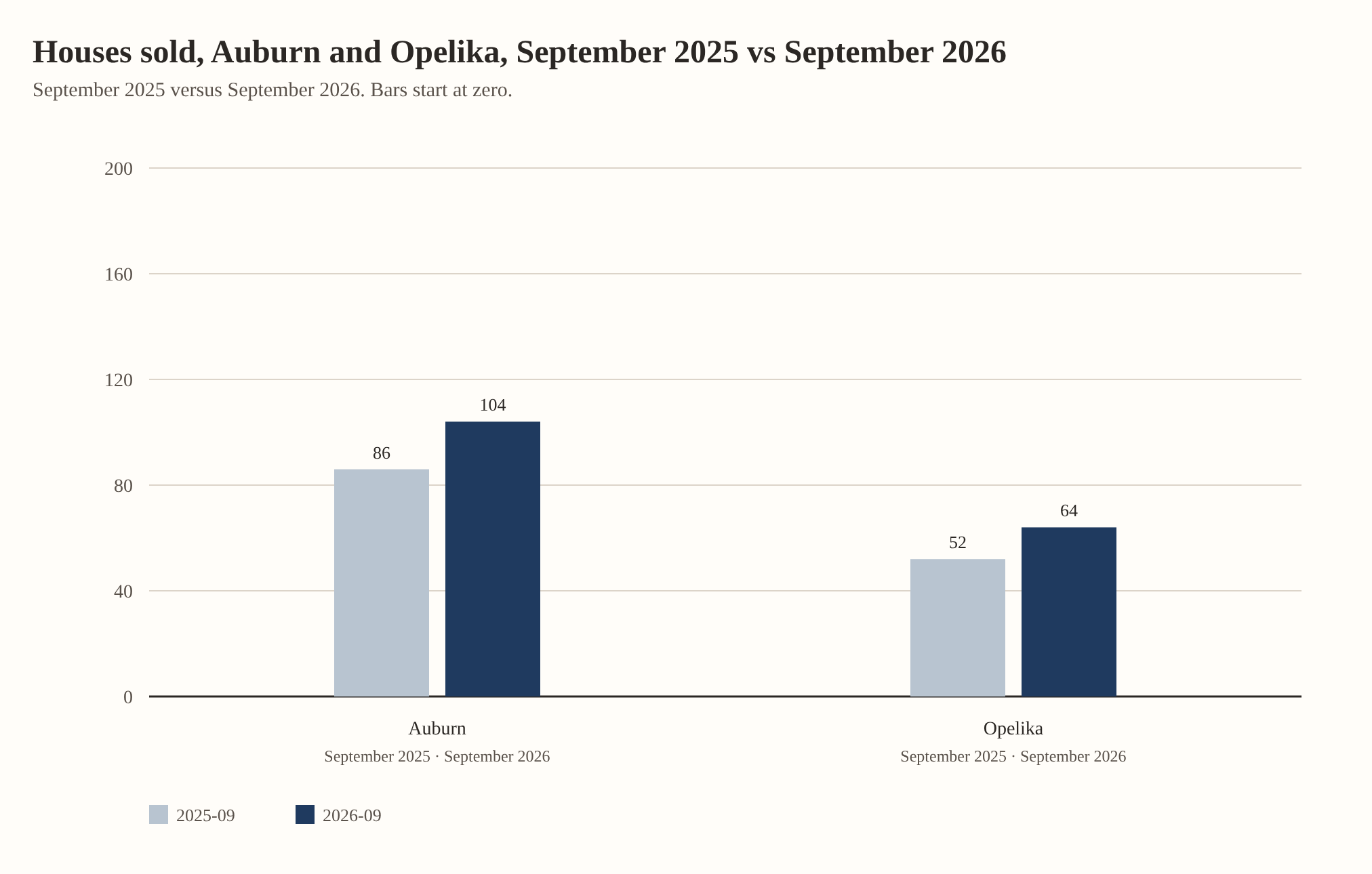
Chart 1. Houses sold, Auburn and Opelika, September 2025 vs September 2026. Source: Lee County Association of REALTORS® Housing Stats, September 2026 (published Oct 7, 2026).
Active inventory increased too. Auburn had 429 houses on the market in the September 2026 count, up from 278 in September 2025, per the same Lee County Association of REALTORS® report. Opelika had 278, up from 240. Both sales and active inventory increased in each city.
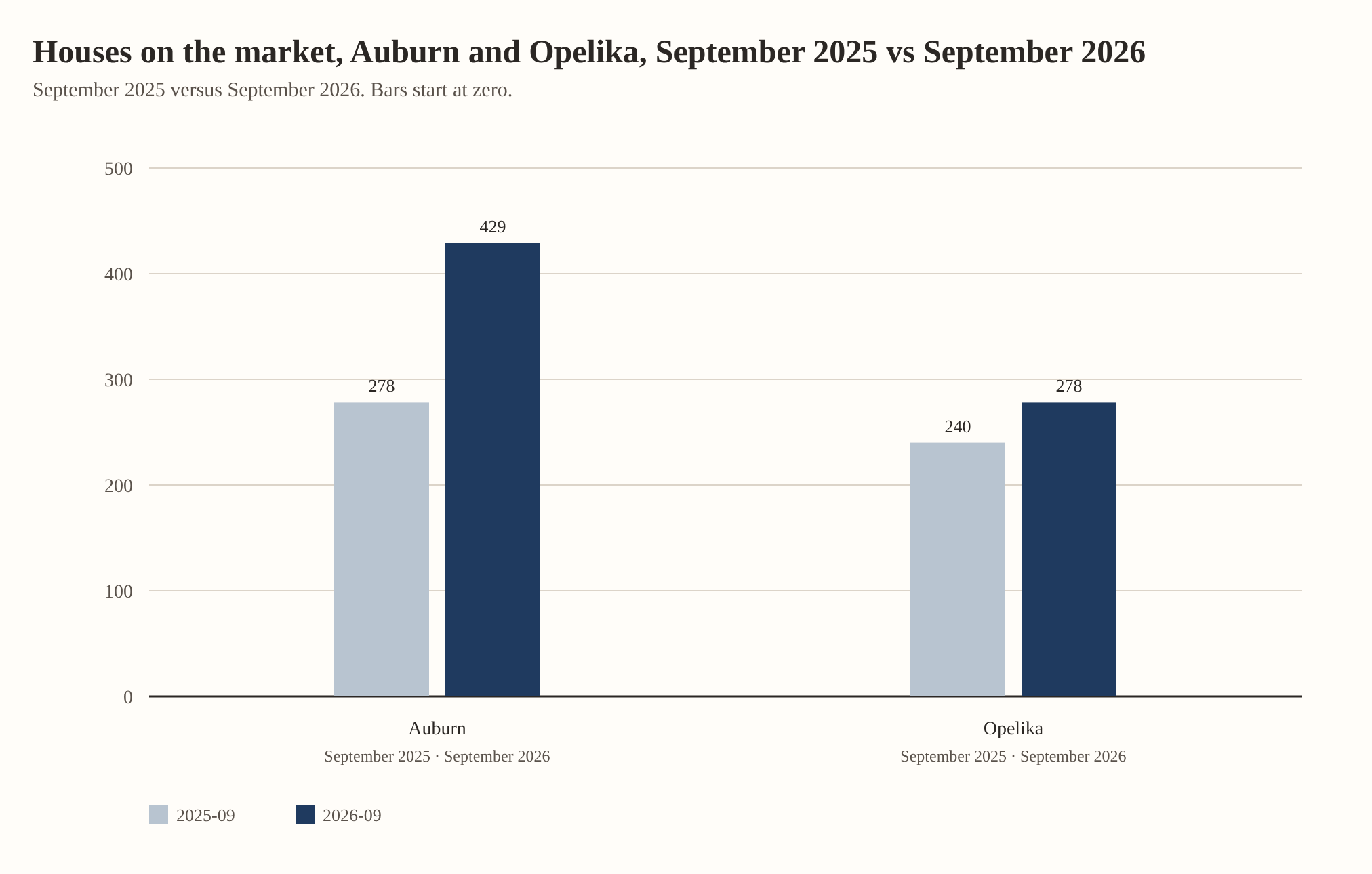
Chart 2. Houses on the market, Auburn and Opelika, September 2025 vs September 2026. Source: Lee County Association of REALTORS® Housing Stats, September 2026 (published Oct 7, 2026).
If your rental is a condo, look at Auburn's condo numbers separately. The Lee County Association of REALTORS® shows 24 condo sales in Auburn in September 2026 at a median of $267,500, compared with 18 sales at a median of $389,875 in September 2025. With that few sales, a change in which units happened to sell can swing the median hard, so don't read it as your unit losing value. Condos on the market went from 49 to 79 over the same comparison.
My read: buyers are still closing, and more of them closed this September than last, but a seller has more competition for their attention than a year ago. That puts more weight on pricing your rental right from day one and on its condition when buyers walk through. A citywide median is not your property's value, and it isn't a forecast.
Figures are closed and listing data for Auburn and Opelika as of September 2026, from the Lee County Association of REALTORS® Housing Stats report. Market conditions change and past figures are not a prediction. Information deemed reliable but not guaranteed; readers should independently verify.
Taxes can change the whole answer
Selling a rental isn't taxed like selling the home you live in, and this is the line on the net sheet where I'd bring in a CPA or tax attorney before you decide. A few federal basics from IRS Topic 409: a gain is generally long-term if you held the property for more than 1 year. For tax year 2025, most net capital gain is taxed at no more than 15% for most individuals. A zero rate applies at taxable income up to $48,350 for single filers and $96,700 for married couples filing jointly, and a 20% rate applies above the 15% thresholds.
On a rental, depreciation matters here too. IRS Topic 409 says unrecaptured section 1250 gain from selling real property is taxed at a maximum 25% rate, and your CPA can tell you how much of your gain falls in that bucket based on the depreciation you've taken. Alabama's side of it is its own question; I cover it in my guide to capital gains tax when you sell in Alabama.
Where a 1031 exchange fits
If you want out of this property but not out of real estate, a like-kind exchange may let you defer the gain. Per the IRS Instructions for Form 8824, for 2018 and later years section 1031 applies only to real property held for use in a trade or business or for investment. The deadlines are tight. You must identify replacement property within 45 days of transferring the one you gave up, and you must receive it within 180 days or by your tax return due date (with extensions), whichever is earlier. Cash or other non-like-kind property you take out of the deal is taxable to that extent, and exchanges with related parties carry a 2-year holding rule.
A 1031 is deferral, not elimination. I walk through how it works for Alabama owners in my 1031 exchange guide. This is not investment or tax advice and no return is guaranteed.
Your tenant comes with the decision
A sale doesn't end a residential lease on its own. If your tenant has a lease running into next summer, a buyer generally takes the property with that lease in place. If the tenancy is month-to-month, ask an Alabama attorney to confirm the required notice and lawful termination date before making sale plans, and review my guide to selling a rental with tenants in Alabama. Alabama law also sets rules on access for showings and on security deposits, and that guide walks through them.
My read on the practical side: the lease shapes who your buyer is. An investor may be happy to buy with a good tenant in place and a clean rent history. A buyer who plans to live in the home may need vacant possession at closing or by an agreed date, depending on the contract, lease, financing, and legal requirements. Confirm lawful possession timing before promising a vacancy date. Read your lease before you list, keep your tenant informed, and get legal advice on anything the lease doesn't spell out.
Confirm the rules for your exact parcel
Before you decide to hold, make sure the way you rent the property is actually allowed where it sits. Confirm whether the parcel is in the City of Auburn, the City of Opelika, or unincorporated Lee County. A mailing address doesn't settle that. Then check zoning, any rental or short-term rental rules, and your HOA covenants if you have them.
If you're weighing a switch to short-term rental instead of selling, start with my rundown of Auburn short-term rental rules. Local rules change. Confirm current requirements with the City of Auburn, the City of Opelika, or Lee County before relying on anything here. This is not legal advice.
Hold or sell: how I'd frame it
None of these signals decides it alone, but here's how I'd sort them.
Signs that point toward holding:
- Your cash flow stays positive even under the stress scenarios you picked.
- The projected after-tax holding outcome holds up against selling and reinvesting over the same period.
- No major replacement is due in the next few years, or you've already reserved for it.
- Your lease and the parcel's rules support the way you rent.
- Selling now would trigger a tax bill you'd rather not take this year.
Signs that point toward selling:
- Your equity has grown and your return on it has shrunk.
- A big replacement is coming that you'd rather not fund.
- You want to move the money into real estate that fits your plans better, possibly through a 1031 exchange.
- Your lease timing lines up with a clean sale window.
- You're simply ready to stop being a landlord. That counts as a reason, and I'd never talk you out of a new chapter.
Does selling my rental end my tenant's lease in Alabama?
Not on its own. The buyer generally steps into the existing lease. For a month-to-month tenancy, ask an Alabama attorney to confirm the required notice and lawful termination date, and review my tenant-sale guide before planning possession.
How do I know what my Auburn rental's cap rate is?
Divide a year of net operating income by what the property would sell for today. Use your own rent, vacancy, and expense records, not a citywide figure, and get a dated market analysis for the value side.
How long do I have to find a replacement property in a 1031 exchange?
Per the IRS Form 8824 instructions, you have 45 days to identify replacement property and 180 days to receive it, or your tax return due date with extensions if that comes first. Talk with your CPA before you list.
Let's put your numbers side by side
I'm Amy Cotney, a REALTOR® with Roots Real Estate - Investment Development here in Auburn. If you're on the fence about your rental, I'm glad to pull a dated market analysis on it and build a net sheet you can set right next to your hold math, so you're comparing real numbers instead of hunches. Call or text me at (334) 332-4002, or read more about how I work. I build strong relationships that lead to sold homes and happy buyers, through communication, not automation.
Sources
- U.S. Census Bureau, American Community Survey 2020-2024 5-year estimates, tables B25064 (Median Gross Rent), B25031 (Median Gross Rent by Bedrooms), B25003 (Tenure), and B25004 (Vacancy Status), Auburn city and Opelika city, Alabama, via Census Reporter: https://api.censusreporter.org/1.0/data/show/acs2024_5yr?table_ids=B25064,B25031,B25003,B25004&geo_ids=16000US0103076,16000US0157048
- Internal Revenue Service, Topic no. 409, Capital gains and losses (tax year 2025 rates and thresholds): https://www.irs.gov/taxtopics/tc409
- Internal Revenue Service, Instructions for Form 8824, Like-Kind Exchanges (2026): https://www.irs.gov/instructions/i8824
- Lee County Association of REALTORS®, Housing Stats: September 2025 & September 2026, Auburn and Opelika, Residential and Condo (published October 7, 2026). LCAR monthly stats: https://www.leecorealtors.org/#stats