Updated October 2026
A 1031 exchange lets you sell an investment property, put the proceeds into another investment property, and postpone tax by deferring recognition of qualifying gain rather than recognizing it in a taxable sale. Postpone is the important word. The tax doesn't vanish; it travels with you into the property you buy. And the exchange has to be set up before your sale closes, with an independent qualified intermediary holding the money and two federal deadlines running from your closing date.
If you own an Auburn rental house, a game-day condo near campus, or a Lake Martin place you rent out, this is the plain-English version of how it works, and where I fit in.
This is general information, not tax advice. Talk with a CPA and a qualified intermediary before you close. I coordinate the real estate side: the listing, the contracts, the closing dates, and the replacement-property search. I'm not your tax adviser, your attorney, or your qualified intermediary, and I never hold exchange funds.
The Bottom Line
- A 1031 exchange defers qualifying gain. It does not erase it, and it doesn't guarantee a tax-free sale.
- Only real property held for investment or business use qualifies. Your main home and a property you bought to flip don't.
- You have until midnight on the 45th day after your sale closes to identify replacement property in writing, and until the 180th day (or your tax return due date, if earlier) to close on it.
- Sale proceeds can't touch your hands or your bank account. A qualified intermediary holds them.
- Once you've closed a regular cash sale, it's too late to turn it into an exchange.
What a 1031 exchange actually does
The federal statute says no gain or loss is recognized when "real property held for productive use in a trade or business or for investment" is exchanged solely for like-kind real property (26 U.S.C. §1031). The IRS puts it more simply: if you make a like-kind exchange, you generally aren't required to recognize a gain or loss (IRS, Like-Kind Exchanges, Real Estate Tax Tips).
Here's why that's a deferral and not a pardon. Under the same statute, your new property generally takes the basis of the property you gave up, adjusted for any money received and gain recognized. The gain you didn't pay tax on stays baked into the replacement property. Sell that one later without another exchange, and the deferred gain comes due. The IRS's own Form 8824 instructions call it "the deferred gain" for a reason (IRS, Instructions for Form 8824).
If you want the bigger picture on what you might owe when you sell without an exchange, I covered that in capital gains tax when you sell in Alabama.
Which Alabama properties can qualify
The property you sell and the property you buy both have to be real property held for investment or for use in a business. A few rules shape what that means for East Alabama owners:
- Real estate only. Effective January 1, 2018, the IRS says like-kind treatment is limited to real property. So the furniture, TVs, and grill on the balcony of a furnished game-day condo aren't part of the like-kind exchange (IRS, Real Estate Tax Tips).
- Not property held primarily for sale. The statute says the exchange rule "shall not apply to any exchange of real property held primarily for sale" (26 U.S.C. §1031). A house you bought to fix and flip is a different animal.
- Not your personal residence. A home used solely as your residence doesn't qualify. Main-home sellers look at a different set of rules, and the Form 8824 instructions point them there.
- U.S. for U.S. The IRS says real property in the United States is not like-kind to real property outside the United States.
What surprises a lot of owners is how broad "like-kind" is within U.S. real estate. Investment property can be exchanged for business property and the reverse. A condo doesn't have to be traded for another condo. Land can be exchanged for a rental house. A game-day condo could, in principle, roll into a rental home in Auburn, or into land, as long as both sides meet the investment test. If you're weighing what to buy next, my post on Auburn cap rates and rent yields is a good place to start.
Lake Martin houses and game-day condos you also use
Lake and condo owners ask this one a lot. You rent it out on football weekends or over the summer, but your family also uses it. Does it count?
It depends on the facts, and renting it now and then doesn't automatically make it investment property. The IRS has published conditions for dwelling units (a house, apartment, condominium, or similar) under which it says it will not challenge the property as held for investment. In broad terms: you've owned it long enough before the exchange, you've rented it to others at a fair rental, and your own personal use stayed limited. The replacement property faces parallel tests after the exchange.
The IRS guidance also describes a Tax Court case about a lakeside vacation home that was never rented and used only personally. It didn't qualify, and the court said a "mere hope or expectation that property may be sold at a gain cannot establish an investment intent" (IRS, Revenue Procedure guidance on dwelling units). For a Lake Martin place, that's the whole conversation in one sentence.
Falling outside those conditions isn't automatically fatal. It means your CPA has to look at your rental history, personal use, and investment purpose and make the call. Family use and below-market rentals can count as personal use, so bring your calendar and your rental records to that meeting. For the investment side of lake ownership, see whether a Lake Martin house is a good investment, and for condos, my Auburn game-day condo investment guide.
The two deadlines: 45 days and 180 days
Both clocks start on the day you transfer the property you're selling. Not the day you list it, and not the day you go under contract. Closing day.
- Identification period. The federal deferred-exchange regulations say it "ends at midnight on the 45th day thereafter." By then, your replacement property has to be identified in writing.
- Exchange period. It ends at midnight on the earlier of the 180th day after the transfer or the due date, including extensions, of your tax return for the year of the sale.
That second part trips people up. The Form 8824 instructions list "the due date (including extensions) of your tax return for the year in which you transferred the property given up" as one of the two possible deadlines (IRS, Instructions for Form 8824). Sell late in the year, and your filing deadline the following spring can arrive before day 180 unless your return is extended. If you're closing this fall, ask your CPA about that now.
These are statutory deadlines. They aren't business-day allowances, they aren't related to how long a home sits on the market, and neither I nor anyone else on your team can extend them.
How you identify replacement property
Identification has to be in a written document signed by you and delivered before the end of the 45-day period, and the federal regulations require each property to be "unambiguously described." "A condo somewhere near Jordan-Hare" won't do it. Your qualified intermediary will tell you exactly where the signed identification needs to go.
How many properties you can name depends on which rule you're using. They're alternatives, each with its own condition:
- The three-property rule. Identify up to three properties, regardless of their value.
- The 200 percent rule. Identify any number of properties, as long as their combined fair market value doesn't exceed 200 percent of the value of the property you sold.
- The 95 percent rule. If you go past both limits, the identification only works if you actually acquire at least 95 percent of the total fair market value of everything you identified.
My read: most sellers are best served by a short, realistic list they can actually close on. A long list that relies on the 95 percent rule raises the stakes considerably if a deal falls through.
Why the exchange has to be set up before closing
The federal deferred-exchange regulations treat you as receiving money when it's "credited to the taxpayer's account, set apart for the taxpayer, or otherwise made available." If your sale proceeds land in your checking account, even for a day, the exchange is likely blown. That's why a completed cash sale can't be converted into an exchange after the fact.
The standard fix is a qualified intermediary, often called a QI. The QI can't be you or what the regulations call a "disqualified person," and you sign a written exchange agreement with them. That agreement has to limit your rights to "receive, pledge, borrow, or otherwise obtain the benefits of money or other property" before the exchange period ends. The QI holds the proceeds from your sale and uses them to buy the replacement property.
Because of those independence rules, your listing agent isn't your QI. I don't hold exchange funds. What I do is make sure your QI and closing attorney are in the loop before we sign a contract, so the exchange paperwork is ready well ahead of closing day.
Cash, a smaller mortgage, and depreciation can still create a tax bill
A 1031 exchange doesn't have to be all-or-nothing, but anything you take out that isn't like-kind property can be taxed. The statute says that when you receive money or other property, gain "shall be recognized, but in an amount not in excess of the sum of such money and the fair market value of such other property" (26 U.S.C. §1031).
The Form 8824 instructions spell out what counts, often called "boot": cash paid to you, the fair market value of non-like-kind property you receive, and net liabilities assumed by the other party, meaning debt relief (IRS, Instructions for Form 8824). Exchange expenses you paid reduce that total.
In plain English, two common surprises:
- Cash left over. Keep some proceeds out of the deal, and that cash can be taxable.
- A smaller mortgage. Pay off a loan on the property you sell and take on less debt on the one you buy, and that difference can create taxable gain too. Under the Form 8824 instructions, additional cash you contribute can offset net debt relief; matching mortgage balances isn't required. Your CPA must calculate recognized gain using the complete exchange facts.
There's also depreciation. The same instructions warn that you "may be required to recapture as ordinary income part or all of the realized gain" for certain depreciated property. If you've been depreciating a rental for years, that piece matters. Your CPA should run the actual numbers on Form 8824 before you set a price range for the replacement property.
Alabama questions to settle before closing
Federal law is only half of it. Your CPA needs to confirm how Alabama treats your specific exchange on your state return.
Withholding is a piece that can catch out-of-state owners of lake houses and game-day condos. The Alabama Department of Revenue says nonresident withholding on real property sales is "3 percent or 4 percent of the purchase price" (ADOR, Nonresident Withholding). Its exemptions page says a transfer where gain is "completely not recognized by the seller for Alabama income tax purposes, such as a like kind exchange," isn't subject to that withholding. A partially non-recognized transfer is subject to withholding only to the extent of the recognized gain. The same page lists a $300,000 purchase-price threshold (ADOR, Exemptions from Nonresident Withholding).
Withholding isn't the same thing as your final Alabama tax, and the exemption comes with forms and conditions. If you live outside Alabama, ask your closing attorney and QI early which forms apply to your sale.
Related parties and who holds title
Two things to flag before anyone signs a contract.
Related parties. If you exchange with a family member or a related entity, and either of you disposes of the exchanged property within 2 years, the deferred gain generally has to be reported (26 U.S.C. §1031). The Form 8824 instructions also say to "file Form 8824 for the 2 years following the year of a related party exchange."
Title. Who owns the property you're selling: you, you and a spouse, an LLC? Tell your CPA and QI up front. Changing how title is held right before or after an exchange isn't something to do casually, and I'd never promise it's harmless.
What the Auburn market looks like for a replacement search
The 45 days go fast, so the supply of possible replacement properties matters. Per the Lee County Association of REALTORS®, 79 condos were on the market citywide in Auburn at the September 2026 count, compared with 49 a year earlier. Houses on the market in Auburn rose from 278 at the September 2025 count to 429 in September 2026.
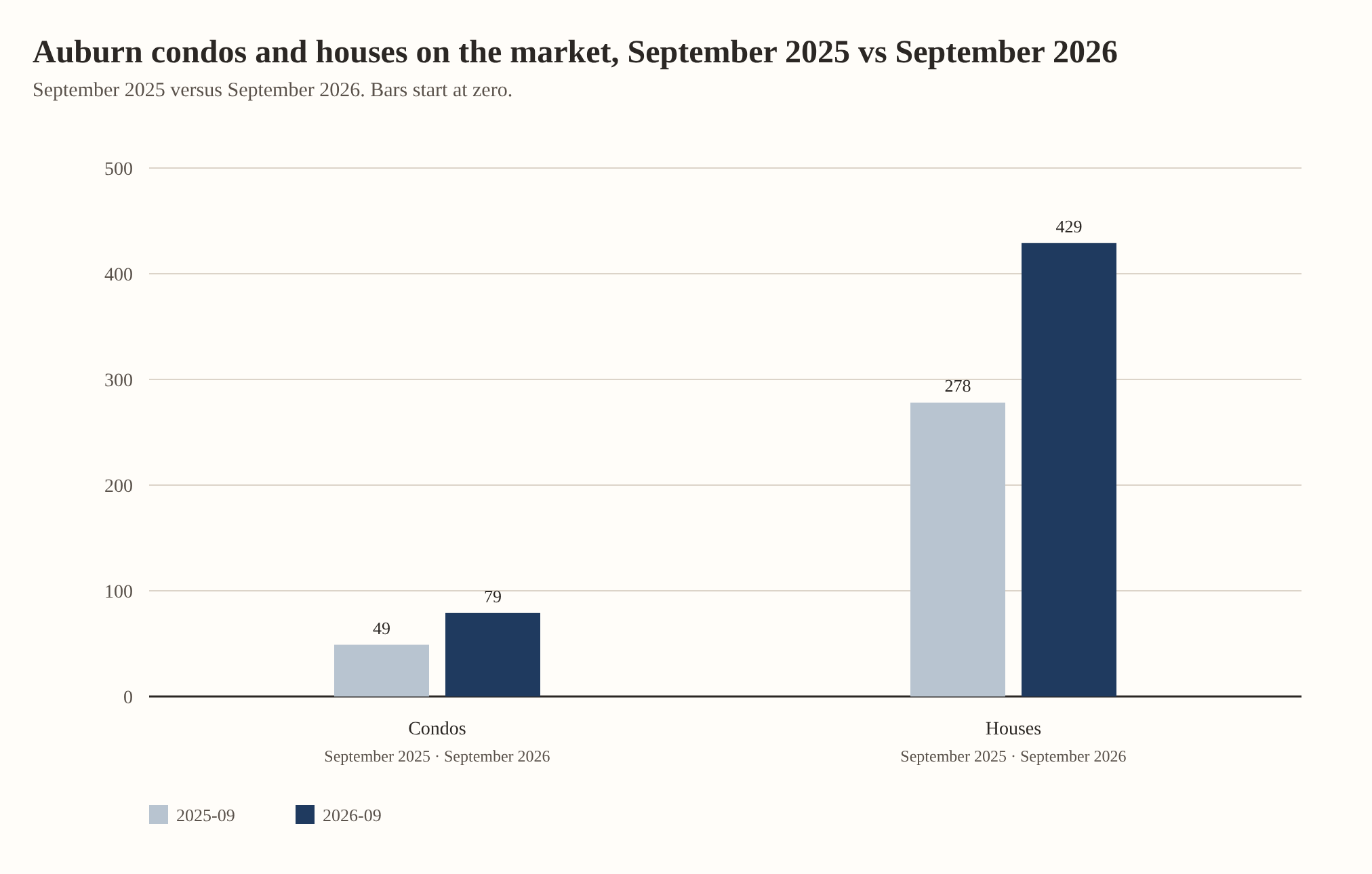
Chart 1. Auburn condos and houses on the market, September 2025 vs September 2026. Source: Lee County Association of REALTORS® Housing Stats, Sept 2026, Auburn (pub. Oct 7, 2026), section Condo September 2025; Lee County Association of REALTORS® Housing Stats, Sept 2026, Auburn (pub. Oct 7, 2026), section Condo September 2026; Lee County Association of REALTORS® Housing Stats, Sept 2026, Auburn (pub. Oct 7, 2026), section Residential September 2025; Lee County Association of REALTORS® Housing Stats, Sept 2026, Auburn (pub. Oct 7, 2026), section Residential September 2026.
On the sales side, 24 condos sold in Auburn in September 2026, up from 18 in September 2025, according to the Lee County Association of REALTORS®. Those 24 condo sales averaged 48 days on the market in September 2026, against an average of 96 days for the 18 sales in September 2025. The Auburn condo median sold price was $267,500 on 24 sales in September 2026, versus $389,875 on 18 sales in September 2025. With that few sales, my read is that the median says more about which units closed that month than about what your condo is worth.
For houses, the Auburn residential median sold price was $436,000 in September 2026, compared with $423,889 in September 2025, per the Lee County Association of REALTORS®. Of the 104 houses sold in Auburn in September 2026, 47 were new construction, which is worth knowing if a new build is on your replacement list.
My read on all of this: more choice than last September helps when you're on a 45-day clock, but none of it changes the clock. Market time for a typical sale has nothing to do with your identification and exchange deadlines.
Figures are closed-sale and active-listing data for Auburn as of September 2026 and September 2025, from the Lee County Association of REALTORS® Housing Stats report. Market conditions change and past figures are not a prediction. Lake Martin isn't part of this Auburn report, so these figures don't describe the lake market.
How I coordinate the timeline
Here's the order I like to work in when a client tells me they're thinking about an exchange:
- Before listing. You talk to your CPA about whether the property qualifies and what the numbers look like. You choose a QI. I'll want both names so we can keep everyone on the same page.
- Before signing a sale contract. Your QI and closing attorney confirm the exchange documents will be ready for closing. I start a replacement search early, so you're not starting cold once the 45-day clock starts.
- At closing. Proceeds go to the QI, not to you. The clocks start.
- From closing to day 45. We tour, compare, and narrow the list. You sign the written identification, and your QI tells you where it has to go and by when.
- Through day 180 (or your return due date, if earlier). We negotiate, inspect, and close on the replacement, with the QI funding the purchase.
My read: the stress in an exchange usually doesn't come from the tax rules themselves. It comes from a replacement contract that falls apart late in the window. So I try to keep a realistic backup within the identification rules your CPA and QI are comfortable with.
How do I avoid capital gains when I sell a rental property?
A 1031 exchange is one way to postpone federal capital gains tax on a rental, by reinvesting through a qualified intermediary into like-kind investment real estate within the 45-day and 180-day deadlines. It defers the tax rather than eliminating it, and cash or debt relief you take out can still be taxed. Your CPA can tell you whether it fits your situation. If you're also dealing with tenants in place, see selling a rental with tenants in Alabama.
Can I decide to do a 1031 exchange after my sale closes?
No. If the proceeds were credited to your account or made available to you, it's too late. The exchange has to be arranged before closing.
Can my real estate agent hold the money?
No. Sale proceeds go to an independent qualified intermediary under a written exchange agreement. I coordinate dates and the property search; I don't hold funds.
Does my game-day condo or Lake Martin house qualify if I use it sometimes?
Maybe. It turns on how long you've owned it, how much it's rented at a fair rate, and how much you and your family use it. Your CPA has to make that call on your facts.
Working with me
I'm Amy Cotney, a licensed real estate salesperson and REALTOR® with Roots Real Estate - Investment Development in Auburn. When you're selling an investment property and planning an exchange, I'll keep the listing, the contracts, the replacement search, and the closing dates moving in step with your CPA and qualified intermediary. You can read more about me and how I work, or reach out when you're ready to talk through your timeline.
This is not investment or tax advice and no return is guaranteed.
I build strong relationships that lead to sold homes and happy buyers, through communication, not automation.
Sources
- U.S. Code, 26 U.S.C. §1031, Exchange of real property held for productive use or investment, via Cornell Legal Information Institute: https://www.law.cornell.edu/uscode/text/26/1031
- Code of Federal Regulations, Treatment of deferred exchanges, via Cornell Legal Information Institute: https://www.law.cornell.edu/cfr/text/26/1.1031(k)-1
- Internal Revenue Service, Instructions for Form 8824 (2025): https://www.irs.gov/instructions/i8824
- Internal Revenue Service, Like-Kind Exchanges, Real Estate Tax Tips: https://www.irs.gov/businesses/small-businesses-self-employed/like-kind-exchanges-real-estate-tax-tips
- Internal Revenue Service, Revenue Procedure on dwelling units and like-kind exchanges: https://www.irs.gov/pub/irs-drop/rp-08-16.pdf
- Alabama Department of Revenue, Withholding Requirement on Sales/Transfers of Real Property by Nonresidents: https://www.revenue.alabama.gov/individual-corporate/nonresidentwh/
- Alabama Department of Revenue, Exemptions from Nonresident Withholding Requirement on Sales of Real Property: https://www.revenue.alabama.gov/individual-corporate/nonresidentwhexmpt/
- Lee County Association of REALTORS® Housing Stats, Sept 2026, Auburn (pub. Oct 7, 2026), section Condo September 2026
- Lee County Association of REALTORS® Housing Stats, Sept 2026, Auburn (pub. Oct 7, 2026), section Condo September 2025
- Lee County Association of REALTORS® Housing Stats, Sept 2026, Auburn (pub. Oct 7, 2026), section Residential September 2025
- Lee County Association of REALTORS® Housing Stats, Sept 2026, Auburn (pub. Oct 7, 2026), section Residential September 2026