Updated October 2026
Yes, you can sell a rental house in Alabama with a tenant living in it. The lease doesn't vanish when the deed changes hands. Your tenant still gets advance notice before showings. And if you want the house empty for closing, your lease and Alabama's landlord-tenant law decide how and when that can happen. Here's how I walk Auburn-area owners through it.
First, I'm a real estate agent, not a lawyer. The rules below come from the Alabama Uniform Residential Landlord and Tenant Act, and the advice comes from how these sales run in practice. Your lease is specific to you, so have a real estate attorney look at your plan before you send a tenant any notice.
The Bottom Line
- A sale doesn't end a residential lease on its own. The lease you signed is the starting point.
- Your tenant can't unreasonably refuse showings, and you owe them notice first. The statute's words are "at least two days' notice."
- Fixed-term leases and month-to-month tenancies end in different ways. Don't apply one rule to the other.
- A notice to leave is not an eviction. Only a court can order a tenant out.
- No lockouts, no utility shutoffs, and no moving a tenant's belongings to speed things along.
Does selling the house end the lease?
Not by itself. In my experience, the buyer takes the house with the lease attached, and the tenant keeps living there on the same terms until the lease ends the way it's written to end. The Act itself expects a rented home to be sold with the lease in place. Unless otherwise agreed, a landlord who sells premises that include a dwelling unit "subject to a rental agreement" in a good faith sale to a bona fide purchaser is relieved of liability only "as to events occurring after written notice to the tenant of the conveyance" (Ala. Code § 35-9A-205, subsection (a)). A sale also isn't one of the grounds the Act lists for ending a tenancy over a tenant's noncompliance (Ala. Code § 35-9A-421).
So the first document I ask a landlord for isn't the deed. It's the signed lease, plus every amendment and renewal. Look for the end date, any renewal option, any early-termination language, and anything that mentions a sale. Those answers decide whether you're marketing to an investor who wants a tenant in place or planning around a move-out date. Have an attorney confirm how your lease treats a sale before you promise a buyer anything.
If you inherited the rental with a tenant already in it, sort out who has authority to sell first. My guide to how probate works in Alabama covers that side of things.
Showing a rental with tenants inside
Alabama's law is more specific here than most owners expect. The Act's access section, Ala. Code § 35-9A-303, says a tenant "shall not unreasonably withhold consent" for the landlord to enter and "exhibit the dwelling unit to prospective or actual purchasers, mortgagees, tenants, workmen, or contractors." Buyer showings fit squarely in that list. Listing photos and appraisal visits aren't named on their own, so I treat them like any other entry: notice, reasonable hours, and the tenant's cooperation.
The other half of that bargain is notice. Unless an exception applies, the landlord gives "at least two days' notice" of intent to enter and comes in only at reasonable times. A note posted on the primary entry door that states the time and purpose of the visit counts. A tenant can agree to shorter notice, and plenty will if you ask kindly and keep your word. All of this is in § 35-9A-303(c) and (d).
There's a firm limit, too. The landlord "shall not abuse the right of access or use it to harass the tenant." Back-to-back showings every evening during dinner is how you lose a tenant's goodwill, and honestly, I wouldn't want that either.
The Act also allows entry without the tenant's consent to show the home to a buyer, but only under narrow conditions. It has to fall within four months of the lease's expiration, the tenant must have signed a general notice separate from the lease, the landlord has to come in with the buyer, and the regular notice still applies (§ 35-9A-303(b)(4)). Most of the time, cooperation is the better path.
Here's what works with tenants, in my experience:
- Talk to your tenant before the listing goes live. Explain the timeline and what it means for them.
- Set showing windows in advance, a couple of set times a week, and stick to them.
- Offer something for the inconvenience, such as a rent credit or a professional cleaning before photos. That's an agreement between you and your tenant, so put it in writing.
- Bunch showings together so your tenant isn't leaving home every night.
If you own your rental from somewhere else, coordinating all of this from a distance is its own project. My post on selling your home from out of state walks through selling when you can't be here in person.
Want it vacant? Fixed-term leases vs. month-to-month
This is where owners get tripped up most often.
A fixed-term lease runs on its own terms: its end date, its renewal clause, and whatever notice provisions it contains. The statute's termination rules for periodic tenancies, in Ala. Code § 35-9A-441, are written for week-to-week and month-to-month tenancies and don't automatically apply to it. If you want the tenant out before the end date, the usual route is a voluntary move-out agreement. That's a contract between you and the tenant, often with a payment or a rent credit attached, and it should be in writing and reviewed by an attorney.
A periodic tenancy (week-to-week or month-to-month) can be ended by either side with written notice. For month-to-month, the written notice has to be given "at least 30 days before the periodic rental date specified in the notice," so the timing depends on when rent is due. For week-to-week, the statute calls for written notice at least "seven days" before the termination date. Both rules are in § 35-9A-441(a) and (b). Check both the current Code and your lease before you send anything.
If a tenant stays after the tenancy has properly ended, the landlord can seek possession through the court. When the holdover is willful and not in good faith, the Act lets the landlord also recover up to three months' periodic rent or actual damages, whichever is greater, plus reasonable attorney's fees (§ 35-9A-441(c)).
My advice: don't sign a purchase contract that promises vacant possession until the lease end date and the move-out plan are settled. A buyer's closing date and a tenant's move-out date are two different promises, and only one of them is fully in your control.
If a tenant won't leave or stops paying
A sale doesn't change the rules here. If a tenant materially breaks the lease or doesn't pay rent, the written notice must allow "not less than seven business days after receipt" before the tenancy can end (Ala. Code § 35-9A-421, subsections (a) and (b)). A tenant also can't keep curing the same kinds of problems indefinitely, since the Act caps repeat cures (§ 35-9A-421(d)).
Three different things often get lumped together:
- A termination notice. This is a letter from the landlord. It doesn't remove anyone.
- An eviction filing. In Alabama, the landlord files an eviction action, and the Act gives district and circuit courts jurisdiction over those cases in the county where the property is located (Ala. Code § 35-9A-461, subsection (b)).
- A court-ordered recovery of possession. That's the only point at which the tenant can be required to leave.
Nobody can honestly promise you a date for that process, and I won't either. What I can tell you is what not to do. Don't change the locks, shut off utilities, or remove a tenant's belongings without court process. If a landlord unlawfully removes or excludes a tenant, or willfully interrupts essential services like water, heat, or electricity, the tenant can recover possession or end the lease and collect up to three months' periodic rent or actual damages, whichever is greater, plus attorney's fees (Ala. Code § 35-9A-407). If a tenant won't leave, call a landlord-tenant attorney before you do anything else. The same goes if you're deciding which tenants to renew and which to give notice, or if a tenant recently complained about repairs. Talk to a lawyer before you act.
Security deposits, rent, and closing
Under the Act, a security deposit generally can't exceed "one month's periodic rent," with exceptions for pets, changes to the premises, or increased liability risks (Ala. Code § 35-9A-201). The landlord has 60 days after "termination of the tenancy and delivery of possession" to refund the deposit or provide an itemized list of amounts withheld (§ 35-9A-201(b) and (c)). The sale doesn't start that clock.
That matters. If your tenant stays on with the new owner, their tenancy hasn't ended, so there's no refund due at closing just because the house sold. The Act binds whoever holds the landlord's interest when the tenancy ends (§ 35-9A-201(h)), and a selling landlord "remains liable to the tenant for all security recoverable by the tenant" and all prepaid rent (§ 35-9A-205(a)). In practice, the purchase contract spells out how the deposit and any prepaid rent move to the buyer, and your closing attorney or title company handles the transfer and proration. Get it in writing, and make sure your tenant knows who the new landlord is and where to send rent.
The paperwork buyers will ask for
None of this is a list the statute hands you. It's standard transaction practice, and having it ready before you list keeps things moving:
- The signed lease, every amendment, and any renewal
- The rent ledger showing what's been paid and when
- The security deposit amount and where it's held
- Copies of any notices you've sent or received
- Written agreements about showings, credits, or move-out
- Open maintenance requests and recent repairs
An investor buying with a tenant in place will look closely at the lease and ledger. In my experience, that buyer is pricing the rental income as much as the house. If your property is unusual for its area, my post on pricing a home with no comparable sales explains how I build a price when the usual comps don't fit. For the general questions every seller asks, start with my Auburn home seller FAQ.
July LCAR All Areas residential market context
Here's regional context for Auburn-area owners. Per the Lee County Association of REALTORS®, the LCAR All Areas residential reporting cut had 834 listings on the market in July 2026, up from 650 in July 2025. By my math, that's 28.3% more homes on the market. Homes sold went the other way, to 239 from 260, which is 8.1% fewer by my math.
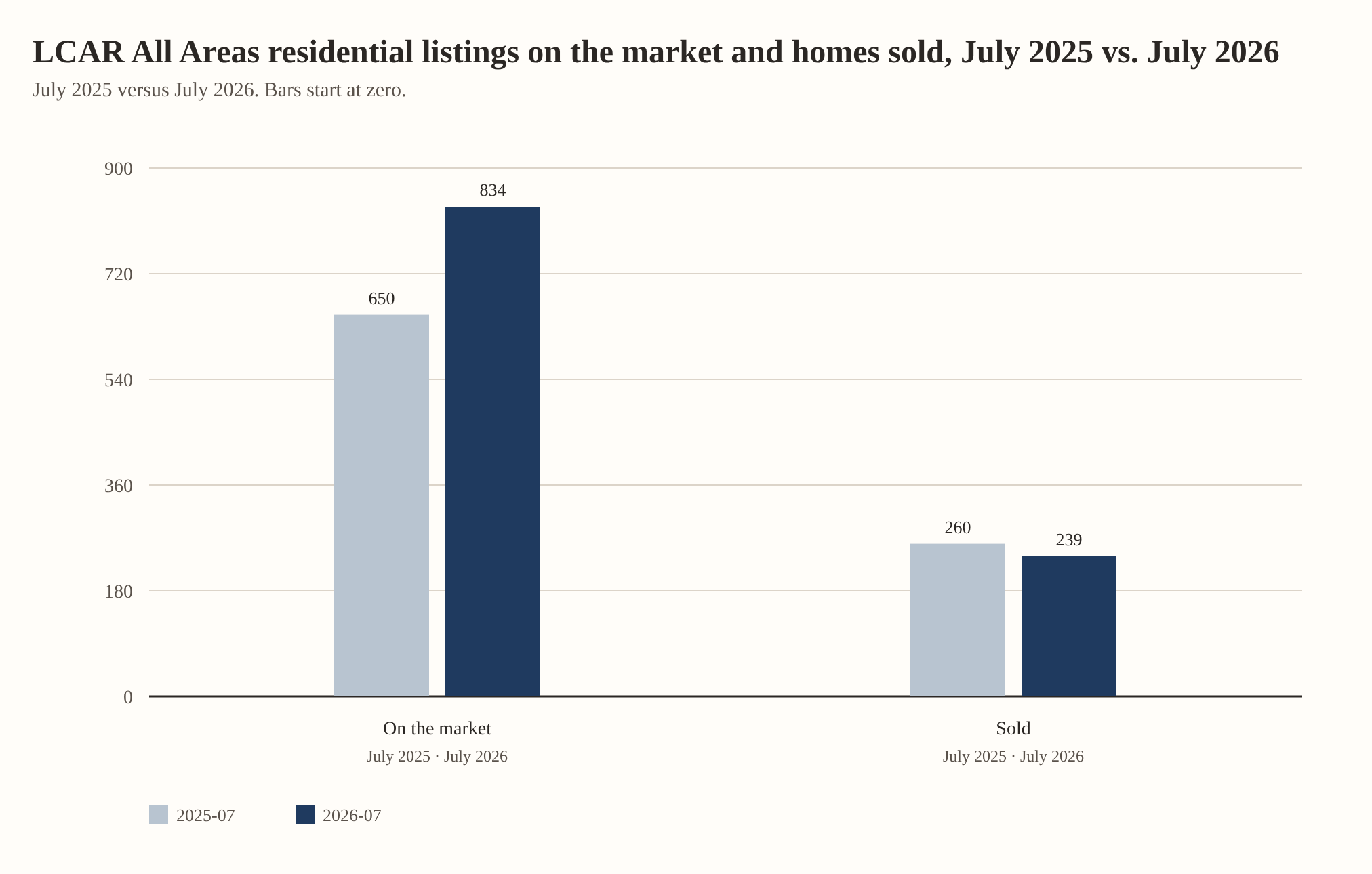
Chart 1. LCAR All Areas residential listings on the market and homes sold, July 2025 vs. July 2026. Source: Lee County Association of REALTORS® monthly housing statistics, ALL AREAS column, July 2025; Lee County Association of REALTORS® monthly housing statistics, ALL AREAS column, July 2026.
Prices held up. The median sold price was $406,260 in July 2026, compared with $387,150 in July 2025, a 4.9% increase by my math, according to the Lee County Association of REALTORS®. Average days on market was 54 in July 2026 and 54 a year earlier.
These data do not separate tenant-occupied from vacant sales or show whether occupied rentals sell more slowly. In my transaction experience, showing access and presentation matter. That doesn't mean you have to empty the house. It means picking a lane early. You can sell to an investor who wants the lease and the rent, or you can plan a lawful, written move-out and sell vacant to a wider pool of buyers. Mixing the two is where I see sales stall.
Figures are listing and closed data for LCAR All Areas residential as of July 2025 and July 2026, from the Lee County Association of REALTORS®. Market conditions change and past figures are not a prediction.
Check the buyer's plans with the City of Auburn
If your buyer wants to keep renting the house, or rent it out a different way, they should confirm zoning and rental-use rules for that specific address with the City of Auburn Planning Department. City land-use rules don't create a separate eviction process, but they can affect what a buyer is allowed to do with the property after closing. Local rules change. Confirm current requirements with the City of Auburn before relying on anything here. This is not legal advice.
Selling your rental with someone in your corner
I'm Amy Cotney, a REALTOR® with Roots Real Estate - Investment Development here in Auburn. I help owners sell tenant-occupied homes by keeping the landlord, the tenant, and the buyer talking to each other. You can read more about me and how I work. I build strong relationships that lead to sold homes and happy buyers, through communication, not automation. If you own a rental and you're weighing a sale, call or text me at (334) 332-4002 and let's look at your lease together.
Sources
- Lee County Association of REALTORS® monthly housing statistics, ALL AREAS column, July 2026
- Lee County Association of REALTORS® monthly housing statistics, ALL AREAS column, July 2025
- Alabama Legislature, Code of Alabama § 35-9A-201, Security deposits; prepaid rent (Alabama Uniform Residential Landlord and Tenant Act), retrieved October 5, 2026
- Alabama Legislature, Code of Alabama § 35-9A-205, Limitation of liability (conveyance) (Alabama Uniform Residential Landlord and Tenant Act), retrieved October 5, 2026
- Alabama Legislature, Code of Alabama § 35-9A-303, Access (Alabama Uniform Residential Landlord and Tenant Act), retrieved October 5, 2026
- Alabama Legislature, Code of Alabama § 35-9A-407, Tenant's remedies for landlord's unlawful ouster, exclusion, or diminution of service (Alabama Uniform Residential Landlord and Tenant Act), retrieved October 5, 2026
- Alabama Legislature, Code of Alabama § 35-9A-421, Noncompliance with rental agreement; failure to pay rent (Alabama Uniform Residential Landlord and Tenant Act), retrieved October 5, 2026
- Alabama Legislature, Code of Alabama § 35-9A-441, Periodic tenancy; holdover remedies (Alabama Uniform Residential Landlord and Tenant Act), retrieved October 5, 2026
- Alabama Legislature, Code of Alabama § 35-9A-461, Landlord's action for eviction, rent, monetary damages, or other relief (Alabama Uniform Residential Landlord and Tenant Act), retrieved October 5, 2026