Updated October 2026
If you're asking what a typical cap rate is in Auburn, here's the straight answer: the sources reviewed for this article did not establish a typical Auburn cap-rate range. So the cap rate that matters is the one a specific property's own lease, expense records, and price produce. The good news? You can build that number yourself in an afternoon, and I'll walk you through it.
The Bottom Line
- A cap rate is a property's yearly net operating income divided by its price or value. It leaves out your mortgage.
- Gross rent yield and cash-on-cash return are different numbers. Don't let anyone swap one in for another.
- Auburn residential and condo median sold prices rose between July 2025 and July 2026. For a specific property, if rent and operating expenses stay unchanged while its price rises, its cap rate goes down.
- Census rent and vacancy figures for Auburn are useful background, but they're from 2024 and carry wide margins of error. Your property's actual leases come first.
- An owner-occupied home that becomes a rental is assessed at a higher ratio in Alabama, so the seller's tax bill won't follow you.
Cap rate, gross yield, and cash-on-cash are three different numbers
These three get mixed up constantly, and the mix-up can make a so-so deal look great. Here's how I keep them straight.
Measure | How it's calculated | What it leaves out |
|---|---|---|
Gross rent yield | A year of scheduled rent divided by price | Vacancy, taxes, insurance, repairs, management, and every other expense |
Cap rate | A year of net operating income (rent minus vacancy and operating expenses) divided by purchase price or current value | Your mortgage, depreciation, and your personal income taxes |
Cash-on-cash return | A year of pre-tax cash flow after mortgage payments divided by the cash you put in | Appreciation and loan paydown |
Gross yield will always look bigger than the cap rate on the same property, because it ignores expenses. Cash-on-cash depends on your loan, so two buyers can get two different answers on the same house. The cap rate is the one that describes the property itself.
One more thing to pin down: the denominator. A cap rate on your purchase price and a cap rate on today's value are two different figures once the value moves. Pick one, label it, and stick with it.
How to build an Auburn cap rate from a property's own numbers
This is the process I walk through with any client weighing a rental. Ask for these documents early. A seller with a well-run rental usually has them ready.
- Start with signed leases, not asking rent. An asking rent is a hope. A lease is income. Near campus, check whether rent is priced per bedroom or for the whole unit, and whether utilities are included.
- Subtract a vacancy allowance. Budget for the stretch a rental can sit empty between tenants. Use the property's own turnover history if the seller has it.
- List every operating expense. Property taxes, insurance, HOA dues, management, repairs, lawn care, and any utilities the owner pays. Use a current insurance quote for that address and the actual HOA budget, not a guess.
- Set capital reserves aside on their own line. Roofs, HVAC systems, and water heaters wear out. Show what you're reserving for them separately so you can compare deals that treat reserves differently.
- Don't subtract the mortgage. Net operating income stops before debt service. Depreciation and your income taxes stay out of it too.
- Divide by the price, and say which price. That's your cap rate. Then stress-test it: what happens with a lower rent, a longer vacancy, or a bigger repair bill?
If the seller hands you a "pro forma" or "stabilized" income figure, that's a projection. Ask for the trailing twelve months of actual income and expenses so you can compare the two side by side.
Property taxes change when a home becomes a rental
In my experience, this one catches first-time investors off guard. According to the Alabama Department of Revenue, single-family owner-occupied residential property is assessed at 10% of appraised value, while property not otherwise classified is assessed at 20%.
In the department's own worked example, a $100,000 appraisal at the owner-occupied ratio produces a $325 tax bill. By my math, the same appraisal at the 20% ratio comes to $650 at that example millage. That's an illustration using the state's sample millage, not Lee County's rate. Before you underwrite, confirm the classification and current bill for the parcel with the Lee County Revenue Commissioner.
What Auburn rent and vacancy data can tell you
Public rent data for Auburn is a backdrop, not an input. According to the U.S. Census Bureau's American Community Survey 2024 1-year estimates, median gross rent was $1,159 in the City of Auburn and $1,144 in Lee County. Gross rent includes utilities and lumps every bedroom count together, so it isn't the rent any particular house will get today.
The same survey counted 14,300 renter-occupied homes out of 30,006 occupied homes in the City of Auburn. By my math, that's a 47.7% renter share. For vacancy, I divided the 2,625 units vacant for rent by the sum of renter-occupied, rented-but-not-yet-occupied, and vacant-for-rent units. That gives a 14.7% rental vacancy rate for 2024. The margin of error on the vacant count is wide, so treat that figure as rough, citywide, and two years old. It says nothing about the vacancy at a specific address.
Auburn University is the other piece of context everyone asks about. Per the university's Office of Institutional Research, total enrollment went from 35,172 in fall 2025 to 35,733 in fall 2026, about 1.6% higher by my math. Undergraduate enrollment rose from 28,953 to 29,693. More students don't automatically mean a full rental, but enrollment is worth tracking if you're buying near campus.
For a sense of what students budget, the university's 2026-2027 estimated cost of attendance lists housing and food at $16,124 off campus and $18,424 on campus for the academic year. Those are combined housing and food estimates, so they aren't rent, and they aren't a per-bed price.
What Auburn sale prices did, July 2025 to July 2026
Here's why prices matter for cap rates: the purchase price is the bottom half of the fraction. Per the Lee County Association of REALTORS®, the Auburn residential median sold price was $494,087 in July 2026, up from $431,625 in July 2025. That's 14.5% higher by my math. The Auburn condo median sold price was $357,250, compared with $272,500 a year earlier, which works out to 31.1%. Condo sales were small in both months, with 14 in July 2025 and 32 in July 2026, so one or two sales can swing that median.
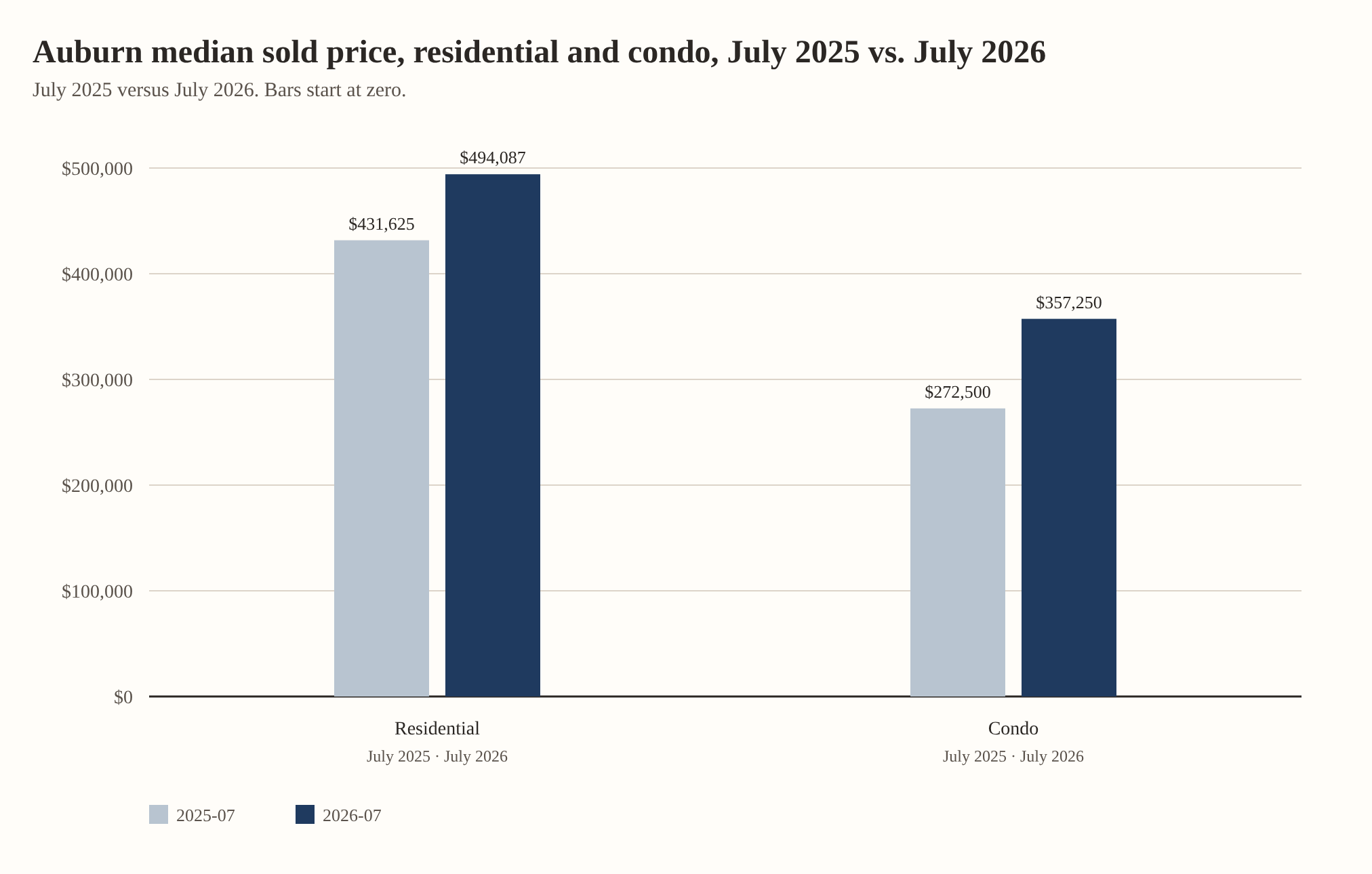
Chart 1. Auburn median sold price, residential and condo, July 2025 vs. July 2026. Source: Lee County Association of REALTORS® monthly housing statistics, AUBURN column, July 2025; Lee County Association of REALTORS® monthly housing statistics, AUBURN column, July 2026.
My read: these are all-home medians, not rental-property prices, and they aren't a cap-rate input for any one deal. But the arithmetic is simple. If a house's rent and expenses stay put while its price rises, its cap rate goes down.
The supply side shifted too. According to the Lee County Association of REALTORS®, Auburn had 442 residential homes on the market in July 2026, compared with 320 in July 2025, a 38.1% increase by my math. Residential sales went from 136 to 114, about 16.2% fewer. Average days on market went from 49 to 54.
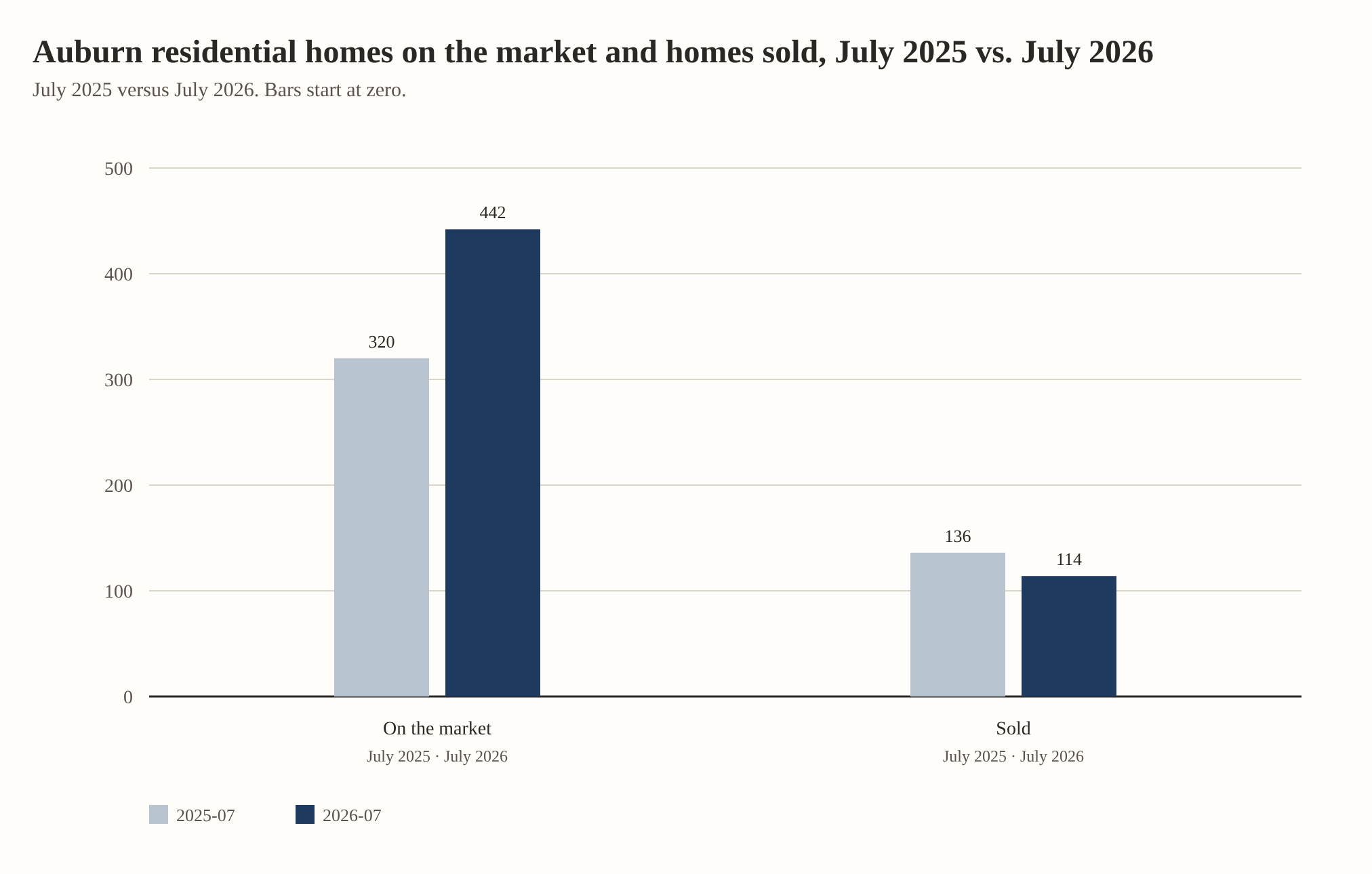
Chart 2. Auburn residential homes on the market and homes sold, July 2025 vs. July 2026. Source: Lee County Association of REALTORS® monthly housing statistics, AUBURN column, July 2025; Lee County Association of REALTORS® monthly housing statistics, AUBURN column, July 2026.
In my experience, more choices on the market give an investor more room to ask for leases, expense records, and repair credits. That's my opinion, not something these counts prove. And a single July compared with the prior July is not a full-year trend.
Figures are listing and closed data for Auburn (the AUBURN column) as of July 2026, from the Lee County Association of REALTORS® monthly housing statistics. Market conditions change and past figures are not a prediction.
Financing changes your return, not the cap rate
Your loan doesn't touch the property's cap rate. It changes your cash-on-cash return, because mortgage payments come out after net operating income. According to Freddie Mac's Primary Mortgage Market Survey, the average 30-year fixed rate was 7.40% for the week of October 8, 2026, compared with 6.30% a year earlier. The 15-year fixed averaged 6.73%.
Those are national averages for conventional loans, and investment-property loans are priced on their own terms. My read is that higher borrowing costs put pressure on the cash-on-cash side first. When a deal only works at a lower rate than you can actually get, it's the financing that's carrying it, not the property. Get a written quote from a lender before you run your cash-on-cash numbers.
Nothing here is legal, tax, or lending advice. Rates shown are national weekly averages and are not a quote, an offer of credit, or a prediction. For terms on your own situation, talk to a licensed lender.
Check the rules before you count the rent
Income you can't legally collect doesn't belong in a cap rate. If you're thinking about short-term or game-day rentals, read my rundown of Auburn short-term rental rules and then confirm the parcel's zoning and any registration or licensing requirements with the City of Auburn Planning Department. Condos and subdivisions add another layer: recorded covenants and HOA rules can cap or restrict leasing. If a condo is on your list, my Auburn game day condo guide looks at that option as an investment.
A few football Saturdays at a premium nightly rate don't add up to a year of income, either. Underwrite the full calendar.
Local rules change. Confirm current requirements with the City of Auburn before relying on anything here. This is not legal advice.
Where I'd start
If you're still deciding where to buy, my guide to the best areas for rental property near Auburn walks through the rental areas around town. If you already own a rental and you're weighing an exit, here's what to know about selling a rental with tenants in Alabama. Either way, bring me the leases and the expense records and we'll build the cap rate together, line by line. (Spreadsheets are my love language. Mostly.)
This is not investment or tax advice and no return is guaranteed. HOA, reserve, and owner-occupancy figures were current as of October 2026 and should be verified against current documents.
I'm Amy Cotney, a REALTOR® with Roots Real Estate - Investment Development in Auburn, and a licensed real estate salesperson. I'm originally from Tallahassee, I owned and ran two boutique businesses before real estate, and now I help people buy, sell, and invest across Auburn, Opelika, and Lake Martin. You can read more about me or reach out here to talk through a rental you're considering. I build strong relationships that lead to sold homes and happy buyers, through communication, not automation.
Sources
- U.S. Census Bureau, American Community Survey 2024 1-year estimates, tables B25064 (Median Gross Rent), B25003 (Tenure), and B25004 (Vacancy Status), City of Auburn and Lee County, AL, via Census Reporter: https://api.censusreporter.org/1.0/data/show/latest?table_ids=B25064,B25003,B25004&geo_ids=16000US0103076,05000US01081
- Alabama Department of Revenue, Property Tax Assessment (property classes, assessment percentages, and worked example): https://www.revenue.alabama.gov/property-tax/property-tax-assessment/
- Auburn University Office of Institutional Research, Total Enrollment Quick Facts, fall 2025 and fall 2026: https://ir.auburn.edu/factbook/enrollment/total-enrollment/quick-facts.php
- Auburn University Office of Student Financial Aid, 2026-2027 Estimated Cost of Attendance: https://auburn.edu/administration/finaid/cost/index.php
- Freddie Mac, Primary Mortgage Market Survey, week of October 8, 2026: https://www.freddiemac.com/pmms
- Lee County Association of REALTORS® monthly housing statistics, AUBURN column, July 2026
- Lee County Association of REALTORS® monthly housing statistics, AUBURN column, July 2025