Published September 2026
Can you buy a house in Auburn and rent it out by the weekend?
That question hits my inbox every August, usually from someone who just looked up a game-weekend nightly rate and did some very optimistic math. Here's the honest answer. It isn't one question. It's three, and three different parties answer them.
The city answers whether the use is allowed at that specific address. The city also answers what license and what tax registration an operator has to carry. And the property's own recorded covenants, plus any HOA or condo rules, answer a third question. Did the owners of that subdivision or that building already say no on their own?
Any one of the three can end the plan. So you work all three before your due diligence window closes, not after you close.
The Bottom Line
- Short-term rental eligibility in Auburn is address-specific. There's no blanket yes or no for the whole city, and there's no blanket yes or no for a neighborhood.
- Three layers govern it: city zoning for that parcel, city licensing and lodging tax registration, and the private covenants recorded on the property.
- Private covenants are usually the fastest answer and the fastest no. Read those first, because you can read them yourself today.
- Get the city's answer in writing, tied to the parcel address, and dated. A verbal yes from anybody is not verification.
- Rules change. Confirm current requirements with the City of Auburn before you commit, and run the contract language past your attorney.
Three layers decide whether an Auburn address can be rented short term
People come to me expecting one rule. There isn't one rule. There are three separate gates, and you have to clear all of them.
Layer | Who answers it | What you need in hand |
|---|---|---|
Zoning and land use | The City of Auburn planning office | Written confirmation for the specific parcel address, and whether the use is by right or needs approval |
Licensing and lodging tax | The City of Auburn revenue and licensing office | License or registration requirements, the renewal cycle, which taxes apply, and who remits each one |
Private covenants | The recorded land records, plus the HOA or condo association | The declaration, the bylaws, the current rules and regulations, and every amendment |
Layer one: zoning and land use for that specific parcel
Zoning is about what the land may be used for. It's set by the city, it varies by district, and two houses on the same street can sit in different districts if a boundary runs between them. The question you're asking the city isn't "does Auburn allow short-term rentals." It's "is this use permitted at this address, under this parcel's current zoning, and is it permitted by right or only with some kind of approval?"
That distinction matters more than anything else on this page. Permitted by right means you follow the process. Permitted with approval means somebody gets to say no. You need to know who decides, how long it takes, and what happens if the answer is no after you own the house.
Layer two: licensing and lodging tax registration
Operating a lodging business is a separate matter from being allowed to use the land that way. Cities generally handle these through a business license, a rental registration, or both, and lodging taxes typically get layered on top at more than one level of government.
Two traps here. First, a booking platform may collect and remit some of those taxes and not others, and the gap is the owner's problem, not the platform's. Second, licenses often renew on a cycle and don't automatically follow the property to a new owner. Ask both questions out loud.
Layer three: private covenants, HOA rules, and condo bylaws
This is the layer people skip, and it's the one that most often kills the plan. Recorded covenants and HOA or condo documents are private contracts that ran with the land long before you showed up. They operate independently of zoning. A city can say yes and a neighborhood association can still say no, and the association usually wins that argument.
In condo buildings especially, look for minimum lease terms, rental caps, owner-occupancy requirements, and any requirement that a tenant be approved by the board. A minimum lease term of any length is a quiet way of banning nightly rentals without ever using the words.
Start with the documents you can read yourself
Here's the part that saves people money. Layer three costs you nothing but an afternoon, and you can do it before you write an offer.
Recorded covenants live in the Lee County land records, and your closing attorney or title company can pull them for a specific parcel. HOA and condo documents come from the association or its management company, and a seller who's been paying dues has them. Ask for the full packet: the declaration, the bylaws, the current rules and regulations, and any amendments. Amendments are where the rental language usually got added, so a declaration alone isn't the whole story.
While you're at it, ask the seller directly. Are you operating this house short term right now? Under what license? Have you ever received a notice from the association or from the city about it? Those are fair questions during due diligence, and the answers tell you a lot.
If the documents prohibit it, you're done. Move to the next house. That's a good outcome discovered cheaply, which is the whole point of doing this first.
Questions to ask the City of Auburn, in this order
Call the city's planning office for the zoning questions and the city's revenue and licensing office for the money questions. Have the property address and the parcel number in front of you, because nobody can answer a hypothetical.
- Is a short-term rental permitted at this specific address under its current zoning?
- If it's permitted, is it by right, or does it require an approval, a permit, or a public hearing?
- If an approval is required, what's the application, who decides it, and how long does the process take?
- What license or registration does the city require to operate, and how often does it renew?
- Which lodging taxes apply at the city, county, and state level, and who remits each one?
- Is any inspection required before the first booking?
- Are there conditions attached to the license, such as parking, occupancy limits, or a local contact who has to be reachable?
- Does the city require notice to adjacent property owners?
- If I sell, does the license or approval transfer to the buyer, or does the buyer start over?
Write down who you spoke with and when. Then ask for the same answer by email. An email from the city, tied to your address and dated, is the thing you can actually act on. Screenshots of forum posts are not.
Local rules change, and rules that changed after this post published won't be reflected here. That's the one gap I'll name and move on from: the current text is the city's to give you, and it's worth the phone call.
Put the answer in the contract, not in your assumptions
If the whole reason you're buying is the short-term rental income, then that plan belongs in the contract, not in your head.
Talk to your real estate attorney about making the purchase contingent on written confirmation that the use is permitted at that address. Leave enough room in your due diligence window to actually get the city's response. Cities answer on their own schedule, not on yours. Build the calendar backward from the deadline.
Keep every piece of paper: the city's email, the covenant packet, the association's written response, the license application and its receipt. If you sell in a few years, that file is what lets the next buyer underwrite the property honestly. And if a question ever comes up while you own it, you'd rather have the folder than the memory.
I'll say the obvious thing once. I'm a REALTOR®, not your lawyer or your CPA. The zoning read, the contract language, and the tax treatment all need the people licensed to give you those answers, and I'm glad to point you to them.
What actually drives short-term rental demand in Auburn
The demand here is real, and it's shaped almost entirely by one calendar.
Home football Saturdays at Jordan-Hare drive the biggest weekends of the year. Graduation, move-in weekends, parents' weekend, the spring game, and home baseball weekends fill in a handful more. Add the occasional conference or wedding downtown and you've got your peak list.
Now the honest part. Those peak weekends are a small share of the year. The rest is regular weeks in a college town. A plan that only pencils out on football math has a lot of empty Tuesdays in it. Underwrite the quiet weeks. If the property works with conservative assumptions about the ordinary months, the big weekends become upside instead of a requirement.
It also changes what you shop for. Walkability to campus and to downtown carries real weight on those peak weekends, and so does parking that doesn't put four cars on a neighbor's grass. Those are property features you can evaluate, not guesses about the market.
What you're buying into right now
Eligibility is the first hurdle. Price is the second, and it decides which lane you're shopping in.
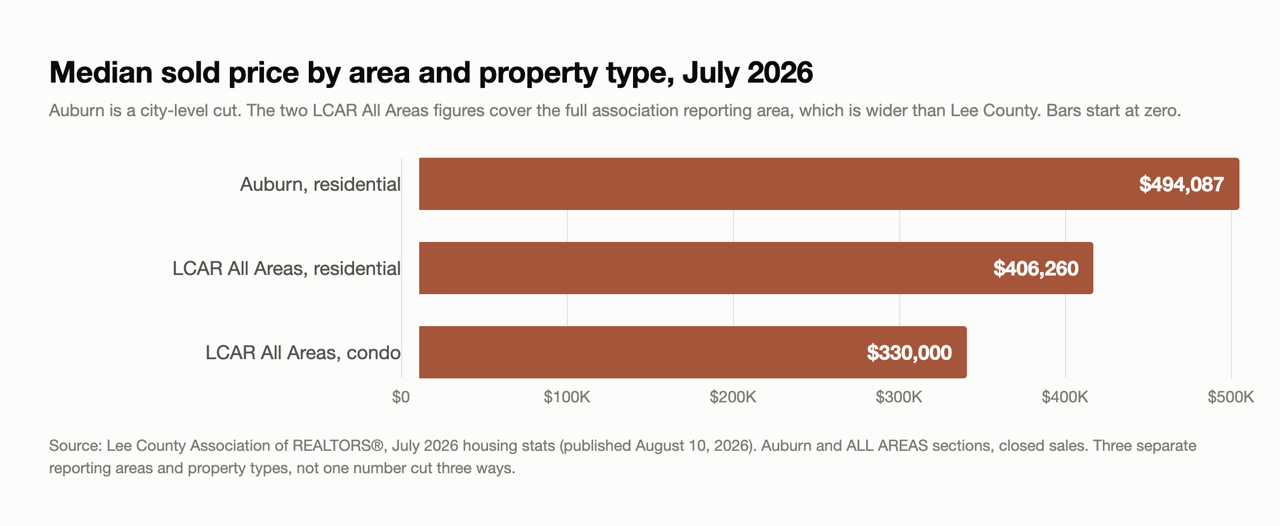
In July 2026, the median sold price in Auburn was $494,087, according to the Lee County Association of REALTORS®, July 2026 housing stats, Auburn section (published August 10, 2026). Across LCAR All Areas in that same month, which is the full association reporting area and wider than Lee County, the residential median sold price was $406,260 and the condo median sold price was $330,000, from the same pack. Those are three separate reporting areas and property types, not one number cut three ways.
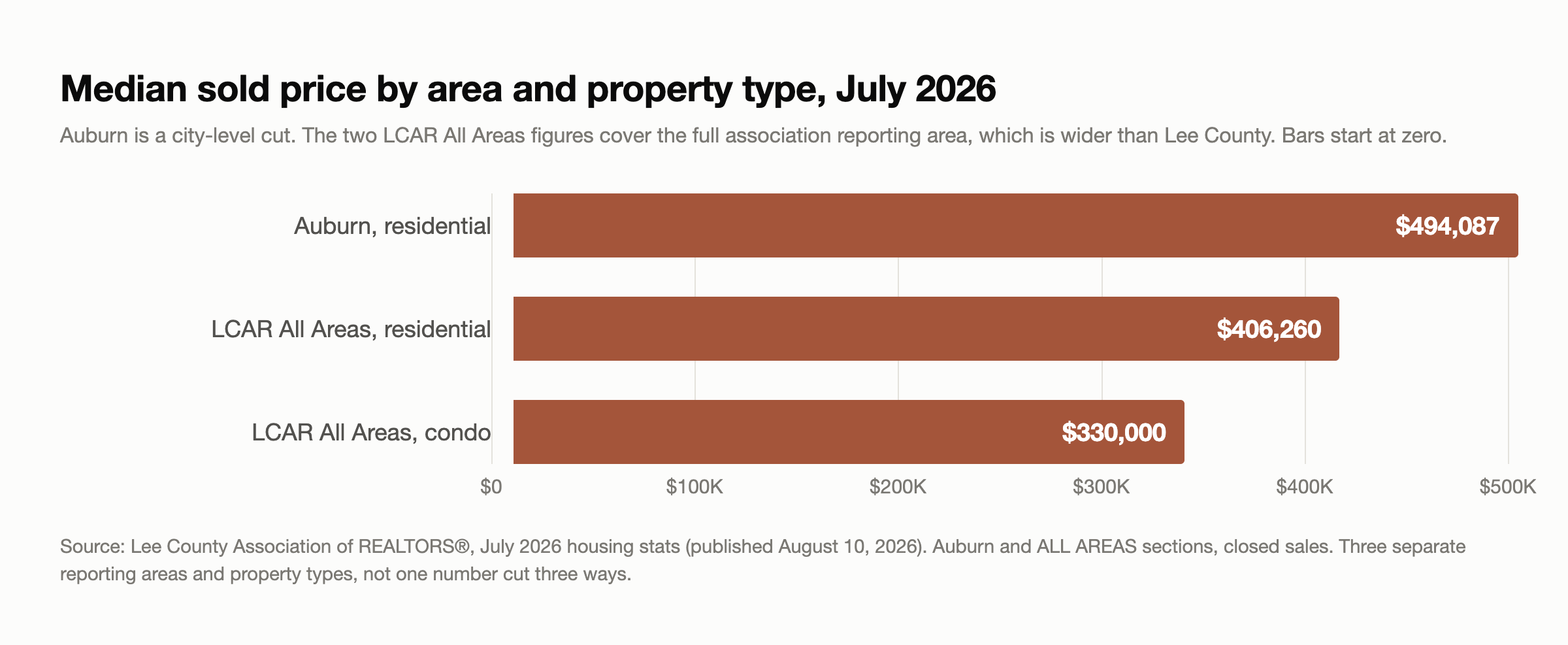
Chart 1. Median sold price by area and property type, July 2026. Source: Lee County Association of REALTORS®, July 2026 housing stats (published August 10, 2026), Auburn and ALL AREAS sections. Auburn is city-level; the other two figures are the LCAR All Areas cut, which is wider than Lee County. Zero baseline.
The condo lane is the lower-cost entry, and it's also where private rental rules bite hardest. That's the trade. A condo gets you in for less and hands you a board, a set of bylaws, and possibly a rental cap that's already full.
Supply tells you how much room you have to be picky.
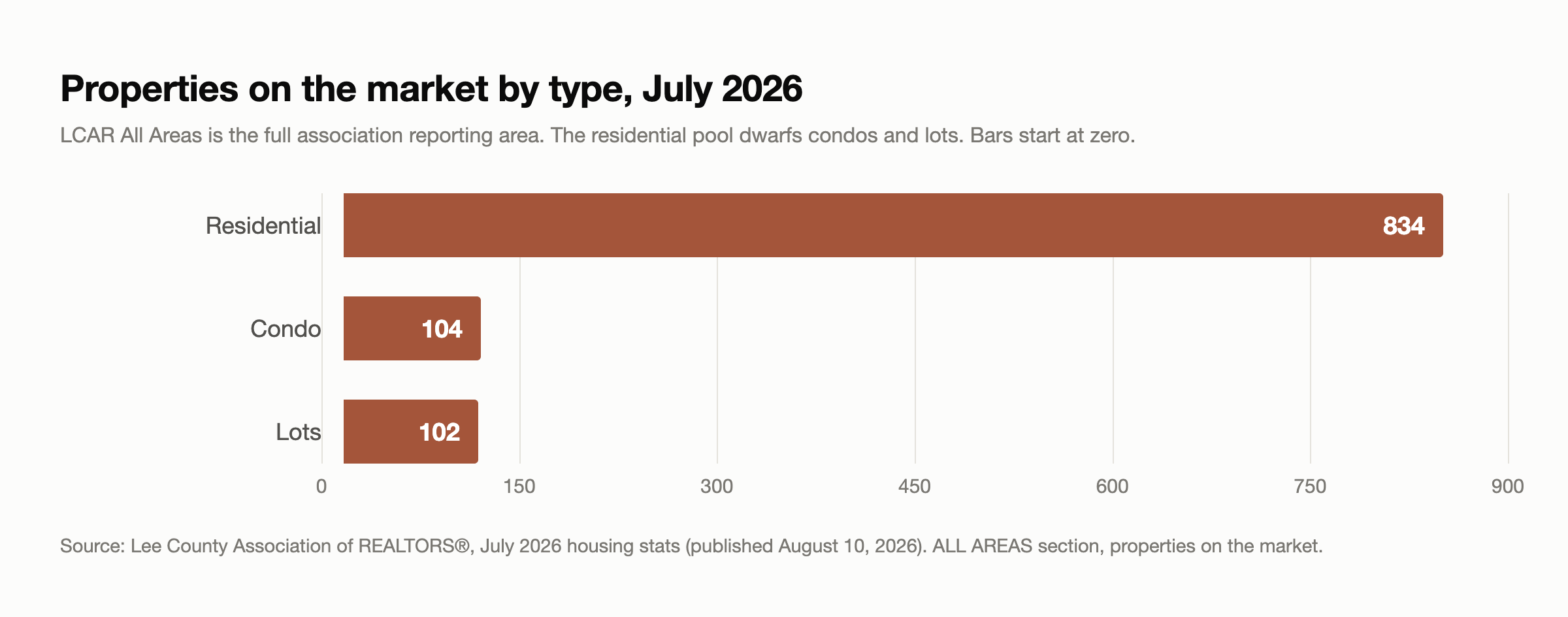
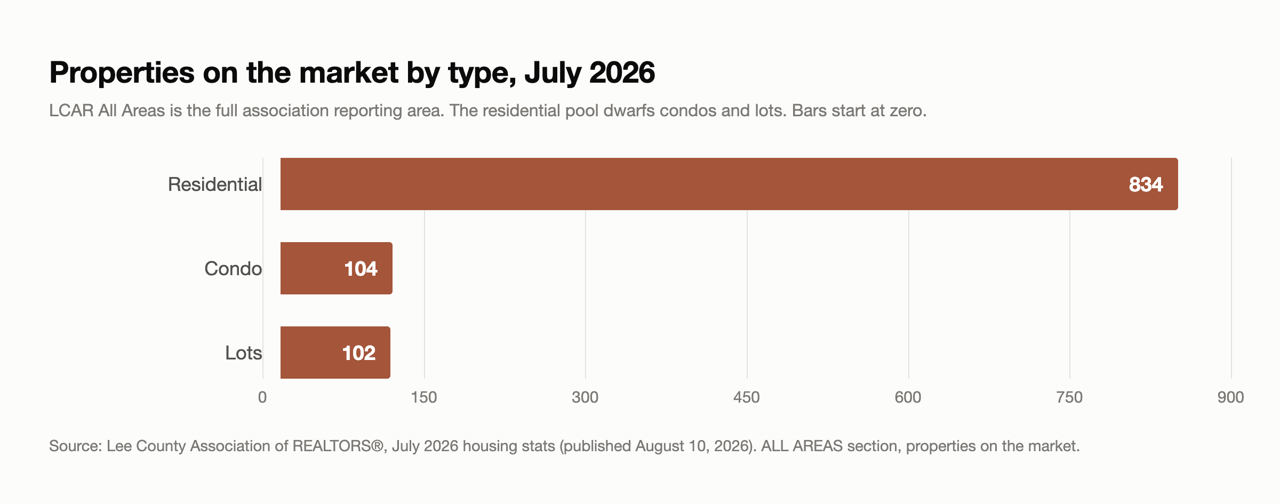
Chart 2. Properties on the market by type, July 2026. Source: Lee County Association of REALTORS®, July 2026 housing stats (published August 10, 2026), ALL AREAS section. LCAR All Areas is the full association reporting area, wider than Lee County. Zero baseline.
In July 2026 there were 834 residential properties on the market across LCAR All Areas, against 104 condos and 102 lots, per the same July 2026 pack. If your plan depends on a condo, you're shopping a much smaller pool, and a single unfavorable bylaw can remove a meaningful share of it.
You do have a little time to work with. Residential properties across LCAR All Areas averaged 54 days on market in July 2026, and condos averaged 63, both from the same July 2026 pack. That's the association-wide average, not a promise about the one house you want. On a well-priced property in a spot people want, you'll have days, not weeks. Which is exactly why the covenant reading happens before you fall in love with a house.
Frequently asked questions
Does Auburn allow short-term rentals?
That's an address question, not a city question. Whether a given property qualifies depends on its zoning district, the licensing and tax registration the city requires, and any private covenants recorded on the property. Ask the City of Auburn about the specific parcel and get the answer in writing.
Can an HOA stop me even if the city says yes?
Generally, yes. Recorded covenants and association rules are private agreements attached to the property, and they work separately from city zoning. Zoning permission doesn't override a covenant that prohibits the use. Have your attorney read the documents before you rely on them either way.
Do I need a business license to operate one?
Assume you need to ask. Licensing, registration, and lodging tax obligations sit with the operator, and they're handled by the city's revenue and licensing office rather than by your booking platform.
Does the booking platform handle my taxes?
Sometimes, partly. A platform may collect and remit certain taxes and not others, and any gap stays with the owner. Confirm which taxes apply at each level of government and ask your CPA how they get filed.
Should my offer be contingent on rental eligibility?
If the income plan is the reason you're buying, I think it should be, and that's a conversation for your attorney. A contingency tied to written confirmation from the city protects you from owning a property you can't use the way you intended.
Do the rules travel with the property when it sells?
Don't assume they do. Ask specifically whether a license or an approval transfers to a new owner or whether the buyer restarts the process. This is one of the most common surprises in the whole category.
Thinking about an Auburn short-term rental?
I'm Amy Cotney, and I work with buyers and sellers across Auburn, Opelika, Lake Martin, and the rest of Lee County. If you're weighing a short-term rental purchase here, I'll help you get the covenant packet in hand early and line up the right questions for the city. Then we'll walk the streets together, so the plan is built on the actual property instead of a spreadsheet.
Call or text me, send an email, or start a search at amycotney.com. I'd love to help.
Disclosures
Local rules change. Confirm current requirements with the City of Auburn before relying on anything here. This is not legal advice.
Figures are closed and listing data for Auburn and the LCAR All Areas cut from the Lee County Association of REALTORS® July 2026 housing stats, published August 10, 2026. Market conditions change and past figures are not a prediction.
This is not investment or tax advice and no return is guaranteed.
Amy Cotney, REALTOR®, is a licensed real estate salesperson (Alabama license #108235) with Roots Real Estate - Investment Development, 235 N Gay St, Auburn, AL 36830. Call or text (334) 332-4002 or email [email protected]. Equal Housing Opportunity.