If you're selling a house in Alabama, here's the honest answer up front: almost every cost on your closing statement is negotiable, and the state sets exactly one of them.
That surprises most sellers. Search "cost to sell a house in Alabama" and you'll hit a wall of national calculator sites, all quoting one all-purpose percentage that's supposed to cover every state. None of them show their work. None of them have ever sat at a closing table in Lee County.
I have, many times. So let me walk you through what actually comes out of your proceeds, which pieces Alabama law controls, and which ones you and I get to negotiate together.
The Bottom Line
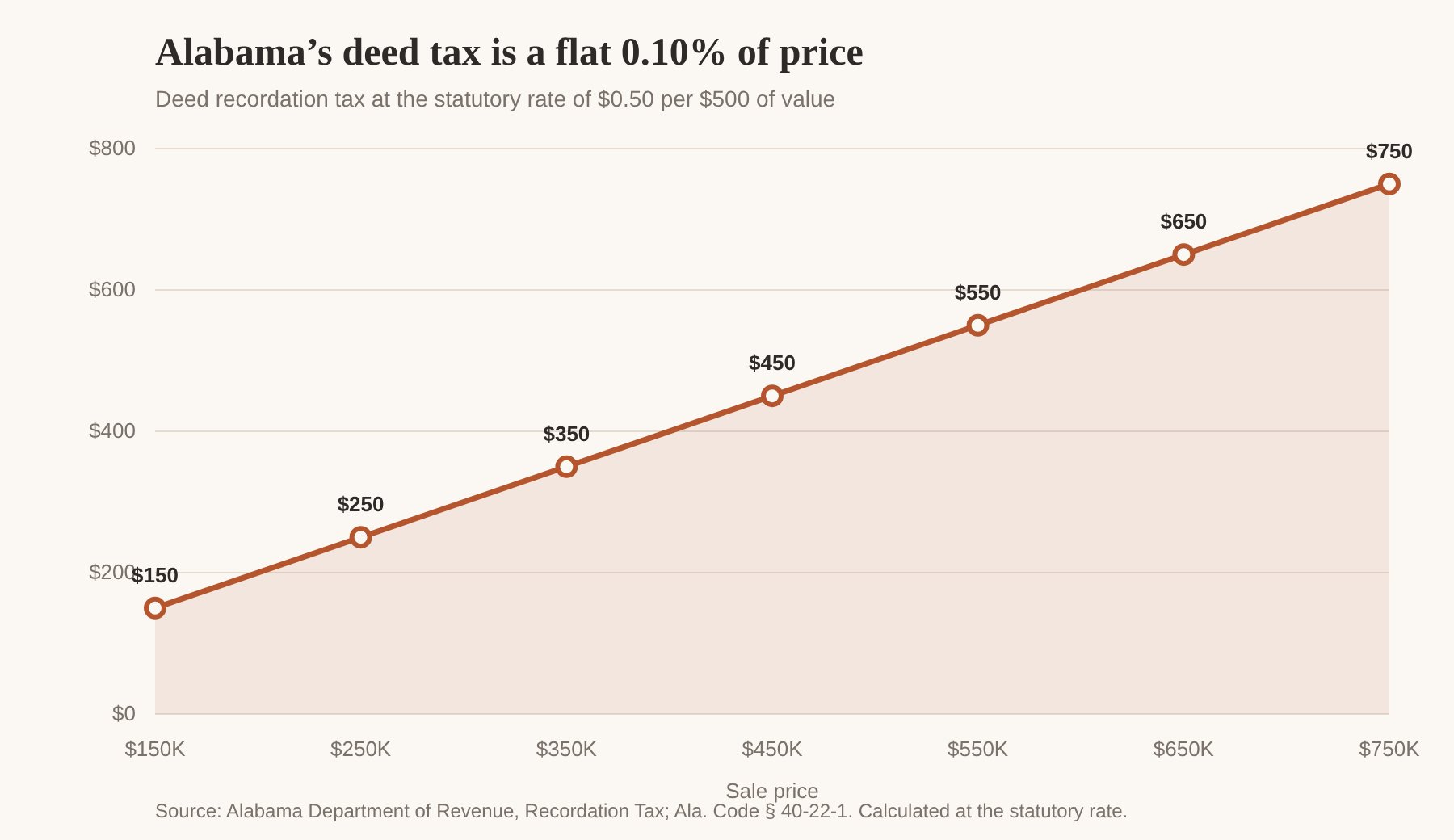
- Alabama sets one seller-side cost by statute: the deed recordation tax, at $0.50 per $500 of value. That works out to $1 per $1,000, or 0.10 percent of your sale price.
- Real estate commission is fully negotiable and not set by law. Anyone quoting you a fixed statewide rate is guessing.
- Alabama property taxes are due October 1 and go delinquent January 1, so most spring and summer closings involve a tax bill nobody has paid yet. That gets prorated.
- Your biggest variable costs usually aren't taxes or fees. They're prep work, post-inspection repairs, and buyer concessions.
- The single best thing you can do is ask for a written seller net sheet before you list, not after you're under contract.
Alabama's Deed Tax Is the One Cost the State Actually Sets
Alabama charges a recordation tax when a deed gets recorded. The Alabama Department of Revenue puts the rate at "$.50 per $500 of value or fraction thereof," and the statute behind it, Ala. Code § 40-22-1, uses the same language.
Translate that into normal-person math and it's clean: $1 for every $1,000 of sale price. A $300,000 sale means a $300 deed tax. A $450,000 sale means $450.
The "or fraction thereof" part just means you round up to the next $500 chunk. Sell at $282,250 and you're taxed on $282,500, so the tax is $282.50. Nobody's going to send you a bill for the difference and you won't notice it on your closing statement.
Alabama law doesn't say who pays it. Under Ala. Code § 40-22-1, the judge of probate calculates the tax when an instrument is presented for recording, and no deed gets received for record until the tax is paid. The Alabama Department of Revenue splits the money two-thirds to the General Fund and one-third to the county. Which party writes the check is a contract question, and local custom varies. In the closings I've sat through it's typically handled as a seller cost, but I confirm it on every deal instead of assuming.
The form nobody warns you about
Section 40-22-1 also requires a Real Estate Sales Validation Form. You have to provide "proof of the actual purchase price paid for the property or if the property has not been sold, proof of the actual value."
You sign an attestation that the number is accurate. The statute is explicit that you aren't required to hand over any further documentation beyond the form itself. It's a five-minute piece of paperwork, but I've watched it delay a recording because nobody mentioned it until closing day. Now I bring it up early.
Two Recording Taxes, Two Different Payers
This is the piece most cost guides blur together. Alabama has a second recordation tax, and sellers often think it's theirs.
It isn't. The mortgage recordation tax runs $0.15 per $100 of indebtedness, per the same Department of Revenue schedule. It's assessed on the loan being recorded, which is the buyer's new mortgage, not on your sale price.
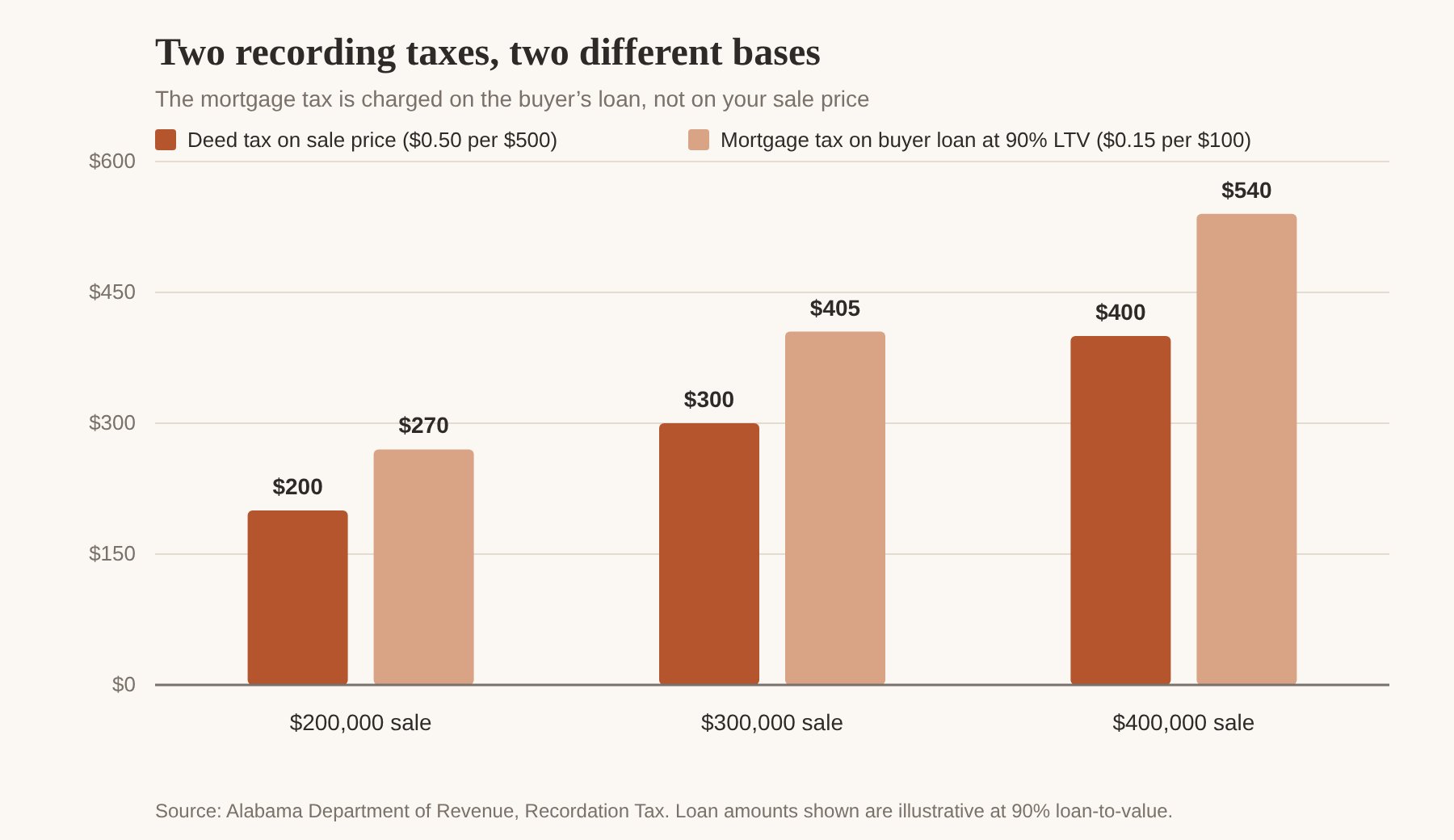
So on a $300,000 sale where the buyer borrows $270,000, you're looking at $300 in deed tax on the conveyance and $405 in mortgage tax on the buyer's loan. Two different taxes, two different bases, and usually two different people paying. If a cost estimate lumps them together, that estimate wasn't built for Alabama.
Real Estate Commission: Negotiable, and Different Since 2024
I'm not going to quote you a rate, and I'd be skeptical of any article that does.
The National Association of REALTORS® is direct about this: "Agent compensation for home buyers and sellers continues to be fully negotiable." Written buyer agreements now have to carry "a conspicuous statement that broker fees and commissions are fully negotiable and not set by law."
Two practice changes took effect August 17, 2024, and both matter to your bottom line:
- Agents must sign written agreements with buyers before touring a home. That means the buyer coming through your house has already had a conversation about who pays their agent.
- Offers of compensation are no longer allowed on the MLS. Per NAR, "Sellers can still offer compensation off an MLS," and sellers can still offer buyer concessions on the MLS, for example concessions toward buyer closing costs.
What that means practically: buyer-agent compensation is now a live negotiation on most deals instead of a default line item. Sometimes that saves a seller money. Sometimes offering it is exactly what gets a house sold in a slower price band. It depends on your house, your price point, and your timeline, which is a real answer even if it's less satisfying than a percentage.
Property Taxes at Closing: Alabama's Calendar Is the Tricky Part
This one catches people every year, and it isn't their fault. Alabama's property tax calendar doesn't line up with the calendar year the way most sellers assume.
Straight from the Alabama Department of Revenue:
When | What happens |
|---|---|
October 1 | Taxes due |
January 1 | Taxes delinquent |
February | Turned over to probate court |
March | Probate court meets |
April | Advertised for sale |
May | Tax sale |
Notice the gap. If you close in April, the tax bill covering your ownership that year isn't due until October. You've lived in the house, but nobody has paid for that stretch yet.
So the closing prorates it. You typically credit the buyer for the portion of the year you owned the home, and the buyer pays the full bill when it comes due in the fall. Your closing attorney or settlement agent runs the actual calculation using the current assessed value and millage.
Two things worth knowing. First, if you have a homestead exemption and the buyer won't qualify for one, the bill after closing can be noticeably higher than what you've been paying. That's a buyer conversation, but it can come back around as a negotiation point. Second, if you escrow your taxes, your lender may be holding money that gets refunded to you after payoff rather than credited at the table. Ask, because it's easy to forget you're owed it.
Closing, Title, and Settlement Costs
These are real, and they're also the ones that vary the most from deal to deal, which is why I won't put fake precision on them here.
What typically lands on the seller side of an Alabama closing statement:
- Settlement or closing fee, charged by whoever conducts the closing.
- Owner's title insurance policy, if the contract puts it on you. On most Alabama contracts I see it lands on the seller, but it's a negotiated term.
- Title search and examination, sometimes bundled into the closing fee and sometimes itemized.
- Deed preparation.
- Mortgage payoff and any payoff statement or wire fees from your lender.
- Recording fees for the deed and for releasing your existing mortgage, which are separate from the recordation tax above.
- HOA estoppel or transfer fees, if your neighborhood has an association. Lake Martin and several Auburn subdivisions do.
- Any unpaid liens or assessments that have to clear before the deed records.
I get a real quote on these for your specific property and closing office before you list. A generic estimate is fine for daydreaming and useless for planning.
The Costs That Never Show Up on a Sample Cost Sheet
Now the honest part. In my experience, the line items above rarely surprise a seller. What surprises them is everything else.
Getting the house ready
Paint, deep cleaning, carpet, landscaping, decluttering, and storage. This is where I lean on my interior decorating background, and it's also where I'll tell you to stop. Not every fix pays you back. I'd rather you spend a few thousand dollars in the right three places than five figures spread across a full pre-list renovation nobody asked for.
Repairs after the inspection
Budget something here even if you're convinced your house is perfect. Mine wasn't, and I sell houses for a living. HVAC, roof, plumbing, and wood-destroying-organism findings are the common ones in this climate. You can negotiate repairs, credits, or price, but you rarely negotiate all the way to zero.
Buyer concessions
Since NAR's practice changes, concessions have become one of the more flexible tools on the table. They show up on the MLS, where offers of compensation no longer can. A concession toward the buyer's closing costs reduces your net just like a price reduction does, so treat it as a real number, not a courtesy.
Carrying costs and moving
Every month your house sits, you're paying mortgage interest, taxes, insurance, and utilities on it. Pricing right the first time is a cost-control strategy, not just a marketing one. Then add movers, and add a temporary rental or storage if your timing doesn't line up perfectly. It usually doesn't.
Alabama Is a Caveat Emptor State, and That Cuts Both Ways
Alabama doesn't require sellers of used residential property to fill out a standard disclosure form the way many states do. Alabama is a caveat emptor, or "buyer beware," state, and the Alabama Association of REALTORS® Legal Helpdesk explains that a seller ordinarily has no general duty to disclose defects to a purchaser.
That is not a license to stay quiet. The same guidance lays out clear exceptions where a seller or seller's agent does have a duty to disclose: known material defects affecting health or safety that the buyer can't readily observe, situations involving a fiduciary relationship, and direct questions from the buyer.
The cost angle is simple. Sellers who treat caveat emptor as permission to hide a problem tend to pay for it later. It shows up as a blown closing, or a repair credit negotiated from a weak position. Sellers who disclose early tend to negotiate from solid ground. I'd rather hand a buyer a receipt for a roof you already fixed than argue about a stain on the ceiling three days before closing.
This is general information, not legal advice. For anything specific to your property, talk to an Alabama attorney.
What This Looks Like on a Real Auburn-Area Price
Some context on the numbers you're working with. The Alabama Association of REALTORS® reported a statewide median sales price of $282,139 in June 2026, up from $263,518 in April and $279,185 in May. This corner of the state runs higher. Lee County's median listing price was $412,500 in June 2026, according to Realtor.com data published by the Federal Reserve Bank of St. Louis.
Listing price and sale price aren't the same thing, so don't plan around that number. But it tells you Auburn, Opelika, and the Lake Martin waterfront sit well above the statewide middle, and your dollar costs scale with price even when the percentages don't. I track the monthly Lee County figures in my Auburn and Opelika housing market update.
Here's how the one fixed cost behaves across the local range:
Sale price | Alabama deed recordation tax | As a % of price |
|---|---|---|
$250,000 | $250.00 | 0.10% |
$282,500 | $282.50 | 0.10% |
$350,000 | $350.00 | 0.10% |
$412,500 | $412.50 | 0.10% |
$650,000 | $650.00 | 0.10% |
$1,200,000 | $1,200.00 | 0.10% |
Calculated at the statutory rate of $0.50 per $500 of value, rounded up to the next $500 increment, per Ala. Code § 40-22-1.
Every other number on your closing statement moves. This one doesn't. It's the only line item on the page that won't argue with you.
Questions I Get About Selling Costs in Alabama
Does Alabama have a real estate transfer tax?
Alabama's tax on transferring property is the deed recordation tax under the recordation tax statutes, Ala. Code §§ 40-22-1 and following. It's $0.50 per $500 of value. If you've seen much larger transfer taxes quoted for other states, that's a different structure and doesn't apply here.
Who pays closing costs when selling a house in Alabama?
It's negotiated in the purchase contract, not assigned by state law. In the closings I've worked, sellers usually carry commission, the owner's title policy, deed preparation, and payoff-related costs. Buyers usually carry loan costs, the mortgage recordation tax, and lender's title insurance. All of it is a term you can trade.
How much will I actually walk away with?
That's what a seller net sheet is for. It takes your likely sale price, subtracts your mortgage payoff and every anticipated cost, and shows you the number that lands in your account. I build one before you list, then update it when you have an offer in hand. If you have to guess, you're planning your next move on a number nobody verified.
Is a Zestimate close enough to plan around?
No, and I say that gently. Online estimates are a starting point built from public records and general models, not a comparative market analysis and not an appraisal. They can't see your kitchen renovation, your foundation issue, or what the house two streets over actually closed at last month. I go through the published error rates and how a real CMA gets built in What Is My Home Worth in Auburn?
Should I sell as-is to skip the repair costs?
Sometimes, yes. Selling as-is is a legitimate strategy, especially for inherited property or a home that needs more work than your timeline allows. Just know that as-is doesn't erase Alabama's disclosure exceptions for known health-and-safety defects. Buyers also price risk conservatively when they can't see behind it. I'd run the numbers both ways with you before deciding.
Let's Run Your Actual Numbers
Selling costs feel scary in the abstract and pretty manageable on paper. The difference is having someone sit down with your specific house, your payoff, and your timeline. Then you get a real number instead of a national average.
If you're thinking about selling in Auburn, Opelika, or on Lake Martin, reach out. I'll put together a net sheet and a pricing conversation, no pressure attached. I'd love to help.
Amy Cotney is a licensed REALTOR® with ROOTS Real Estate Investment Development in Auburn, Alabama (AL Lic# 108235), serving Auburn, Opelika, Lake Martin, and Lee County. Equal Housing Opportunity. This article is general information about Alabama selling costs, not legal, tax, or financial advice. Online home value estimates are a starting point, not a formal comparative market analysis or appraisal. All information is deemed reliable but not guaranteed and should be independently verified.
Sources
- Alabama Department of Revenue, Recordation Tax
- Alabama Department of Revenue, What is the timetable for property taxes?
- Ala. Code § 40-22-1
- National Association of REALTORS®, What the NAR Settlement Means for Home Buyers and Sellers
- Alabama Association of REALTORS® Legal Helpdesk, Caveat Emptor for the Seller's Agent
- Alabama Association of REALTORS®, Alabama's Housing Market Found Its Stride in Q2 (July 28, 2026)
- Federal Reserve Bank of St. Louis, Median Listing Price in Lee County, AL