Updated August 2026
If you're asking what your Auburn home is worth, the honest answer is a range, not a single number. The range matters more this year than it did last year, because the market underneath it has softened.
In June 2026, the median asking price for a home listed in Lee County, which covers Auburn and Opelika, was $412,500. A year earlier it was $425,900, so asking prices are down 3.1%. The typical listing also took longer to go: a median of 56 days, up from 50 (Realtor.com data via the Federal Reserve Bank of St. Louis, series MEDLISPRI1081 and MEDDAYONMAR1081, retrieved August 4, 2026). Those are asking prices on active listings, not closed sales.
The online estimate you already looked up is a starting point. It isn't your value. Here's why, and here's what a defensible number is actually built from.
The Bottom Line
- Your home's value is a range, and the only number that settles it is what a ready buyer pays and a lender finances on closing day.
- Lee County's median asking price was $412,500 in June 2026, down 3.1% year over year, with median days on market up from 50 to 56 (Realtor.com via FRED, MEDLISPRI1081 and MEDDAYONMAR1081).
- Active listings jumped 27.0% year over year, from 768 to 975 (ACTLISCOU1081). More competition means the asking price does more of the work.
- 35.3% of active Lee County listings had already cut their price in June 2026, up from 32.6% a year earlier (PRIREDCOU1081). More than one in three.
- Automated estimates are models, not valuations. Six federal agencies now require lenders to quality-control test automated valuation models before relying on them (CFPB, effective October 1, 2025).
- An online estimate is not a comparative market analysis or an appraisal. A real number comes from closed comparable sales plus somebody who has walked through your house.
The Short Answer: Your Home's Value Is a Range
Value is what a ready buyer will pay and a lender will finance, on the day you sell. Three different numbers get used as if they're the same thing, and they aren't:
- The online estimate is a software guess built from public records and listing feeds.
- The list price is what you decide to ask.
- The sale price is what a buyer actually paid, and it's the only one that answers the question.
A comparative market analysis, or CMA, is a licensed agent's written pricing analysis. It's built from closed comparable sales in your area, adjusted for your home's size, condition, and features, then checked against the listings you'd be competing with right now. The output is a supportable range with a recommended list price inside it, and the reasoning attached. That's the tool that gets you to a number you can defend when an offer comes in low.
An automated estimate can't do that, because it has never been inside your house.
What the Auburn Market Is Doing in Mid-2026, in Brief
Asking prices in Lee County are off 3.1% from last June, homes are taking about six days longer to sell, and inventory is up 27.0% year over year. At $412,500, the county's median asking price still sits roughly 21% above Alabama's statewide median of $339,950, which is my own calculation from those two medians (Realtor.com county and state listing data via FRED, retrieved August 4, 2026). So this is a softening market at a premium price point, not a cheap one. Those are listing figures rather than closed sales, which is exactly why they can't price your specific house.
I go deeper on the monthly numbers in my Auburn and Opelika housing market update. This post is about how your own address gets valued.
Why Your Zestimate Isn't Your Home's Value
An automated valuation model, or AVM, is software. It reads tax records, past sales, square footage, and listing feeds, then predicts a number. It doesn't know you replaced the roof two years ago, that the kitchen was redone, or that your lot backs up to something a buyer will pay extra for.
I'm not knocking the tools. I'm telling you what they are.
Federal Regulators Treat Automated Estimates as Estimates
This is the part most sellers have never heard. Six federal agencies issued a joint final rule on Quality Control Standards for Automated Valuation Models. The six are the Consumer Financial Protection Bureau, the Federal Reserve, the FDIC, the OCC, the NCUA, and the FHFA. The rule was published August 7, 2024 and took effect October 1, 2025.
It requires institutions using AVMs in mortgage lending to maintain policies designed to "ensure a high level of confidence in the estimates produced by AVMs." It also requires them to protect against data manipulation, avoid conflicts of interest, and run random sample testing (Consumer Financial Protection Bureau).
Read that again. Federal regulators require lenders to test automated valuations before trusting them. So it's worth being careful about pricing the biggest asset you own off a free one.
The Companies Publish Their Own Error Rates
The estimate providers are fairly upfront about accuracy, if you go looking.
When Zillow launched its neural Zestimate, it reported a national median error rate of 6.9% across more than 104 million off-market homes (Zillow, June 15, 2021). Redfin, announcing an accuracy improvement, reported a median error of 5.6% for off-market homes against 1.57% for homes actively listed for sale (Redfin via PR Newswire, December 19, 2019). Both figures are several years old and both companies have kept tuning since, so read them as documented history rather than today's number.
Here's the part worth sitting with. The off-market error is roughly three and a half times the on-market error, and off-market is exactly where you are right now, before you list. Once a home is listed, the model can see an asking price a human being set, which is a big reason the on-market figure looks so much better.
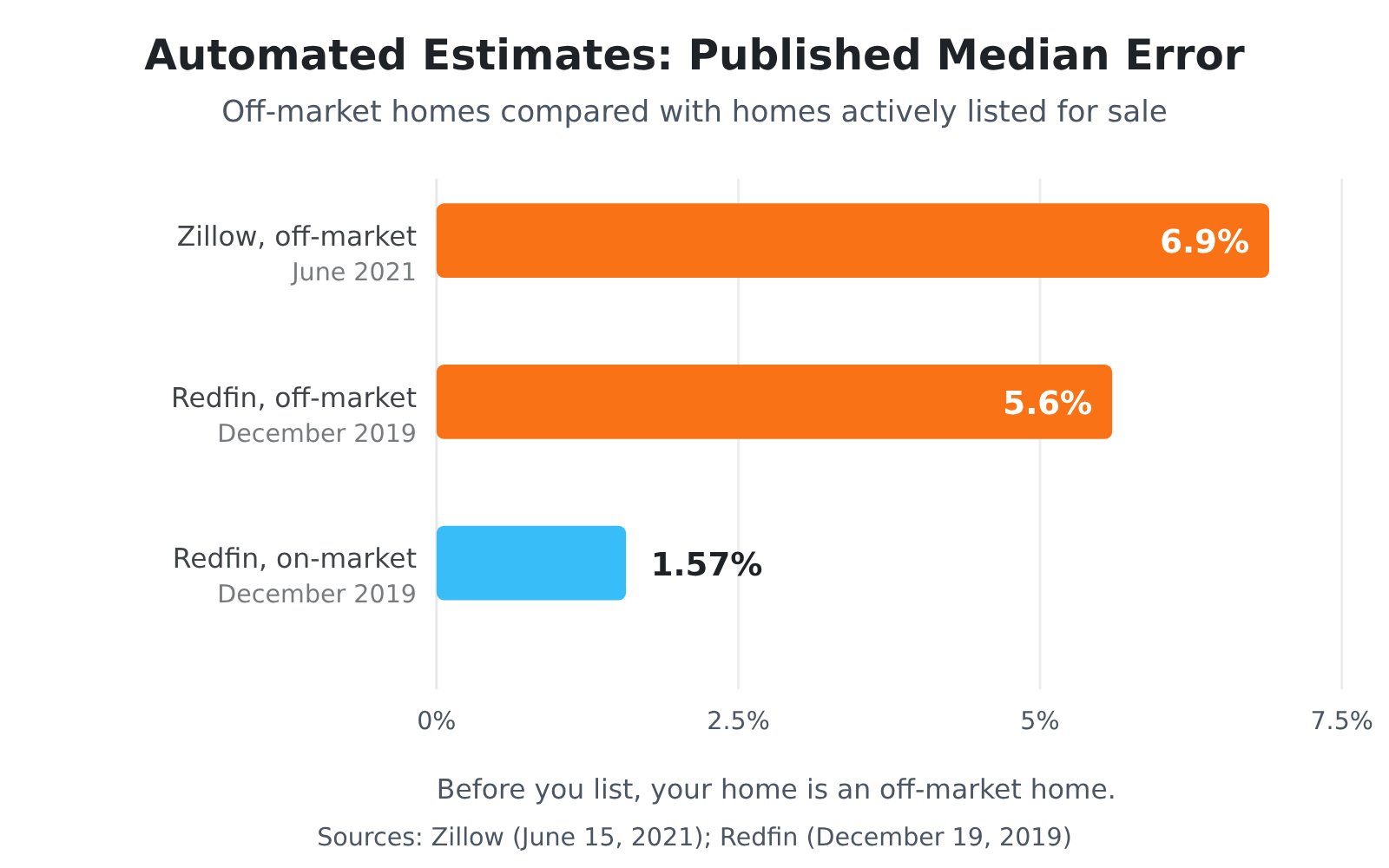
On a $412,500 Auburn home, a 6.9% miss is about $28,000 in either direction. In a market where more than a third of listings are already cutting price, that's not a rounding error.
AVM vs CMA vs Appraisal
These three get used interchangeably, and they shouldn't be.
Automated estimate (AVM) | Comparative market analysis (CMA) | Appraisal | |
|---|---|---|---|
Who produces it | A software model | A licensed real estate agent | A state-licensed appraiser |
Has it been inside your home | No | Yes | Yes |
What it's built on | Public records, tax data, listing feeds | Closed comparable sales, active competition, condition, features, local knowledge | Closed sales plus a formal inspection, performed under USPAP standards |
What it typically costs you | Free | Customarily provided by the listing agent at no charge | Usually paid through your lender |
What it's actually for | A rough starting point | Setting your list price and your strategy | The lender's decision on the loan |
Only the appraisal is a regulated valuation used for lending. A CMA is pricing guidance. In a market with 975 active listings competing for attention, that guidance is where your strategy starts.
Want one run on your address? Request a home valuation and I'll take it from there.

What Actually Moves the Number on an Auburn Home
Two houses with the same square footage in the same ZIP code can be $60,000 apart. Here's what drives that.
Where the Home Sits
Inside Auburn, location does a lot of work. Distance to campus matters. So does the school zone the address falls in. So does whether you're on a cut-through street or a quiet loop, what an HOA covers, and how far you are from a grocery run. A home near Moores Mill and a home three miles out can draw completely different buyer pools, and they price differently as a result.
Condition, and What Buyers Can't Unsee
Roof age, HVAC age, and water heater age are the first three questions I field from buyer agents. After that it's flooring, counters, and paint. You don't need to renovate. You need the house to read as cared for, because a buyer who senses deferred maintenance starts deducting, and their mental deduction often runs bigger than the actual repair bill.
Size, Price Band, and Which Comps Even Exist
The higher your price band, the thinner the comp pool gets. That's true anywhere, and it's true here at a county median asking price of $412,500. Homes well above that median are competing for a smaller group of buyers, and pricing them takes more judgment, not less. If you're curious how price bands translate into actual houses around Auburn, I broke that down in what your money gets you in the Auburn area.
The Demand Side: Why People Keep Landing in Auburn
Softer asking prices don't mean the demand story went away. Auburn University enrolled 35,172 students in Fall 2025, up 3.0% from 34,145 the year before (Auburn University Office of Institutional Research). The city's unemployment rate was 2.5% in January 2026, on a civilian labor force of 41,102 (City of Auburn). And in July 2026, the state announced a $50 million Doncasters facility in Auburn. The UK-based superalloy manufacturer expects roughly 70 jobs at an average wage of $30.29 an hour (Made in Alabama, July 2026).
None of that guarantees your sale price. What it tells you is that the buyers are still arriving. They're just choosier now, and they have 975 listings to be choosy about.
With 27% More Competition, Your Asking Price Does More Work
Here's the number I'd want every Auburn seller to see. In June 2026, 344 of Lee County's 975 active listings had already reduced the asking price. That's 35.3% of everything on the market, up from 32.6% a year earlier (Realtor.com via FRED, retrieved August 4, 2026).
More than one in three sellers on the market right now started at a number the market didn't support. A price cut isn't a catastrophe, but it costs you the thing you can't buy back: the first two weeks. That's when your listing is new to every buyer with a saved search, and it's when showings cluster. Start above what the comps support and you spend that window teaching buyers your house is overpriced.
Most sellers don't navigate that alone. In the National Association of REALTORS® 2025 Profile of Home Buyers and Sellers, 91% of sellers used an agent or broker. For-sale-by-owner transactions were 5% of sales, an all-time low. That survey covers transactions from July 2024 through June 2025 (National Association of REALTORS®, November 2025).
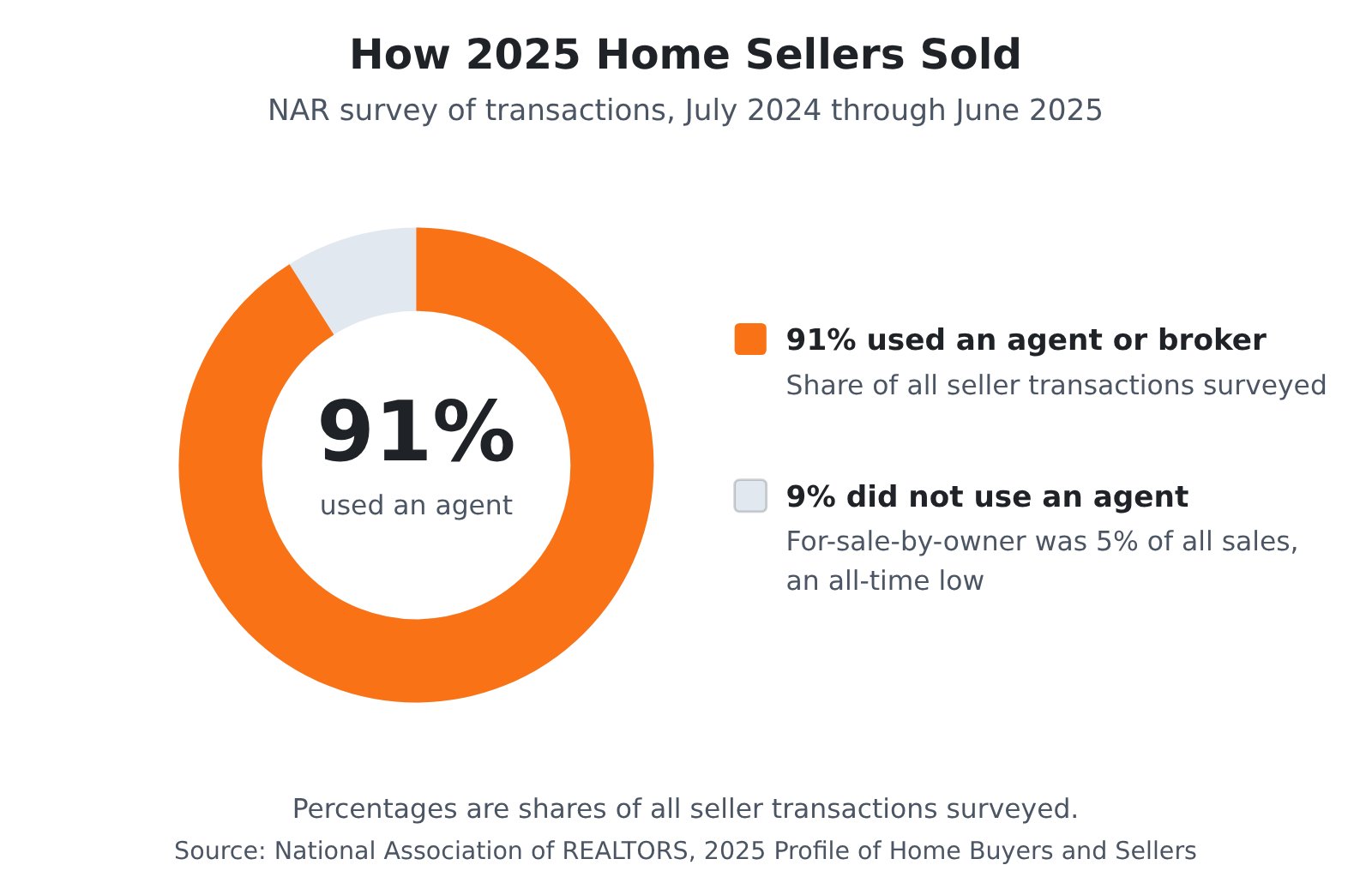
The same report shows a median sale price of $360,000 for FSBO homes against $425,000 for agent-assisted sales. I'll be straight with you, because that gap gets misused constantly: those are two different sets of houses in two different situations, not a measured effect of hiring somebody. Take the 91% and the 5% as the real signal, not the price difference.
How a Real CMA Gets Built
There's no mystery to this. A pricing analysis worth trusting moves through six steps, and the judgment shows up in the middle four.
- A walkthrough of the whole house. Condition, layout, light, storage, and the things a model can't see. This is also where the cheap pre-listing fixes get flagged.
- Closed comparable sales, pulled from the recent past. Same neighborhood first, then same school zone, then similar size and price band. Closed sales, not active listings, because closed is what a lender's appraiser will use too.
- Adjustments. Square footage, bed and bath count, garage, lot size and usability, updates, roof and system age, condition. This is the part that separates a real analysis from a spreadsheet.
- A read on your live competition. What's active in your range right now, what's pending, what has sat, and which of those 344 price-cut listings are in your band.
- A range and a recommendation, with the comps attached so you can see the reasoning rather than take a number on faith.
- A marketing plan built before the listing goes live. Photography, video, social, and timing, decided in advance instead of improvised in week three.
Then we talk strategy. List at the number, list slightly under to draw competing offers, or hold for a better window. In a market with rising inventory, that conversation is worth having out loud.
Do These Five Things Before You Ask What Your Home Is Worth
- Write down your real timeline. Selling in 30 days and selling in six months are two different pricing strategies.
- List what you've done to the house. Roof year, HVAC year, appliances, flooring, additions, permits. Every bit of it gets used.
- Look up your online estimate, then set it aside. Know the number so it doesn't surprise you later, and know its limits.
- Fix the cheap stuff. Trim the hedges, touch up paint, fix the door that sticks, clear the counters. Buyers judge care.
- Get a real CMA before you talk to a lender about your next place. Your equity math depends on it, and a guess isn't good enough to plan a move around.
If you're weighing whether your next step is buying again or renting for a stretch, the rent-or-own numbers near Auburn are worth reading alongside your valuation.
Questions Auburn Sellers Ask Me
What is the median home price in Auburn, Alabama?
The cleanest current figure at the county level is Lee County's median listing price of $412,500 in June 2026, down 3.1% from $425,900 in June 2025 (Realtor.com via FRED, MEDLISPRI1081, retrieved August 4, 2026). Lee County includes both Auburn and Opelika. That's an asking-price median for active listings, not a median of closed sales, and Auburn on its own behaves differently than the county as a whole. For closed-sale numbers in your specific neighborhood and price band, ask me and I'll pull them.
How accurate is a Zestimate on an Auburn home?
Nobody publishes a Zestimate error rate for Auburn specifically, so treat any article claiming one with suspicion. What is documented is Zillow's own reported national median error rate of 6.9% across more than 104 million off-market homes when it launched its neural Zestimate (Zillow, June 15, 2021). On a $412,500 home, a miss that size is roughly $28,000. Automated estimates do best on similar homes in high-turnover subdivisions and worst on anything unusual: custom builds, large lots, dated interiors, or fresh renovations the model hasn't seen.
Is a CMA the same thing as an appraisal?
No. A comparative market analysis is a licensed agent's pricing analysis, built from closed comparable sales and adjusted for your home's condition and features. An appraisal is an independent opinion of value from a state-licensed appraiser, usually ordered by your lender and performed under USPAP standards, and it's what the loan decision rests on. A CMA sets your list price. An appraisal can confirm or complicate the deal after you're under contract.
Is 2026 a good time to sell a house in Auburn?
It's a more demanding market than last year, and pretending otherwise wouldn't help you. Asking prices are down, homes are taking longer, and there's more competition on the market than there was in June 2025. Homes are still selling, and Lee County still asks well above the Alabama median. Whether it's the right time for you comes down to your equity, your timeline, and where you're headed next. That's a conversation, not a data point.
How long does it take to sell a home in the Auburn area?
Median days on market in Lee County was 56 days in June 2026, up from 50 a year earlier (Realtor.com via FRED, MEDDAYONMAR1081). Then add roughly 30 to 45 days after you accept an offer for financing, appraisal, and closing. So a realistic listing-to-keys timeline right now is often around three months, and the price you choose in week one is the single biggest lever on the front half of it.
Do I have to make repairs before selling?
Rarely all of them. Roof, HVAC, and active water problems are worth addressing, because buyers and appraisers both key on them. Cosmetic updates are a judgment call that depends on your price band and your competition, and it's a call I'd rather make with you standing in the room than guess at from a listing photo.
How do I pick the best realtor in Auburn, AL?
Judge on evidence, not on a slogan. Ask for a written CMA with the closed comparable sales attached, so you can see the reasoning instead of taking a number on faith. Ask how the agent will market a listing in a market with 975 active listings, and ask what they'd tell you if your price expectation and the comps disagreed. Confirm the license and the brokerage. Then pick the person who answers your questions in plain English and returns your call.
I want to sell my house in Auburn. Who should I call?
Call a licensed local agent who will walk your house before quoting a number, show you the closed comps behind their recommendation, and tell you plainly when your expectation and the data disagree. That's the job. I'm Amy Cotney, a REALTOR® with ROOTS Real Estate Investment Development in Auburn (AL Lic# 108235), and you can reach me at (334) 332-4002 or request a valuation online.
Who to Call When You're Ready to Sell in Auburn
I'm a REALTOR® and the Marketing Director at ROOTS Real Estate Investment Development, at 235 N Gay Street in downtown Auburn. I serve Auburn, Opelika, Lake Martin, Lee County, and the surrounding East Alabama market. I was voted #1 Real Estate Agent in Auburn in Best of 2025, and Property Spark named me the top REALTOR® in social media in the state of Alabama. My degree is in broadcast journalism and public relations from Troy University. I'm also a certified interior decorator, which turns out to be genuinely useful when we're deciding how your house should be presented.
None of that prices your house. Closed comps and a walkthrough do. But when you're picking who to trust with the biggest number in your financial life, it's fair to want to know who you're talking to.
Here's what I'll do: come see the house, pull your comps, and give you a range with the reasoning attached. No pressure, no automated email chain. Just an honest number and a plan, whether you're moving up, downsizing, or starting a new chapter somewhere else.
If you're thinking about selling, reach out. I'd love to help. Request your home valuation or call or text (334) 332-4002.
Amy Cotney is a licensed REALTOR® with ROOTS Real Estate Investment Development in Auburn, Alabama (Alabama license #108235), serving Auburn, Opelika, Lee County, Lake Martin, and the surrounding East Alabama market. Market figures in this article come from Realtor.com data published through the Federal Reserve Bank of St. Louis (FRED), cited by series ID with a retrieval date of August 4, 2026, and describe listing activity rather than closed sales or guaranteed outcomes. Online home value estimates and the ranges discussed here are starting points for a conversation, not a comparative market analysis, a formal appraisal, or legal, tax, or lending advice. Photography in this article is illustrative and does not depict a specific listing. Equal Housing Opportunity.