Updated September 2026
Yes, you can sell a house during a divorce in Alabama. It's just rarely a one-signature decision. If the house is your homestead, Alabama law generally requires both spouses to sign. Your case may have orders that limit what either of you can do with the property. And the two of you (or a judge) need to settle price, timing, and where the money goes before anyone signs a listing agreement.
I'm not an attorney or a CPA, and nothing here replaces either one. What I can do is walk you through the real estate side, so you walk into those conversations with better questions.
The Bottom Line
- On a homestead, plan on both spouses signing. Alabama's homestead statute requires the other spouse's signature and assent, even when only one name is on the deed.
- Read your case orders before you list. A pending divorce doesn't automatically block a sale, but an order in your case might.
- A sale price is not a payout. The mortgage payoff, liens, selling costs, and anything your settlement directs come off the top.
- A quitclaim deed doesn't take anyone off the mortgage. Neither does the divorce decree.
- Taxes depend on the path you choose. Selling now, transferring the house to one spouse, and selling after the divorce are treated differently.
- Put the listing rules in writing. Price, price drops, offers, bills, and proceeds should all be settled before the house goes live.
Can one spouse sell the house without the other?
Usually not, if it's the home you've lived in as a married couple. Alabama's homestead statute, Ala. Code § 6-10-3, says no mortgage, deed, or other conveyance of the homestead by a married person is valid "without the voluntary signature and assent of the husband or wife." That assent also has to be acknowledged before an officer authorized to take acknowledgments of deeds.
That rule is about the homestead, and it doesn't settle everything else. A spouse whose name isn't on the deed can still have a marital-property claim to the house in the divorce. A spouse whose name is on the deed shouldn't assume they can sell alone. Pull a copy of your deed, then ask your attorney two questions: does this house count as our homestead, and whose signatures will a buyer's title company need?
Then there's the case itself. Alabama's Rules of Civil Procedure, Rule 65(b), allow restraining orders in domestic relations cases, and the usual short time limit on an order granted without notice doesn't apply to those cases. That doesn't mean every divorce comes with one. It means you need to read what's actually been entered in your case (temporary orders, agreements, anything the judge has signed) before you call an agent. If an order touches the house, the listing waits until your attorneys sort it out.
My read: the smoothest divorce sales start with both spouses agreeing to sell, in writing, with both attorneys looped in, before the house ever hits the market.
Who gets what when the house sells?
Alabama doesn't hand you a formula. The state's property-division statute, Ala. Code § 30-2-51, leaves the division to the judge, and it doesn't set a default percentage for the home or require a sale. So nobody can promise you an even split, and nobody can promise the house will be sold.
One rule in that statute is worth knowing. The judge generally can't consider property one spouse owned before the marriage, or received by inheritance or gift, "unless the judge finds from the evidence that the property, or income produced by the property, has been used regularly for the common benefit of the parties during their marriage." If the house (or the money for the down payment) came from one side of the family, that history matters, and so does how the two of you have used it since. If an inherited property is part of the picture, my guide to selling an inherited house in Alabama covers that side of things.
Whatever split you land on, the number you're dividing is smaller than the sale price. The mortgage payoff comes out first, then any liens, your selling costs, and any payments your settlement or judgment directs. Alabama also taxes the recording of a deed at "$.50 per $500 of value or fraction thereof," per the Alabama Department of Revenue. By my math, that's $100 for every $100,000 of value conveyed. Your purchase contract and local custom decide which side pays it.
Before you argue about percentages, get a current payoff statement from your lender and have the title company check the parcel for liens. You'll be negotiating over real numbers instead of hopeful ones.
What the market looks like while you decide
Timing is often the sticking point. One spouse wants out now, and the other wants to wait for a better price. The most recent picture I have comes from the Lee County Association of REALTORS® July housing stats, and I'm using the association's all-areas residential cut. That's a market-wide figure, not an Auburn-only number, and it's not an appraisal of your house.
Prices held up. The median sold price was $406,260 in July 2026, compared with $387,150 in July 2025, a gain of about 4.9% by my math. The average sold price was $453,087, compared with $438,686 a year earlier.
What changed is competition. The association counted 834 homes on the market in July 2026, up from 650 in July 2025, about 28.3% more by my math. New listings rose to 291 from 265. Sales went the other way: 239 homes sold in July 2026, compared with 260 in July 2025, down about 8.1% by my math. The bars below put those three counts side by side for both Julys.
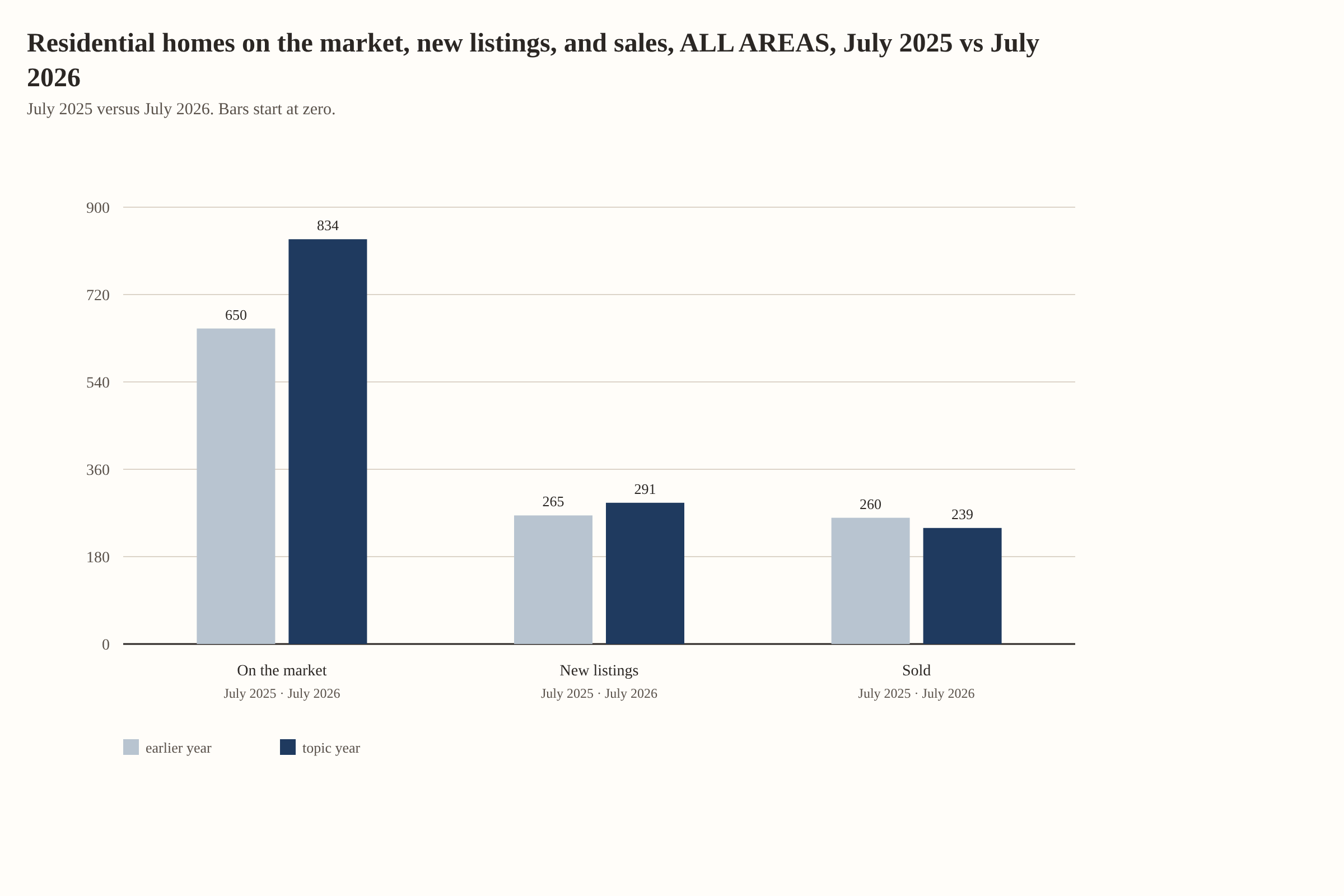
Chart 1. Residential homes on the market, new listings, and sales, all areas, July 2025 vs July 2026. Source: Lee County Association of REALTORS®, July 2025 housing stats, all areas (published August 10, 2026); Lee County Association of REALTORS®, July 2026 housing stats, all areas (published August 10, 2026).
Put the homes on the market next to that month's sales and, by my math, the all-areas cut works out to roughly 3.5 months of listings per month of sales in July 2026, against about 2.5 in July 2025. That is a rough ratio, not an official months-of-supply figure, and it covers every residential listing in the association's market. Average days on market was 54 in July 2026 and 54 in July 2025. For existing (not new construction) homes, it was 41 days, compared with 50.
My read: buyers have more to choose from than they did a year ago, so the price you agree on matters more than usual. So does agreeing ahead of time on when you'll adjust it. A house that sits while two attorneys trade emails about a price drop risks going stale. I get into seasonality in the best time to sell a house in Auburn, and if yours is a higher-end or lake property, selling a luxury home in Auburn or on Lake Martin covers how pricing and marketing change at that level.
Figures are closed and listing data for the association's all-areas cut as of July 2026, from the Lee County Association of REALTORS®. These figures are general market guidance. Information is deemed reliable but not guaranteed, and readers should independently verify. Market conditions change and past figures are not a prediction.
If one of you keeps the house instead
Sometimes the answer isn't selling at all. One spouse keeps the house and buys out the other. That can work well, but there's a trap. The Consumer Financial Protection Bureau says it plainly: "taking your name off a home or vehicle title doesn't take your name off the mortgage or auto loan," and "sending creditors a copy of your divorce decree doesn't end your responsibility on a joint account."
So a quitclaim deed moves ownership. It doesn't move the loan. If both names are on the mortgage, both of you stay responsible to the lender until that loan is paid off or the lender approves something else, often a refinance into the keeping spouse's name alone. Call the servicer and ask what options exist for your specific loan.
That refinance happens at today's rates, not the rate you locked years ago. Freddie Mac's weekly survey put the national 30-year fixed average at 7.03% in its September 24, 2026 release, compared with 6.30% a year earlier. The 15-year fixed averaged 6.42%. A new loan also carries Alabama's mortgage recordation tax of "$.15 per $100 of indebtedness or fraction thereof," per the Alabama Department of Revenue. Run the buyout math at a new rate before you agree to it.
Nothing here is legal, tax, or lending advice. Rates shown are national weekly averages and are not a quote, an offer of credit, or a prediction. For terms on your own situation, talk to a licensed lender.
How federal taxes change the math
Federal tax treatment depends on which path you pick, so run each option past a CPA before you sign a settlement.
If you sell the house
The IRS guide Selling Your Home lets you exclude up to $250,000 of gain from income, and up to $500,000 for a married couple filing jointly. To qualify, you generally need to have owned the home for at least 24 months and lived in it as your main home for at least 24 months out of the last 5 years before closing.
Two divorce-specific rules in that guide help. If you received the home from a spouse or former spouse, you can count the time they owned it. And you can count the home as your residence while your spouse or former spouse lives there under a divorce or separation instrument. That second one matters for the spouse who moved out.
If one spouse takes the house
The IRS guide for divorced or separated individuals says a transfer between spouses, or between former spouses if incident to divorce, "is not a taxable event." Incident to divorce means within 1 year after the marriage ends, or related to the ending of the marriage.
The catch is basis. The spouse who receives the house takes on the other spouse's adjusted basis. So the one who keeps the house also keeps any built-up gain, and any tax on it lands on them when they eventually sell. Which path costs less depends on your gain, your filing status, and your timing, which is why this belongs with a CPA.
What to agree on before you list
None of these terms comes from a statute. They're the questions that stall a divorce sale when nobody answers them up front. Take this list to your attorneys and get the answers written into your agreement or order:
- Occupancy. Who lives in the house during the listing, and who keeps it ready for showings?
- Carrying costs. Who pays the mortgage, property taxes, insurance, utilities, and yard care until closing?
- Repairs. What gets fixed before listing, what's the spending cap, and who approves it?
- Price and price changes. What's the list price, and what's the rule for a reduction if it doesn't sell after an agreed stretch of time?
- Offers. How do you accept, counter, or reject an offer, and what happens if the two of you disagree?
- Communication. Every showing report, offer, and counteroffer goes to both of you at the same time.
- Proceeds. Where does the money sit at closing (for example, in escrow or an attorney's trust account) until your settlement or judgment says how to divide it?
My recommendation: choose one listing agent you both trust to treat you equally, and put in writing that the agent works from the joint instructions in your agreement. For the everyday selling questions (showings, timelines, what closing day looks like), my Auburn home seller FAQ covers the basics.
Disclosures and paperwork to discuss
If your house was built before 1978, the federal lead rule from the Environmental Protection Agency applies to most sales. As the sellers, you'll need to disclose any known lead-based paint, give the buyer the EPA pamphlet, include a Lead Warning Statement in the contract, offer the buyer a 10-day window for a lead inspection or risk assessment, and keep signed copies of the disclosures.
Beyond that, compare notes on the house before you list. The spouse who moved out may not know about the leak that started last spring, and a buyer's side will ask. Walk through property condition, title, and the sale documents with your agent and your attorney together, so both of you sign off on the same information.
Working with me
I'm Amy Cotney, a REALTOR® and licensed real estate salesperson with Roots Real Estate - Investment Development in Auburn. I help sellers in Auburn, Opelika, Lake Martin, and across East Alabama price, prepare, and market their homes, and if your sale is part of a divorce, I'll work alongside your attorneys, not around them. You can read more about me and how I work.
If you're weighing a sale during a divorce, call or text me at (334) 332-4002, and we'll start with a quiet conversation about the house, the timeline, and what your attorneys need from me.
Sources
- Alabama Department of Revenue, Recordation Tax: https://www.revenue.alabama.gov/tax-types/recordation-tax/
- Code of Alabama § 6-10-3, Homestead Exemption, Alienation by Married Person (official text published by the Alabama Legislature)
- Code of Alabama § 30-2-51, Allowance Upon Grant of Divorce; Certain Property Not Considered (official text published by the Alabama Legislature)
- Alabama Rules of Civil Procedure, Rule 65: https://judicial.alabama.gov/docs/library/rules/cv65.pdf
- Freddie Mac, Primary Mortgage Market Survey, week of September 24, 2026: https://www.freddiemac.com/pmms
- Internal Revenue Service, Publication 523, Selling Your Home: https://www.irs.gov/publications/p523
- Internal Revenue Service, Publication 504, Divorced or Separated Individuals: https://www.irs.gov/publications/p504
- Consumer Financial Protection Bureau, Can a debt collector contact me about a debt after a divorce?: https://www.consumerfinance.gov/ask-cfpb/can-a-debt-collector-contact-me-about-a-debt-after-a-divorce-en-1413/
- U.S. Environmental Protection Agency, Real Estate Disclosures About Potential Lead Hazards: https://www.epa.gov/lead/real-estate-disclosures-about-potential-lead-hazards
- Lee County Association of REALTORS®, July 2026 housing stats, all areas (published August 10, 2026): https://www.leecorealtors.org/#stats
- Lee County Association of REALTORS®, July 2025 housing stats, all areas (published August 10, 2026): https://www.leecorealtors.org/#stats