Updated September 2026
It's one of the first questions I hear from Auburn homeowners who are ready for a new chapter. Do I sell my house first, or buy the next one first?
Here's my honest answer. For most people who still have a mortgage, selling first is the lower-risk order, in my view. It turns your equity into cash you can count, and it takes the two-mortgage question off the table. Buying first makes sense when a lender confirms you can carry both payments, you have cash for the overlap, and you'd rather pay for that overlap than move twice.
The Bottom Line
- Sell first if your down payment depends on this sale, or if you can't qualify with both housing payments counted. You'll know your number, but you may need a short-term place to live.
- Buy first if a lender confirms you qualify with both payments and you have cash to cover the gap. You move once, but you carry two houses until the old one closes.
- Auburn's July numbers show more homes to choose from and fewer closed sales than a year earlier. That cuts both ways when you're selling and buying at once.
- Taxes, homestead status, and flood zones are property by property. Check each address, and bring your lender and CPA in early.
What Auburn's numbers say about the house you're selling
Start with the sale side, because that's the money most people are counting on. The Lee County Association of REALTORS®, July 2026 housing stats, Auburn (published August 10, 2026), puts the median sold price for Auburn residential sales at $494,087. In the July 2025 report it was $431,625. By my math, that's up 14.5% year over year.
Marketing time drifted a little longer. Average days on market for Auburn residential sales was 54 in July 2026, against 49 in July 2025. For existing homes (not new construction), the association counted an average of 47 days in July 2026, versus 46 a year earlier.
Two cautions before you build a plan on those. A citywide median isn't your home's value. Your house sells for what a buyer pays for it, based on its condition, its street, and the comparable sales around it. And days on market counts the time before a contract, not the time to closing. It can't tell you whether your sale and your purchase will close on the same day.
If you're still deciding when to list, I walk through the calendar in my guide to the best time to sell a house in Auburn.
What you'll be shopping against when you buy
Now flip it around. The same July 2026 report counted 442 Auburn residential homes on the market, up from 320 in the July 2025 report. By my math, that's a 38.1% jump. Closed sales went the other way: 114 Auburn residential homes sold in July 2026, compared with 136 in July 2025, down 16.2% by my math.
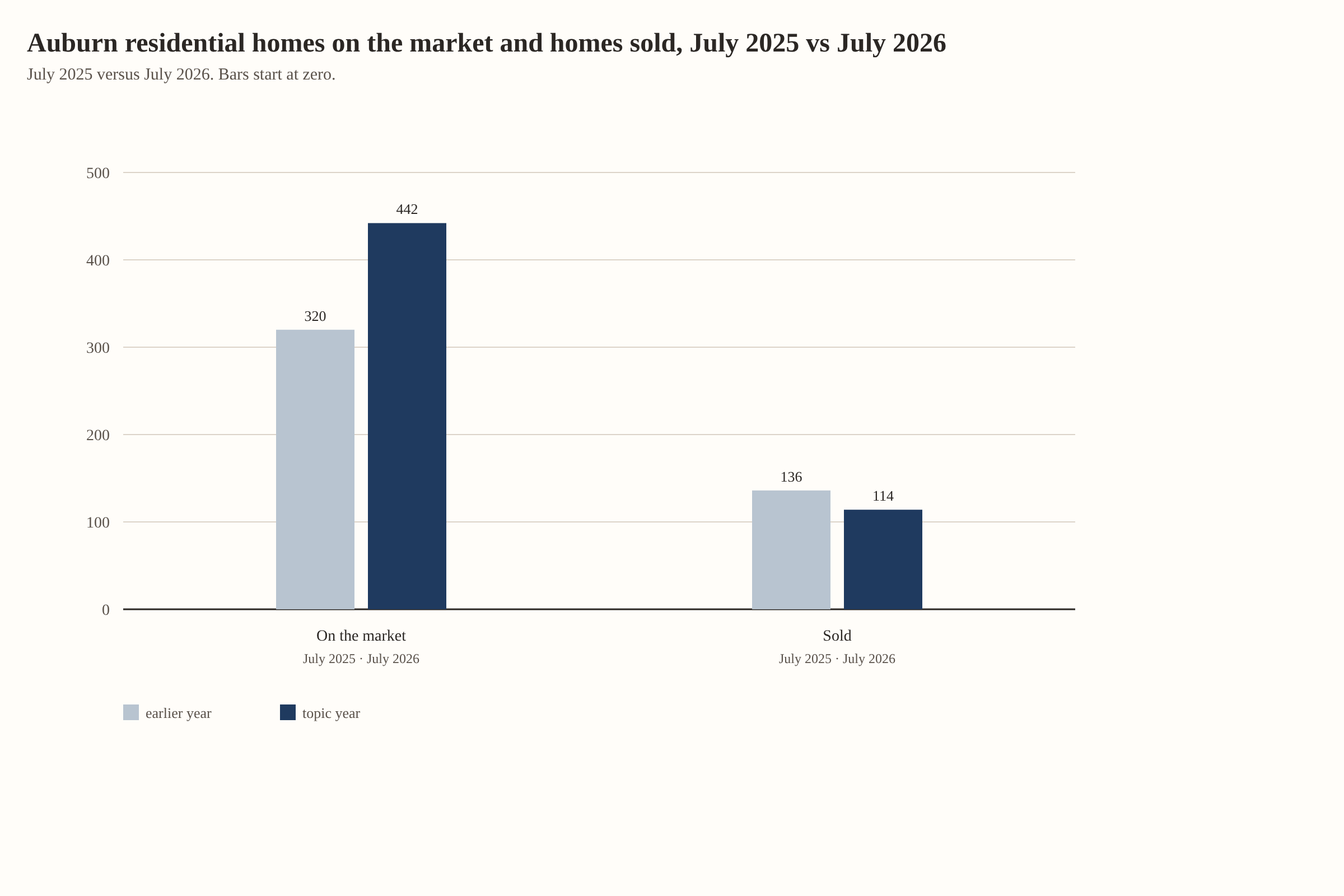
Chart 1. Auburn residential homes on the market and homes sold, July 2025 vs July 2026. Source: Lee County Association of REALTORS®, July 2025 housing stats, Auburn (published August 10, 2026); Lee County Association of REALTORS®, July 2026 housing stats, Auburn (published August 10, 2026).
Set those two counts side by side for each July and the gap between listings and closed sales is plain to see. Dividing homes on the market by that month's sales gives roughly 3.9 for July 2026 and 2.4 for July 2025, by my math. That's a rough ratio, not an official months-of-supply figure, and it covers every Auburn residential listing, not just your price range.
My read: more listings means more houses to tour when you're the buyer, and more competition for attention when you're the seller. If you're doing both, you feel both at once. What these counts can't tell you is how any one seller will respond to your offer terms. That's a conversation for when you've found the house.
If a new job is what's moving you, here's what I tell people relocating to Auburn for a job. And if you're shopping around the southwest side of town, my Moores Mill neighborhood guide is a good place to start.
Can you qualify to buy before your house sells?
This is the question that decides it for most people, and the answer belongs to your lender. Here's what the rules look like going in.
Fannie Mae's Selling Guide covers the exact situation of a current home that's pending sale but won't close before the new loan. In that case, both the current housing payment and the proposed one are used to qualify you. The lender can leave the current payment out only if it has the executed sales contract and confirmation that the buyer's financing contingencies have cleared.
In plain English, if your house isn't under contract with the financing hurdles cleared, plan on the lender counting both payments.
If you're thinking about keeping the current house as a rental instead of selling, the reserve rules come into play too. Under Fannie Mae's minimum reserve requirements, reserves for other financed properties are 2% of the aggregate unpaid principal balance for a borrower with one to four financed properties. That calculation leaves out your principal residence and any property that's sold or pending sale.
For a sense of where rates sit, Freddie Mac's Primary Mortgage Market Survey put the U.S. 30-year fixed average at 7.03% as of September 24, 2026, up from 6.95% the week before. That's a national weekly average, not the rate you'll be quoted.
Some buyers use a home equity line of credit on the current house to fund the next down payment. The CFPB's HELOC brochure flags the catch in one line: "If you sell your home, you are generally required to pay off your HELOC in full immediately." The line uses your home as collateral, and a variable rate means the payment can change. It can work as a bridge, but only after a lender looks at your actual income, debts, and equity.
How much cash does selling first free up?
The CFPB's brochure defines equity as "the value of your home minus the amount you owe on your mortgage." What you walk away with at closing is that equity minus your selling costs.
Nobody can pull that number off a citywide median. You need three things specific to your house:
- A realistic sale price, based on recent comparable sales near you
- Your loan payoff amount, from your mortgage servicer
- An itemized estimate of your closing costs
My read: this is the strongest reason to sell first. When your sale has closed before you shop in earnest, you know exactly what you can put down. You also shop as a buyer with no sale hanging over the deal. In my experience, that clarity buys a lot of peace of mind.
What happens if the two closings don't line up?
Two closings rarely land on the same day by accident. Your purchase lender has a fixed step near the end. Per the CFPB’s page on the Closing Disclosure, "the lender is required to give you the Closing Disclosure at least three business days before you close on the mortgage loan." Anything that moves that date can ripple into your sale.
If you sell first and the new house isn't ready, you'll need somewhere to land in between. That might be a short-term lease, a stretch with relatives, or storage plus a furnished rental. Get real local quotes for the months you'd actually need. HUD publishes Fair Market Rents as a benchmark, but those aren't units you can rent.
If you buy first and the old house hasn't sold, you'll carry two mortgages, two insurance policies, two sets of utilities, and two yards to mow until it closes. Nobody has ever told me they loved mowing two lawns. Budget for a longer overlap than you hope for.
Buying from out of town while you sell here adds a layer of scheduling. Here's how buying a house in Auburn remotely works when you can't be here for every step.
Can a contingency or a flexible closing date bridge the gap?
There are contract tools built for exactly this problem. A contingency can make your purchase depend on your sale. A closing date can build in some cushion. A possession agreement can let you stay in your house for a short time after it closes.
Each of these is negotiated deal by deal and written into your actual contract, so the protection is only as good as the paper. Review the terms with your agent, and with a real estate attorney if anything feels uncertain, before you sign.
Taxes and homestead when you own two houses for a while
On the federal side, IRS Publication 523 lets you exclude up to $250,000 of gain from the sale of your home, or $500,000 for a married couple filing jointly. One of the tests is that you owned and lived in the home for at least 24 months out of the last five years before the sale.
The Alabama Department of Revenue lists gains from the sale of your personal residence among the income reported on the state return. The state's top rate of 5% applies to taxable income over $3,000 for single filers and over $6,000 for married couples filing jointly. How that plays out on your sale is a question for your CPA.
Property tax is where an overlap gets local. Per the Lee County Revenue Commissioner, homestead property is assessed at 10% of value rather than 20%, and you must live in the house on October 1st of the year you claim it. The same page lists added exemptions for older, disabled, or blind owners, with income limits. If you'll own two houses across an October 1st, your move date affects which one can carry the homestead. Pull each parcel's actual tax bill before you estimate carrying costs.
Check the flood map for both addresses
If you buy first, you'll insure two properties for a while. Look up each address on the FEMA Flood Map Service Center before you commit. A flood zone isn't an insurance quote, so get actual premiums from your agent too.
If one of those houses sits on the water, my notes on selling waterfront property at Lake Martin cover the extra steps a lake sale can bring.
So which order is right for you?
Here's how I'd sort it, as my own read rather than a rule.
Selling first usually fits when:
- Your down payment depends on the money from this sale
- Your lender says you can't qualify with both payments counted
- A short-term rental or a stay with relatives is manageable for a few months
Buying first usually fits when:
- A lender has confirmed you qualify with both payments in the math
- You have cash set aside to carry both houses for longer than you expect
- Moving twice would cost you more, in money or sanity, than an overlap
If you land somewhere in the middle, a contingency or a negotiated closing timeline may be the bridge. That's where a clear plan, and steady communication between both sides of both deals, does the heavy lifting.
I'm Amy Cotney, a REALTOR® with Roots Real Estate - Investment Development in Auburn, and lining up a sale with a purchase is a big part of what I help homeowners plan. If you'd like to talk through your own timing, you can learn more about me and how I work and reach out anytime.
I build strong relationships that lead to sold homes and happy buyers, through communication, not automation.
Figures are listing and closed data for the Auburn area as of July 2026, from the Lee County Association of REALTORS® monthly housing stats. These figures are general market guidance. Information is deemed reliable but not guaranteed, and readers should independently verify. Market conditions change and past figures are not a prediction.
Nothing here is legal, tax, or lending advice. Rates shown are national weekly averages and are not a quote, an offer of credit, or a prediction. For terms on your own situation, talk to a licensed lender.
Sources
- Freddie Mac, Primary Mortgage Market Survey, week of September 24, 2026: https://www.freddiemac.com/pmms
- Fannie Mae Selling Guide B3-6-06, Qualifying Impact of Other Real Estate Owned: https://selling-guide.fanniemae.com/sel/b3-6-06/qualifying-impact-other-real-estate-owned
- Fannie Mae Selling Guide B3-4.1-01, Minimum Reserve Requirements: https://selling-guide.fanniemae.com/sel/b3-4.1-01/minimum-reserve-requirements
- Consumer Financial Protection Bureau, What You Should Know About Home Equity Lines of Credit: https://files.consumerfinance.gov/f/documents/cfpb_heloc-brochure.pdf
- Consumer Financial Protection Bureau, What is a Closing Disclosure?: https://www.consumerfinance.gov/ask-cfpb/what-is-a-closing-disclosure-en-1983/
- U.S. Department of Housing and Urban Development, Fair Market Rents: https://www.huduser.gov/portal/datasets/fmr.html
- Internal Revenue Service, Publication 523, Selling Your Home: https://www.irs.gov/publications/p523
- Alabama Department of Revenue, Income to Be Reported on the Alabama Income Tax Return: https://www.revenue.alabama.gov/individual-corporate/income-to-be-reported-on-the-alabama-income-tax-return/
- Alabama Department of Revenue, What is Alabama's Individual Income Tax Rate?: https://www.revenue.alabama.gov/faqs/what-is-alabamas-individual-income-tax-rate/
- Lee County Revenue Commissioner, Homestead Exemptions: https://www.leecountyrevenuecommissioner.com/Default.asp?ID=348&pg=Homestead+Exemptions
- FEMA Flood Map Service Center: https://msc.fema.gov/portal/home
- Lee County Association of REALTORS®, July 2026 housing stats, Auburn (published August 10, 2026): https://www.leecorealtors.org/#stats
- Lee County Association of REALTORS®, July 2025 housing stats, Auburn (published August 10, 2026): https://www.leecorealtors.org/#stats