
Updated August 2026
If you're weighing a move between Auburn, Atlanta, and Birmingham, here's the short version. Auburn and Birmingham cost about the same to live in. Atlanta costs meaningfully more. And almost the entire difference is housing.
That last part surprises people. For a family of four, Atlanta is actually cheaper than the Auburn area on groceries and on transportation. It still ends up thousands of dollars more expensive a year, because the housing line swamps everything else.
The Bottom Line
- Overall prices in the Atlanta metro ran about 13.8 percent above the Auburn-Opelika metro in 2024, with Birmingham sitting between the two (BEA Regional Price Parities, all items).
- A single adult needs $36,279 a year after taxes in the Auburn-Opelika metro, $37,888 in the Birmingham metro, and $44,328 in the Atlanta metro (MIT Living Wage Calculator, accessed August 2026).
- Housing accounts for more than the whole gap. Atlanta's housing budget for one adult runs $8,877 a year above Auburn-Opelika's, while the total budget gap is $8,049.
- Alabama's effective property tax rate is 0.37 percent versus Georgia's 0.79 percent (Tax Foundation, 2024 data published in 2026). Georgia wins on sales tax.
- Auburn and Birmingham share a state, so any cost difference between them is local, not state tax policy.
The short answer, in one number per metro
The cleanest single comparison comes from the federal government. The Bureau of Economic Analysis publishes Regional Price Parities, which put every metro on one scale where the national average equals 100.
For 2024, the Auburn-Opelika metro came in at 87.9. Birmingham-Hoover came in at 91.6. The Atlanta-Sandy Springs-Roswell metro came in at 100.1, essentially dead-on the national average. That works out to overall prices running about 13.8 percent higher in metro Atlanta than in Auburn-Opelika (BEA Regional Price Parities, all items, 2024, via FRED).
For a three-way view, I switched to the MIT Living Wage Calculator, which models an actual household budget for each metro using the same basket everywhere. Here's what a single adult with no children needs to earn, after taxes, to cover a basic budget:
- Auburn-Opelika metro: $36,279 a year
- Birmingham metro: $37,888 a year
- Atlanta metro: $44,328 a year
Those are after-tax figures, so don't hold them up against a job offer. For that, MIT publishes the gross hourly wage it takes to get there: $21.17 an hour in the Auburn-Opelika metro, $22.20 in Birmingham, and $26.36 in Atlanta, at forty hours a week and fifty-two weeks a year. Those hourly rates include what you hand over in taxes. The annual numbers above don't.
That's $8,049 more per year in Atlanta than in the Auburn-Opelika metro, about 22 percent more (MIT Living Wage Calculator, accessed August 2026).
Notice the shape of that. On the household budget, Birmingham sits close to Auburn-Opelika, not halfway between. The federal price index puts Birmingham a little further out, about a third of the way to Atlanta, but the conclusion holds on either measure. This isn't a three-rung ladder. It's Auburn and Birmingham in one tier, and Atlanta somewhere else.
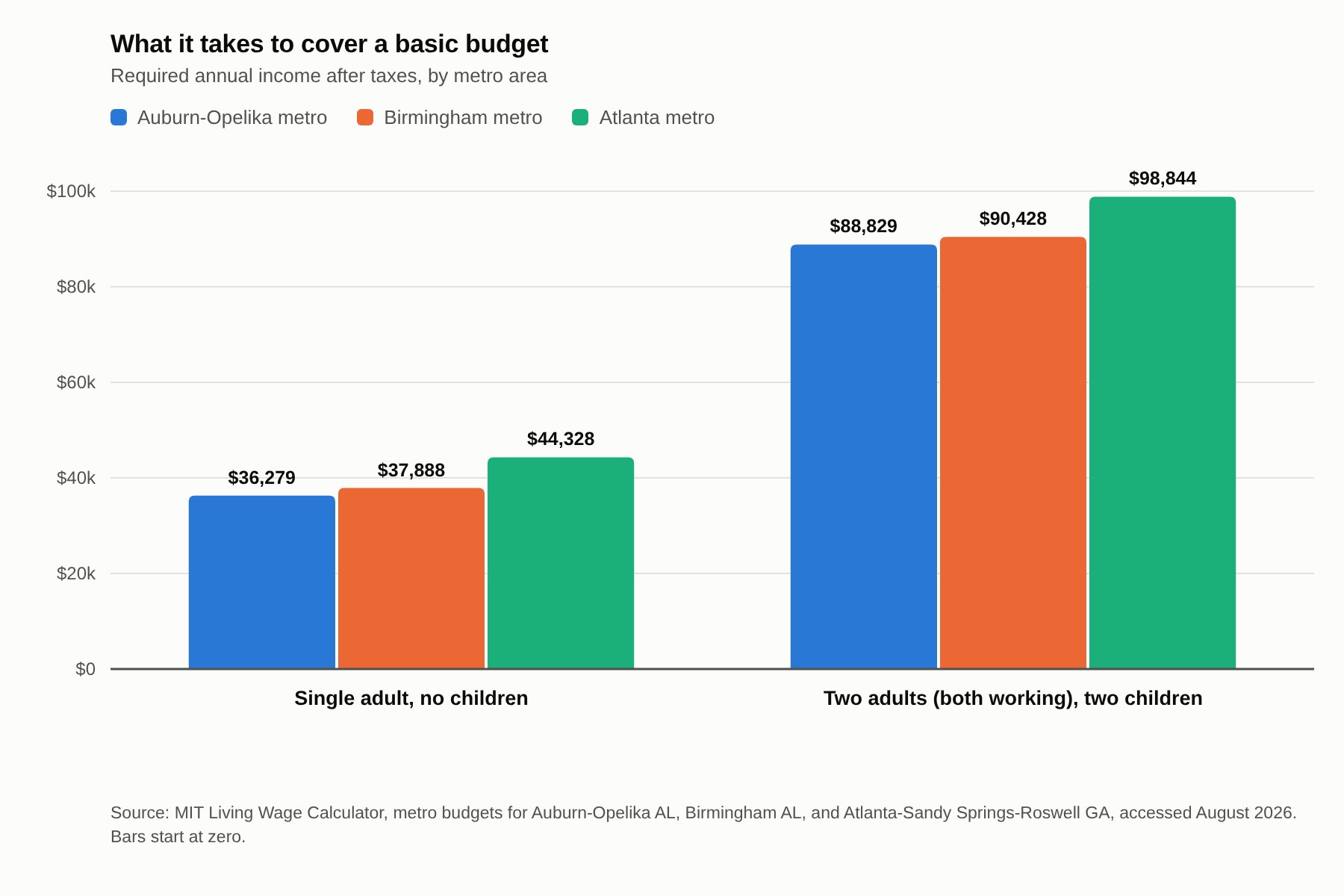
Chart 1. Required annual income after taxes, single adult and two adults with two children, Auburn-Opelika, Birmingham, and Atlanta metro areas. Two-adult figures assume both adults working. Source: MIT Living Wage Calculator, accessed August 2026. Bars start at zero.
Housing is where the whole gap lives
Here's the finding that reframed this whole post for me.
In the single-adult budget, annual housing runs $10,081 in the Auburn-Opelika metro, $11,962 in the Birmingham metro, and $18,958 in the Atlanta metro. Atlanta's housing line is $8,877 a year higher than Auburn-Opelika's, roughly 88 percent more (MIT Living Wage Calculator, accessed August 2026).
Now put that next to the total. The entire budget gap between the two metros is $8,049. The housing gap alone is $8,877. Housing doesn't just drive the difference, it more than accounts for it. Every other category, netted out, actually pulls in Atlanta's favor.
The pattern holds for a household of two adults and two children. Annual housing runs $14,047 in the Auburn-Opelika metro, $14,878 in Birmingham, and $21,783 in Atlanta.
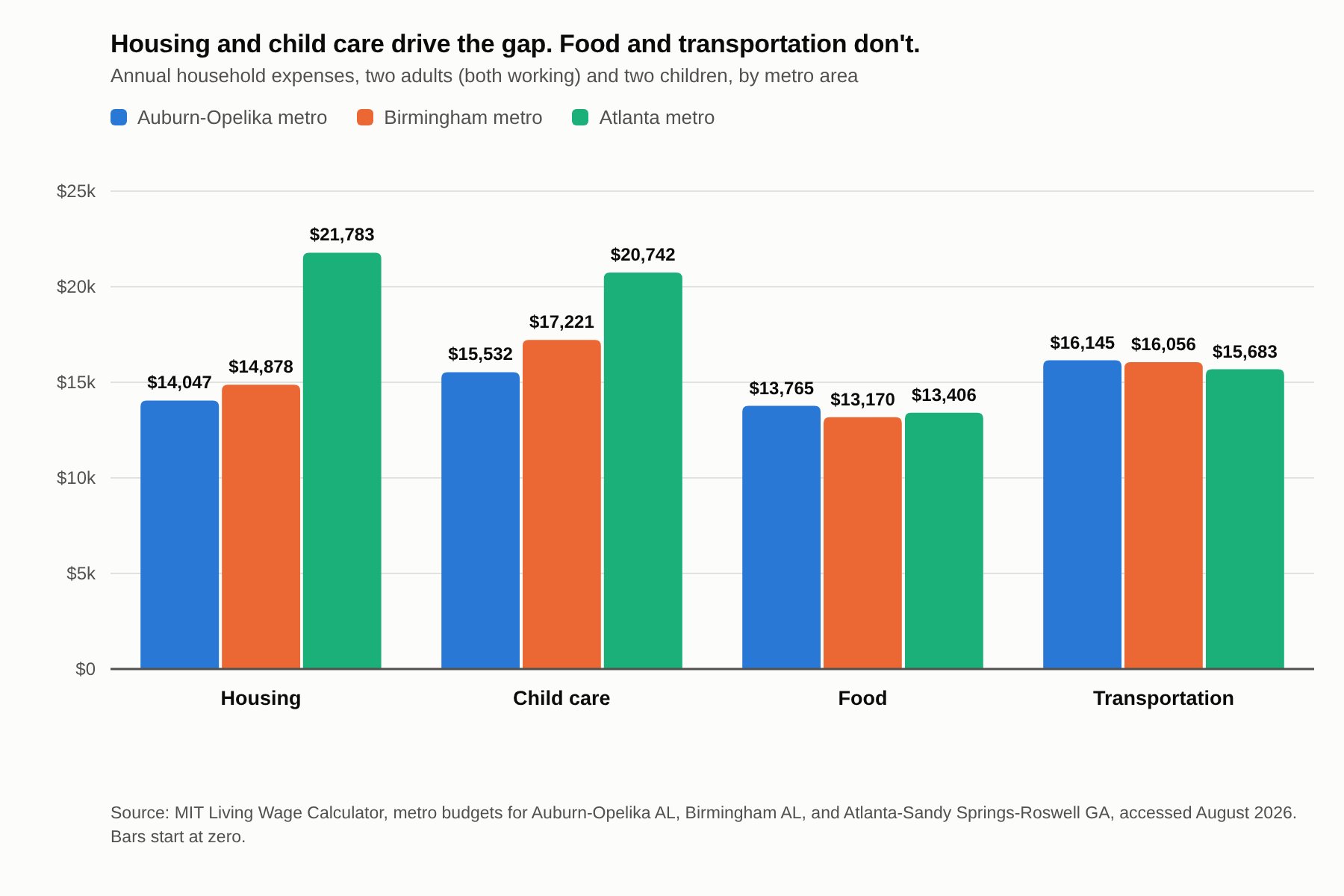
Chart 2. Annual household expenses by category, two adults with both working and two children, Auburn-Opelika, Birmingham, and Atlanta metro areas. Source: MIT Living Wage Calculator, accessed August 2026. Bars start at zero.
Where Atlanta actually comes out ahead
I'd rather give you the honest picture than a tidy one, so here's the part that cuts against the headline.
On groceries, the Auburn-Opelika metro is the most expensive of the three. Annual food for a household of two adults and two children runs $13,765 in Auburn-Opelika, $13,406 in Atlanta, and $13,170 in Birmingham.
Transportation goes the same direction. That same household spends $16,145 a year in the Auburn-Opelika metro, $16,056 in Birmingham, and $15,683 in Atlanta (MIT Living Wage Calculator, accessed August 2026).
Yes, really. Atlanta traffic is its own genre of misery, but a huge metro buys grocery competition and shorter average trips, and the budget reflects it. If somebody tells you a big city is more expensive across the board, that isn't what the data says.
Child care is the line item nobody quotes you
With both parents working, annual child care for two children runs $15,532 in the Auburn-Opelika metro, $17,221 in the Birmingham metro, and $20,742 in the Atlanta metro. That's $5,210 more a year in Atlanta than in Auburn-Opelika, about 34 percent more (MIT Living Wage Calculator, accessed August 2026). If one parent stays home, this line drops to zero in all three metros and the comparison changes shape.
After housing, that's the second-largest gap in the entire budget. It almost never comes up in cost-of-living conversations, and if child care is in your budget it can move the decision on its own.
The full budget side by side
Annual figure | Auburn-Opelika metro | Birmingham metro | Atlanta metro |
|---|---|---|---|
Required income after taxes, single adult | $36,279 | $37,888 | $44,328 |
Housing, single adult | $10,081 | $11,962 | $18,958 |
Required income after taxes, two adults (both working) and two children | $88,829 | $90,428 | $98,844 |
Housing, two adults and two children | $14,047 | $14,878 | $21,783 |
Child care, two children | $15,532 | $17,221 | $20,742 |
Food, two adults and two children | $13,765 | $13,170 | $13,406 |
Transportation, two adults and two children | $16,145 | $16,056 | $15,683 |
All figures: MIT Living Wage Calculator, metro-level budgets for the Auburn-Opelika, Birmingham, and Atlanta-Sandy Springs-Roswell metropolitan areas, accessed August 2026. Two-adult rows assume both adults working.
What crossing the state line does to your taxes
Auburn to Atlanta means changing states. Auburn to Birmingham does not, so that comparison collapses to local differences in millage, local sales add-ons, and the housing market itself.
On property tax, Alabama is the clear winner. Alabama's effective property tax rate on owner-occupied housing is 0.37 percent. Georgia's is 0.79 percent (Tax Foundation, 2024 data published in 2026). To put rough numbers on it, applying those two statewide rates to a $494,087 home, Auburn's median sold price in July 2026, works out to about $1,828 a year in Alabama versus about $3,903 at Georgia's rate, a gap of roughly $2,075.
Please read that as an illustration and nothing more. Those are statewide average effective rates, not Lee County or Fulton County millage, and they are not a real tax bill for any real address.
Sales tax runs the other way, and it isn't close. Alabama's average combined state and local sales tax rate is 9.46 percent. Georgia's is 7.56 percent (Tax Foundation, combined state and average local rates as of July 1, 2026). That's close to a two-point difference on everything you buy, every time you buy it.
Income tax is close to a wash. Alabama is graduated, from 2.00 percent to 5.00 percent. Georgia is a flat 5.19 percent (Tax Foundation, 2026).
So the honest summary is that Alabama wins on property tax, Georgia wins on sales tax, and income tax roughly cancels. I'm not a tax professional, and how any of this lands on your actual return depends on your situation. Talk to a CPA before you build a budget on it.
What a house in Auburn actually costs
Everything above is a rental-based household budget. It tells you what it costs to live somewhere. It does not tell you what it costs to buy a house, and those are two different measures that should never be mashed into one sentence.
So here's the purchase side, for Auburn specifically. Auburn's median sold price was $494,087 in July 2026, up from $431,625 in July 2025. That's a 14.5 percent move in a year (Lee County Association of REALTORS®, July 2026 housing stats, Auburn, published August 10, 2026).
Read that with one caveat. Auburn's average sold price that month was $543,162 against a $494,087 median, and new construction made up 34 percent of July's 114 sales. When a median moves in a market like this one, part of what you're seeing is what sold, not only what prices did.
One geography note worth holding onto. The BEA and MIT figures above describe the Auburn-Opelika metro area, which includes Opelika and the surrounding county. The MLS figures describe the city of Auburn on its own, a smaller and different footprint. Same region, different boundaries, and they are not interchangeable.
One more distinction, because I publish both. My Auburn-Opelika market update tracks median list price for all of Lee County, which is what sellers are asking. The figure above is closed sales inside the city of Auburn. Different metric, different footprint, and they should not be read against each other.
I don't have comparable MLS figures for Atlanta or Birmingham, and I'm not going to substitute a public estimate to fill the slot. If you want a purchase-price comparison across all three, that needs local data from each market. If you want to know what one specific Auburn address is worth, that's a different question and I answer it here.
How I'd run the math on your own move
If you're holding an Atlanta offer and an Auburn offer, the salary numbers alone won't tell you much. Here's the arithmetic I'd do instead.
Start with the budget floor, not the salary
For a single adult, the gap to clear is $8,049 a year. For two adults both working with two children, it's $10,015. An Atlanta offer has to beat an Auburn-area offer by at least that much, after taxes, before you've broken even.
Then adjust for your actual housing plan
If you're buying rather than renting, the living-wage housing line stops being the right input and your own mortgage, insurance, and property tax numbers take over. That's where Alabama's 0.37 percent effective rate against Georgia's 0.79 percent starts showing up in your monthly payment.
Then add the lines people forget
Child care, if it applies to you. That's $5,210 a year of difference between Atlanta and the Auburn-Opelika metro. And sales tax, which quietly runs about two points higher in Alabama on everything you buy.
Do that honestly and the picture usually gets clearer fast. For a lot of the folks I work with, the Auburn number wins on housing by enough that nothing else can catch up.
Thinking about a move to Auburn?
I'm Amy Cotney, and I help buyers and sellers across Auburn, Opelika, Lake Martin, and the rest of Lee County. If you're running this comparison for a real move, I can tell you what your budget actually buys here, which neighborhoods fit your commute, and what the market has been doing lately. My honest guide to living in Auburn covers the day-to-day side of it.
Call or text me, or send me a note. I'd love to help you figure out the next chapter.
Sources
- U.S. Bureau of Economic Analysis, Regional Price Parities by State and Metro Area, all items, 2024, accessed via FRED (Federal Reserve Bank of St. Louis).
- MIT Living Wage Calculator (Dr. Amy K. Glasmeier, Massachusetts Institute of Technology), metro budgets for Auburn-Opelika, Birmingham, and Atlanta-Sandy Springs-Roswell, accessed August 2026.
- Tax Foundation, Alabama tax rates and rankings and Georgia tax rates and rankings, 2026, and State and Local Sales Tax Rates, Midyear 2026.
- Lee County Association of REALTORS®, July 2026 housing stats, Auburn, published August 10, 2026.
Figures are closed data for the city of Auburn for July 2026 and July 2025, from Lee County Association of REALTORS®. Market conditions change and past figures are not a prediction.
Amy Cotney, REALTOR®, is a licensed real estate salesperson (Alabama license #108235) with Roots Real Estate - Investment Development, 235 N Gay St, Auburn, AL 36830. Call or text (334) 332-4002 or email [email protected]. Equal Housing Opportunity.