Updated September 2026
Selling a waterfront house on Lake Martin isn't the same job as selling a house in Auburn. You're selling the house, and you're also selling the water, the shoreline, and whatever is built out over it. That second half comes with an owner you didn't pick: Alabama Power.
So here's the short version. Start with your shoreline permit file, not your countertops. The lake deals I've seen get bumpy late almost always started with a dock that nobody looked into until the buyer's inspector did.
The Bottom Line
- Your shoreline permit is issued to a person, not stapled to the deed. Alabama Power has to consent in writing before it moves to a buyer, so pull your permit file before you list.
- Confirm the dock you own is the dock that was approved. Unpermitted or non-conforming shoreline work turns into a fee, a compliance order, or a removal order, and it lands on the owner.
- Water level drives your photos and your showings. Alabama Power lists full pool at 491 feet above sea level (Lake Martin, Alabama; Alabama Power Shorelines, 2026), then lowers the lake for winter.
- The lake market is seasonal, not flat. Closed residential sales across the Lake Martin Area Association of REALTORS® were 82 in May 2025 and 49 in December 2025.
- It's a thin segment. Waterfront closings across the association ran 36 in July 2026, the same count as July 2025, which is a big part of why an automated online estimate struggles out here.
- Alabama is a caveat emptor state. That is not the same thing as permission to stay quiet.
Your dock sits on Alabama Power's shoreline, not on your lot
Alabama Power operates Lake Martin and publishes the lake's own numbers: full pool at 491 feet above sea level, 880 miles of shoreline, and 41,150 acres of water (Lake Martin, Alabama; Alabama Power Shorelines, 2026). Martin Dam has been in service since 1926 (Martin Dam, Lake Martin, Alabama; Alabama Power Shorelines). That history matters for a seller, because it means the shoreline was permitted structure by structure over a very long time, and the paperwork behind your dock may be older than your ownership.
The part most sellers don't know until we sit down: a residential shoreline permit is personal to the permittee. It is not automatically assignable to whoever buys your house. Alabama Power's shoreline permitting guidelines for Lake Martin treat consent to a transfer as the company's decision to give or withhold, and the guidelines set a notice requirement, with a specific number of days attached, before the adjacent land conveys.
Notice windows and fee schedules get revised, so confirm the current terms with the company rather than with a search result. Call Alabama Power's Shoreline Management office for Lake Martin at 256-825-0053, ask for your permit file, and ask what the transfer steps look like for your specific structure. Do that while you're deciding whether to list, not the week you're trying to close.
One quick field check anyone can do: Alabama Power issues a permit tag that stays on the permitted structure. A buyer's agent can see it from a boat. A missing tag is a question you'd rather answer on your own schedule.
Make sure the dock you have is the dock that's on file
Shoreline structures on Lake Martin are approved to a drawing, and the guidelines carry real consequences when what's built doesn't match what was approved. Unauthorized construction and non-compliance both carry fees, and the larger exposure is the order that can come with them: bring the structure into compliance or remove it, on Alabama Power's timeline, at the owner's expense.
Things I'd walk with a client before we ever talk about price:
- Footprint and length. The guidelines set a total allowable square footage for shoreline structures, a maximum total length, and a minimum setback from your property line extended into the water. If a previous owner added a slip or widened a deck, that math is worth checking.
- Roofed but open. Roofed shoreline structures have to stay open rather than walled or enclosed, apart from an approved storage area. Fully enclosed boathouses fall into a separate legacy category with its own permit track, so know which bucket yours is in.
- No plumbing fixtures. Toilets, sinks, showers, and tubs aren't allowed in shoreline structures. If a prior owner got creative, that's a pre-listing removal, not a repair-request negotiation.
- Flotation. Un-encapsulated white beaded foam is prohibited, and replacing it is a real retrofit with a deadline once a permit is issued. Handle it while you control the schedule.
- Seawalls. New and reconstructed seawalls require rip rap at the base under the current guidelines. If your seawall is failing, the fix has a spec.
Local rules change. Confirm current requirements with Alabama Power Shoreline Management before relying on anything here. This is not legal advice.
The water level is a listing-calendar problem
Alabama Power holds Lake Martin near 491 feet through the summer season and lowers it for the winter (Lake Martin, Alabama; Alabama Power). On a schedule tied to its federal license, the company also runs a deeper drawdown that takes the lake an extra 3 feet below the normal winter level, to near 481 feet (Lake Martin, Alabama; Alabama Power, six-year drawdown cycle). Alabama Power reserves the right to raise and lower the water as it needs to, which is the honest reason no seller should promise a buyer a water level.
What that does to your listing is simple. A dock photographed at full pool and the same dock photographed after the winter drawdown are two different marketing assets. Exposed riprap, a boat lift sitting high, mud where the swim area was: none of it is a defect, and all of it changes how a buyer feels in the first four seconds of a photo.
The flip side is that the low-water months are when shoreline work is actually practical. Seawall repair, ramp work, and dock repairs are far easier when the water is down. If you're aiming at a spring listing, the winter before is your build window. Alabama Power can tell you where the current drawdown schedule stands, and I'd ask rather than assume, since the deeper drawdown years don't line up with every winter.
When Lake Martin buyers actually close
Sellers ask me when the lake sells. The monthly counts answer it better than a rule of thumb does. Across the Lake Martin Area Association of REALTORS®, closed residential sales in July 2026 came in at 75, against 63 in July 2025. June 2026 was 63, against 58 in June 2025. December 2025 closed at 49, against 40 in December 2024. Each of those months came in above the same month a year earlier.
The seasonal shape is the more useful story. May 2025 closed residential sales came in at 82, against 49 in December 2025 across the association. May has been the reliable peak: 82 in May 2025 and 80 in May 2026, essentially flat at the top of two straight seasons. March held at 54 in both March 2025 and March 2026.
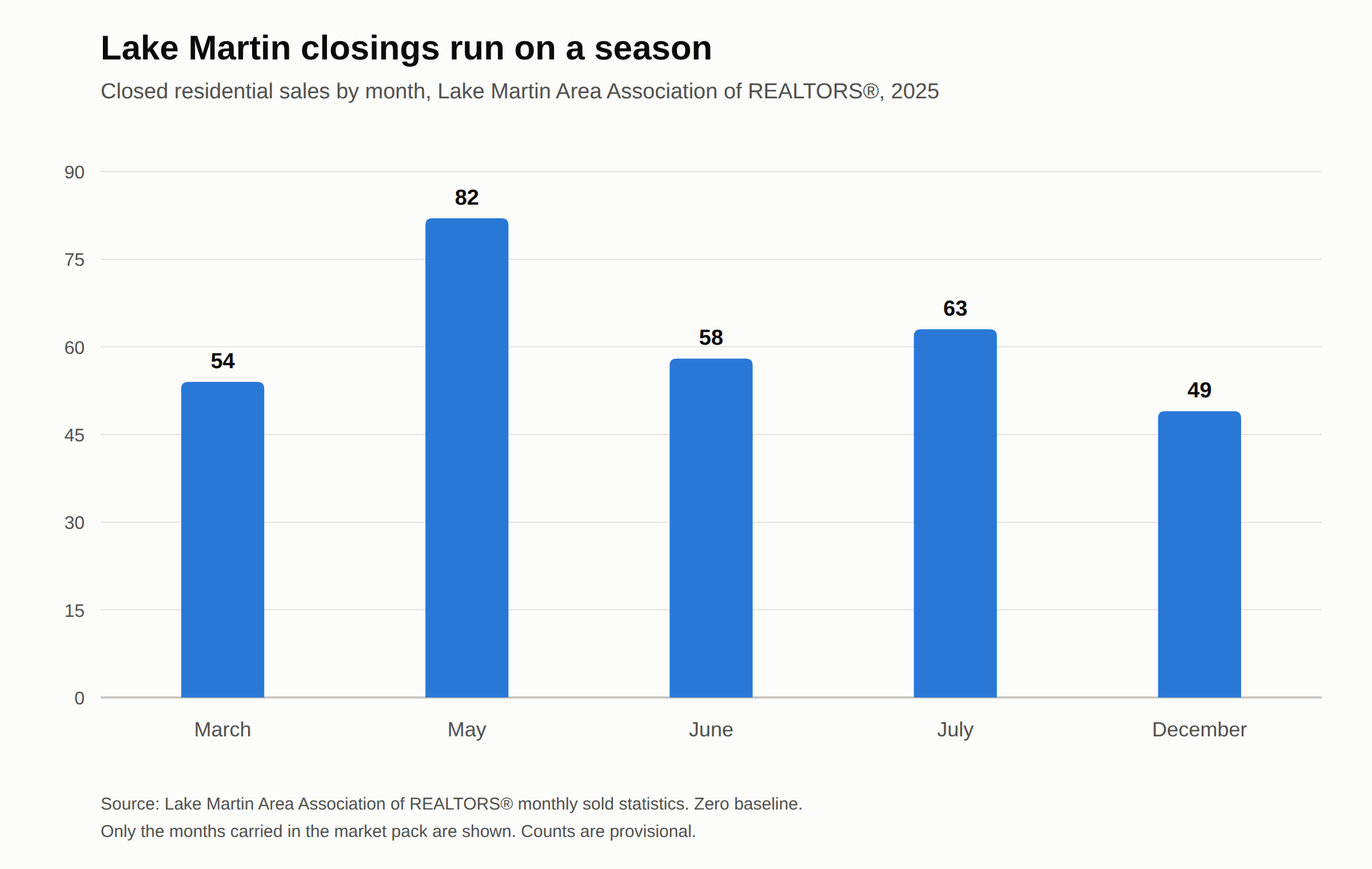
Chart 1. Closed residential sales by month, Lake Martin Area Association of REALTORS®, selected months of 2025. Source: Lake Martin Area Association of REALTORS®. Zero baseline; only the months carried in my market pack are shown.
Read that curve as a working calendar, not a promise. Buyers who want a full-pool summer on the water are shopping in late winter and early spring and closing in May, June, and July. A seller who starts thinking about dock paperwork in April is already behind the people who will be competing with them.
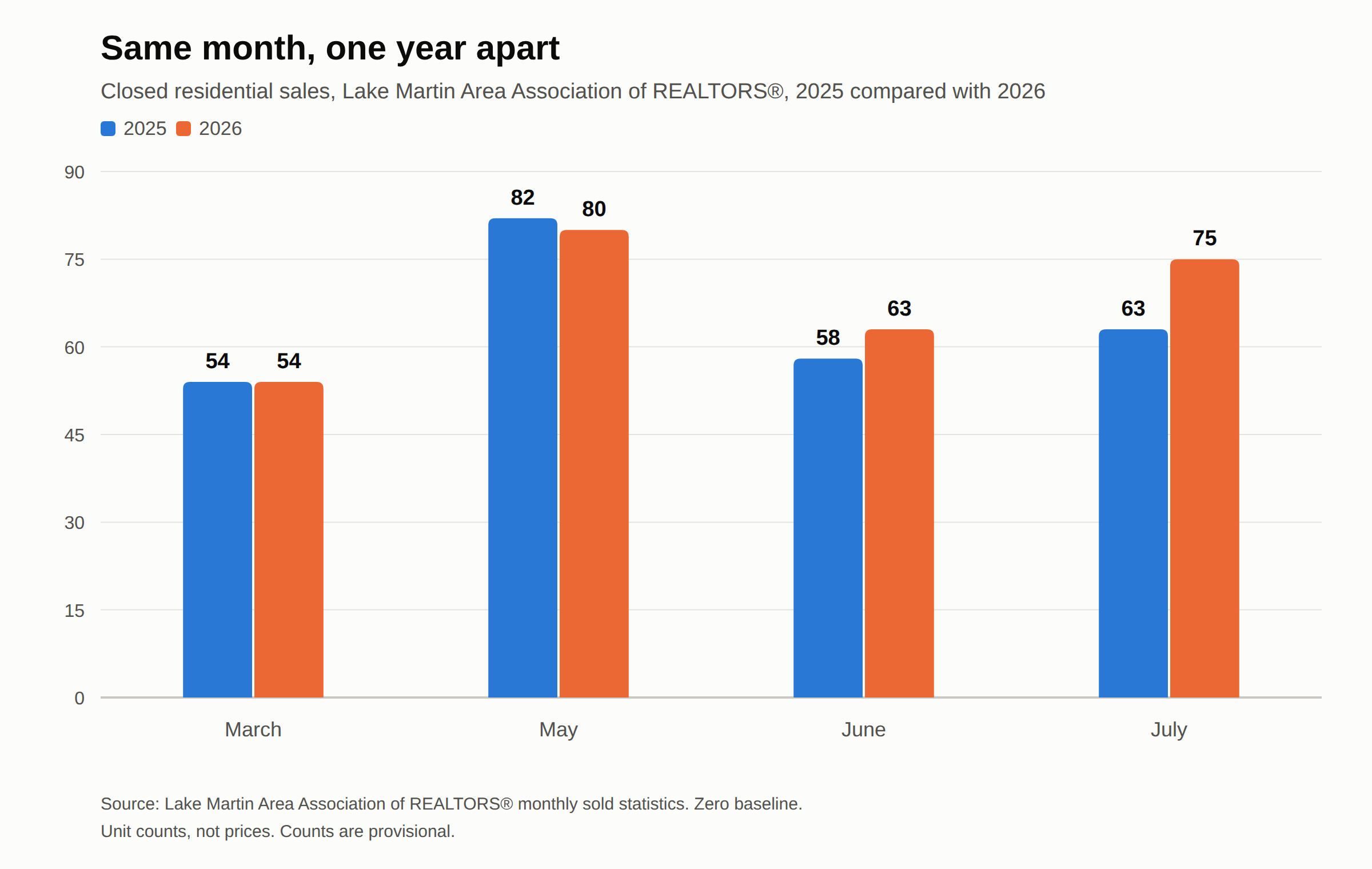
Chart 2. Closed residential sales, same month year over year, Lake Martin Area Association of REALTORS®, 2025 compared with 2026. Source: Lake Martin Area Association of REALTORS®. Zero baseline; unit counts, not prices.
Two boundary notes, because they change what these numbers mean for your house. First, the association footprint is wider than the lake itself, so those totals are not a waterfront-only count. The pack does break waterfront out: of the 75 residential closings in July 2026, 36 were waterfront and 39 were not. Second, the pack reports an average sale price rather than a median, and on 36 waterfront closings in a month an average moves on one or two big sales, so I'm not going to hand you a waterfront median or a premium percentage I can't source. July 2026 is the most recent month in it, and counts are provisional, since sales get added after the fact.
Figures are closed residential data for the Lake Martin Area Association of REALTORS® as of July 2026, from that association's monthly sold statistics. Counts are provisional, since sales get added after the fact. Market conditions change and past figures are not a prediction.
Pricing a thin market takes more than a home value estimate
When a whole month produces 36 waterfront closings across the association, an algorithm has very little to work with. One unusual sale in your cove moves the picture, and the things that actually separate two lake houses are things a model can't see from a tax record.
Online home value estimates are a starting point only and are not a formal comparative market analysis or appraisal. I wrote more about what those estimates actually measure.
Here's what I'm looking at when I price waterfront:
- Linear feet of shoreline frontage. The guidelines set a minimum frontage below which a lot may face limits on what can be built, or may not qualify for a shoreline structure at all. On a small-frontage lot, dock capacity is a pricing fact, not a detail.
- Water depth at the dock, at winter pool. Not at full pool. Buyers with bigger boats ask this question in that exact form.
- Slough geometry. A lot inside a narrow slough has limits on how far a structure may reach across it, and the guidelines allow that a narrow-slough lot may not qualify for a permit.
- The control strip. Alabama Power holds a control strip above the full pool contour. Owning to the water line is not the same as controlling to the water line, and the lake's Martin Datum and mean sea level are two different references, so read your survey carefully instead of eyeballing it.
- Sensitive Resource Area designation. Where it applies, construction and disturbance wait on Alabama Power's written authorization.
- The condition of what's already built. A permitted, tagged, compliant dock with a sound seawall prices differently than the same house with an open compliance question. That gap is usually larger than the cost of fixing it.
Fences aren't allowed at the shoreline, and dredging needs Alabama Power's prior approval case by case, with an approved spoil site named in the application. If someone has told you a quick dredge will fix a shallow slip before closing, treat that as a project with a permit, not a weekend.
Disclosure in a caveat emptor state
Alabama follows caveat emptor for used residential property, so there's no state-mandated seller disclosure form to fill out, and no state-law flood-risk disclosure requirement. New construction is treated differently. That doctrine, and the way Alabama courts have handled "as is" language, is summarized well by Alabama attorney G.K. Middleton, including Kidd v. Benson (Ala. 2020) on "as is" clauses and seller liability.
Here's the practical part. Caveat emptor has exceptions, and the two that reach lake sellers most often are a material defect affecting health or safety that a buyer wouldn't readily observe, and a buyer asking you directly about a condition. Both of those exceptions turn on the buyer having inspected the property, and a direct question creates a duty to answer truthfully. On waterfront, buyers ask about the dock permit, past flooding, seawall condition, and septic, essentially every time.
So the caveat emptor label is cold comfort. If you know the boathouse was enclosed without a permit, or the seawall moved after a wet spring, or the septic field is at the low end of the lot, you're going to get asked. Answering early is cheaper than answering in a post-closing dispute, and in my experience it also keeps a deal together, because a buyer who learns something from you does not go looking for what else you didn't say. I'm not an attorney and this isn't legal advice. Loop in a real estate attorney on anything that feels like a gray area.
Two federal items that catch older lake cottages
Plenty of houses on this lake have been in a family for generations. If yours was built before 1978, the federal lead disclosure rule applies to most pre-1978 housing and gives the buyer a 10-day period to conduct a lead-based paint inspection or risk assessment (United States; EPA, Real Estate Disclosures about Potential Lead Hazards, 2026). That is a real block of days on your contract calendar, and it's easier to plan for than to react to.
Then there's the tax question that surprises second-home sellers. The federal main-home gain exclusion lets qualifying sellers exclude up to $250,000 of gain, or up to $500,000 on a joint return, and the ownership test requires having owned the home at least 24 months out of the five years before the sale (United States; IRS, Sale of your home, 2026). There's also a use test, and a look-back that bars claiming the exclusion again too soon after a prior one.
A Lake Martin house that's been a weekend place or a rental often fails the use test. If you've been assuming that exclusion is waiting for you, find out before you list, not after you sign. I'm not a CPA and this isn't tax or legal advice. Ask yours, early, because the answer can change whether this is the right year to sell.
The pre-listing sequence I'd run
Timing | What to handle | Why it matters |
|---|---|---|
The winter before you list | Pull your shoreline permit file from Alabama Power. Walk the dock and seawall. Book repairs while the water is down. | Low water is when shoreline work is practical, and permit questions take longer to answer than repairs take to make. |
Before photos | Finish shoreline repairs, confirm the permit tag is on the structure, clean the dock and the shoreline. | Buyers compare your photos to every other lake listing. Full pool and a compliant dock is the version you want in that comparison. |
At listing | Put the permit file, the survey, seawall history, and septic records in one folder. | Waterfront buyers ask about all four. Answers in hand keep a question from becoming a delay. |
Under contract | Start Alabama Power's notice and consent steps for the permit. Deliver the federal lead disclosure if the house is pre-1978. | Consent to a permit transfer is not automatic, and the lead rule carries a buyer inspection window. |
Thinking about selling on Lake Martin?
The lake rewards sellers who do the boring work first. Permit file, dock condition, survey, water level, timing. Get those settled and the marketing part is genuinely fun, because a well-prepared waterfront listing at full pool sells itself better than any adjective I could write.
If you're weighing a Lake Martin sale, reach out and let's walk your shoreline before you spend a dollar on the kitchen. Call or text (334) 332-4002, or start at amycotney.com. I'd love to help.
This guide was written by Amy Cotney, REALTOR®, with Roots Real Estate - Investment Development in Auburn, Alabama.
Sources
- Alabama Power Shorelines, Lake Martin lake and dam facts: full pool elevation, shoreline miles, surface acres, and dam in-service date (Lake Martin, Alabama; 2026).
- Alabama Power, on the extended winter drawdown at Lake Martin (published July 2021): the additional drawdown depth and the resulting elevation (Lake Martin, Alabama; six-year drawdown cycle).
- Alabama Power, general guidelines for residential shoreline permitting on Lakes Martin, Yates and Thurlow (revised December 2020): permit transferability, structure standards, flotation, seawalls, frontage and slough eligibility, and fees. Confirm current terms with the Shoreline Management office at 256-825-0053.
- EPA, Real Estate Disclosures about Potential Lead Hazards: pre-1978 coverage and the buyer's inspection window (United States; 2026).
- IRS, Sale of your home: the main-home gain exclusion amounts and the ownership test (United States; 2026).
- G.K. Middleton Law, on caveat emptor in Alabama: the doctrine, its exceptions, and Kidd v. Benson (Ala. 2020).
- Lake Martin Area Association of REALTORS® monthly sold statistics, residential and residential-waterfront closed counts, from my market pack. Periods as cited inline.
Amy Cotney, REALTOR®, is a licensed real estate salesperson (Alabama license #108235) with Roots Real Estate - Investment Development, 235 N Gay St, Auburn, AL 36830. Call or text (334) 332-4002 or email [email protected]. Equal Housing Opportunity.