Updated August 2026
Historic downtown Opelika is the commercial core along Railroad Avenue and the blocks around it. On the National Register of Historic Places it is listed as the Railroad Avenue Historic District, added August 30, 1984, and recorded as "Roughly bounded by 7th and 10th Sts., 1st Ave. and Ave. B" (National Park Service, National Register of Historic Places, reference number 84000640). That listing is the answer to what most people are really asking when they ask whether downtown is historic. The more useful question, if you're thinking about buying here, is who gets a say in what you change. I'll get to that.
The Bottom Line
- Downtown's National Register listing is the Railroad Avenue Historic District, added August 30, 1984, roughly bounded by 7th and 10th Sts., 1st Ave. and Ave. B (National Park Service, National Register of Historic Places, reference number 84000640).
- Opelika has nine National Register listings in all, with listing dates running from 1973 to 2014 (National Park Service, National Register of Historic Places database).
- The City of Opelika runs a Historic Preservation Commission that issues Certificates of Appropriateness, and reports over 756 properties on the National Register and 535 under Design Guidelines (City of Opelika, Historic Preservation, page carries no as-of date).
- Opelika citywide, July 2026: 94 sold, median sold price $336,487, 62 average days on market (Lee County Association of REALTORS® monthly housing statistics, OPELIKA column, July 2026). There is no downtown-only figure in that data set.
What the historic designation actually covers
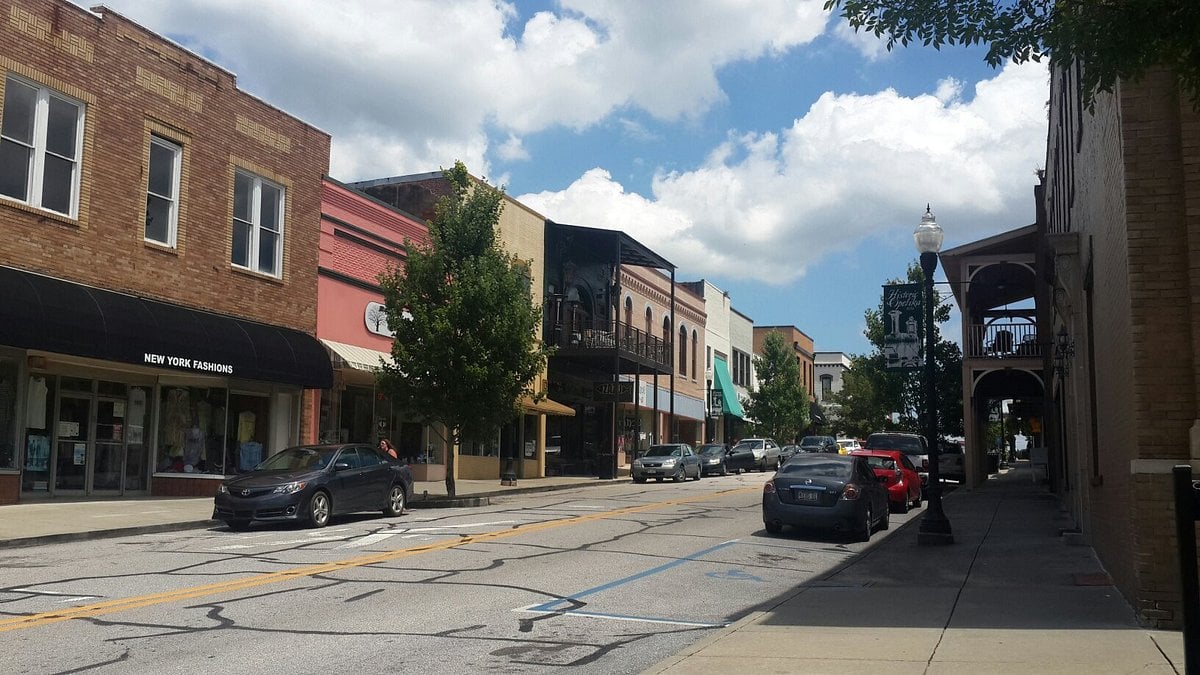
The National Register listing for downtown is filed under the railroad, not under the word "downtown." Its recorded name is the Railroad Avenue Historic District, and the boundary on file reads "Roughly bounded by 7th and 10th Sts., 1st Ave. and Ave. B" (National Park Service, National Register of Historic Places, reference number 84000640). If you're standing on the brick sidewalk looking at the storefronts across from the tracks, you're inside it.
Here's the distinction that matters when you own something inside those blocks. Federal listing on the National Register and local design review by the city are two separate systems. They are administered by different bodies, and one does not automatically trigger the other. Which one applies to a specific address is a question to ask before you make plans, not after.
The railroad came first
Opelika Main Street, the local downtown organization, dates the turning point to 1848, when the Montgomery & West Point Railroad Company extended a rail line from Montgomery to Opelika. The town incorporated on February 9, 1854. Opelika Main Street describes that line as the only direct rail route connecting New Orleans to the Eastern Seaboard.
Industry followed the tracks. In 1900, local investors founded the Opelika Cotton Mill as the first textile plant in the city, employing 125 people. By the early 1970s, Opelika's industries employed nearly 10,000 workers (Opelika Main Street, History of Downtown Opelika).
That sequence is why the oldest building stock downtown is commercial and close-set rather than suburban. You're buying into a street grid that was laid out around freight, not around parking.
Nine listings, and where downtown sits among them
Downtown isn't Opelika's only historic district, and knowing the others helps if you're comparing addresses. My rundown of the best neighborhoods in Opelika walks the city as a whole. The city and its immediate surroundings hold nine National Register listings.
- Dr. J.W. Darden House, listed August 12, 2009 (ref. 09000605)
- Geneva Street Historic District, listed September 15, 1987 (ref. 87000981)
- Lee County Courthouse, listed July 23, 1973 (ref. 73000353)
- Northside Historic District, listed December 31, 2001 (ref. 01001409)
- Pepperell Mill and Mill Village Historic District, listed March 31, 2014 (ref. 14000090)
- Railroad Avenue Historic District, listed August 30, 1984 (ref. 84000640)
- Spring Villa, listed January 3, 1978 (ref. 78000494)
- Summers Plantation, listed February 21, 1991 (ref. 91000095)
- U.S. Post Office, listed November 18, 1976 (ref. 76000339)
Source: National Park Service, National Register of Historic Places database. Each listing's recorded date and location sit on its own record; ask me for the one on any address you're weighing.
Those nine didn't arrive together. They came in across more than four decades, from 1973 to 2014, and downtown's Railroad Avenue district, added August 30, 1984, was the fourth to be listed.
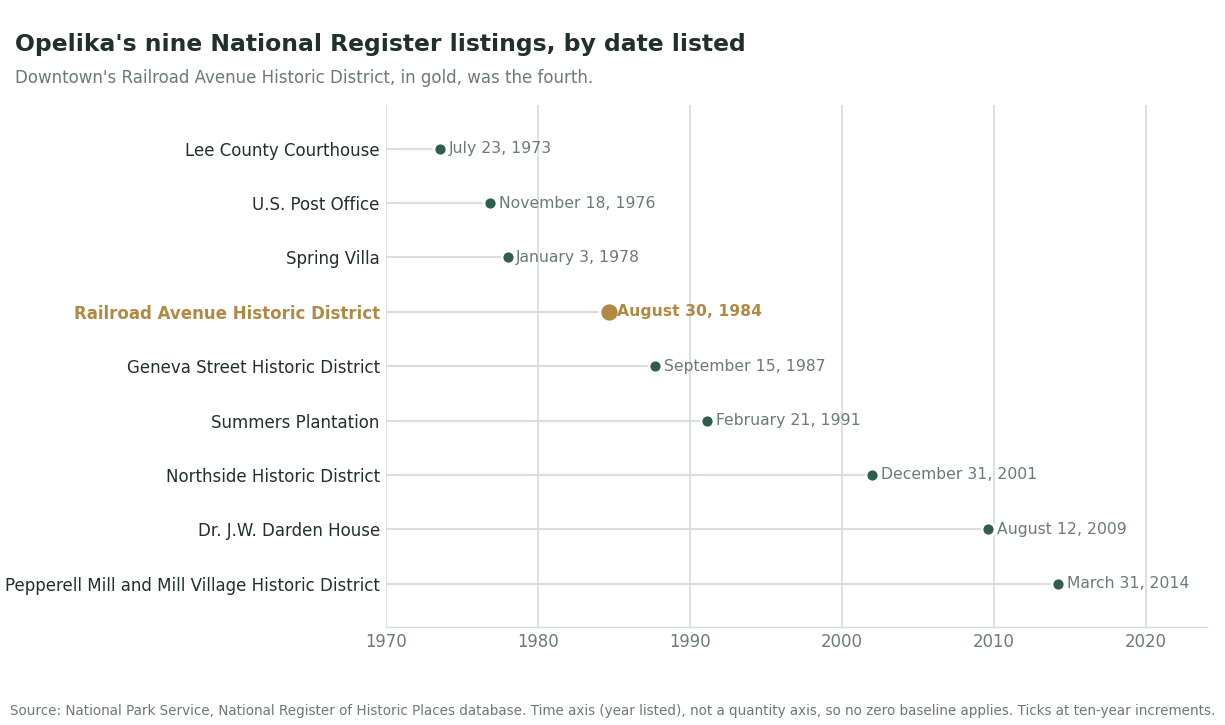
Chart 1. Opelika, Alabama: the nine properties and districts listed on the National Register of Historic Places, plotted by date listed, 1973 to 2014. Source: National Park Service, National Register of Historic Places database. Time axis (year listed), not a quantity axis, so no zero baseline applies. Ticks at ten-year increments.
The question buyers ask last and should ask first
Opelika has a Historic Preservation Commission. In the city's own words, it "was established to provide for the issuance of certificates of appropriateness and to support the historical, cultural, and aesthetic heritage of the City of Opelika" (City of Opelika, Historic Preservation).
A Certificate of Appropriateness, usually shortened to COA, is the city's sign-off on exterior work in a regulated district. Windows, siding, storefront glass, signage, porches, roofing material. If that sounds like a lot of the work you'd want to do on a hundred-year-old building, that's exactly the point of raising it now instead of after closing.
The scale is real. The City of Opelika reports over 756 properties on the National Register and 535 under Design Guidelines. That page doesn't carry an as-of date, and it doesn't name which districts sit under the Design Guidelines versus which are National Register listings only. That gap is the one thing I'd want closed before I advised anyone on a specific address, so call Opelika's Community Development office and ask about the parcel by address.
Local rules change. Confirm current requirements with the City of Opelika before relying on anything here. This is not legal advice.
What's new downtown in 2026
The most recent thing to happen downtown is worth knowing if you're weighing a commercial space or a live-work idea. Opelika Main Street opened Phase 2 of its Downtown Resource Center at 108 S. 8th Street in downtown Opelika, funded by a Main Street Alabama Project Grant, with an open house on March 26, 2026 (The Observer, April 7, 2026). It launched alongside a Historic Downtown Opelika Development Guide, a Downtown Opelika New Business Starter Kit, and a brochure map of downtown.
Kelsey Sullivan, Executive Director of Opelika Main Street, put the goal plainly: "Our goal has always been to make Downtown Opelika the best place to start and grow a business" (The Observer, April 7, 2026).
For a buyer, the practical value is that a development guide and a starter kit exist at all, in one building, with a street address. That's a shorter path to answers than piecing it together from a phone tree.
What the numbers say about buying in Opelika right now
The Lee County Association of REALTORS® reports Opelika figures citywide, not by downtown boundary, so read what follows as a city reading rather than a Railroad Avenue reading. For Opelika in July 2026: 285 homes on the market, 109 new listings, and 94 sold, with 62 average days on market and a median sold price of $336,487 (Lee County Association of REALTORS® monthly housing statistics, OPELIKA column, July 2026).
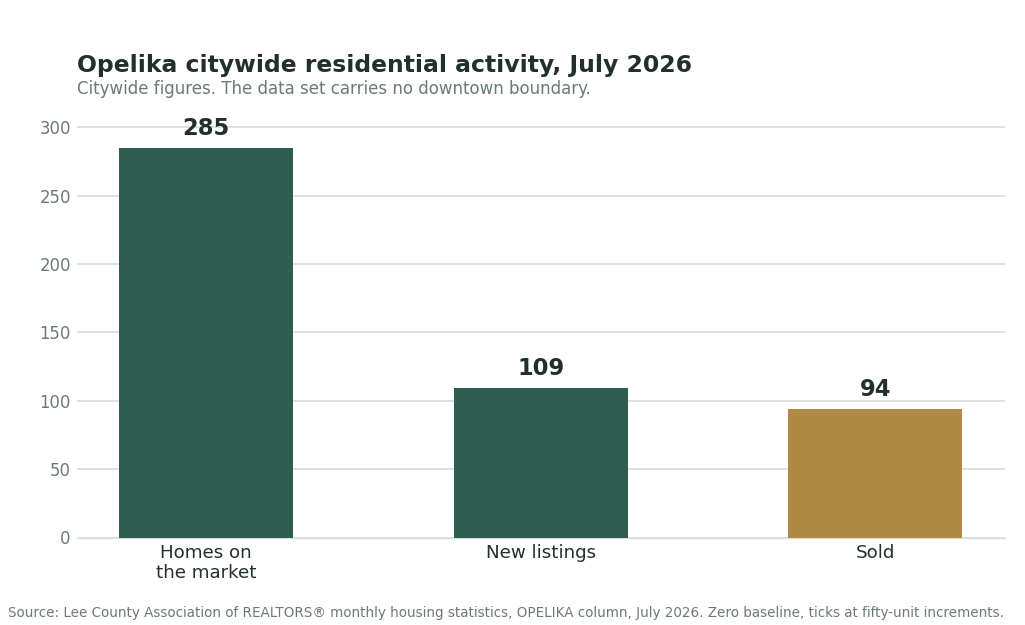
Chart 2. Opelika, Alabama, citywide residential activity, July 2026: 285 on the market, 109 new listings, 94 sold. Source: Lee County Association of REALTORS® monthly housing statistics, OPELIKA column, July 2026. Zero baseline, ticks at fifty-unit increments. Citywide figures; the data set carries no downtown boundary.
Divide the 285 active listings by the 94 monthly sales and you get roughly 3.0 months of supply for Opelika citywide in July 2026. The association publishes the two inputs in the same OPELIKA column for July 2026; the months-of-supply figure is my arithmetic on a single month of sales, not a reported statistic.
One more calibration point, and this one comes from the closed-sale records rather than the monthly report. For single family and attached homes in Opelika, January 1 through August 11 2026, the median price per square foot was $182.19 across 461 sales (analysis of Lee County MLS closed-sale records, single family and attached, Opelika, January 1 through August 11 2026, n=461). That is a partial year, not a full one. Treat it as a reference for the city, not as a downtown number, because square-foot pricing on older buildings turns on condition and construction in ways a citywide median can't capture.
Figures are listing and closed data for Opelika, Alabama (citywide) for July 2026, from Lee County Association of REALTORS® monthly housing statistics, OPELIKA column, and closed-sale data for Opelika, Alabama (citywide) for January 1 through August 11 2026, from an analysis of Lee County MLS closed-sale records. Market conditions change and past figures are not a prediction.
Buying or selling in historic downtown Opelika
If you're looking at a building or a house inside the Railroad Avenue Historic District, the homework runs differently than it does on a subdivision purchase. You want the address checked against the city's design review, you want to know what exterior work the seller already did and whether it was approved, and you want a comp set that accounts for age and construction instead of a citywide median. That's the legwork I do before you write an offer.
If downtown isn't the fit, the trade-offs run differently a few miles west. I broke that one down in my National Village neighborhood profile, and you can browse the whole city on my Opelika neighborhood page.
I'm Amy Cotney, REALTOR®, with Roots Real Estate - Investment Development, and Opelika sits right in the middle of my service area. If you're thinking about buying or selling downtown, reach out. I'd love to help.
Amy Cotney, REALTOR®, is a licensed real estate salesperson (Alabama license #108235) with Roots Real Estate - Investment Development, 235 N Gay St, Auburn, AL 36830. Call or text (334) 332-4002 or email [email protected]. Equal Housing Opportunity.
Sources
- National Park Service, National Register of Historic Places database. Individual records cited by reference number, including Railroad Avenue Historic District, 84000640
- City of Opelika, Historic Preservation
- Opelika Main Street, History of Downtown Opelika
- The Observer, "Opelika Main Street unveils Phase 2 of Downtown Resource Center, funded by Main Street Alabama grant," April 7, 2026
- Lee County Association of REALTORS® monthly housing statistics, OPELIKA column, July 2026
- Analysis of Lee County MLS closed-sale records, single family and attached, Opelika, January 1 through August 11 2026, n=461