Updated October 2026
Sometimes yes, and sometimes absolutely not. A low mortgage rate is worth a lot, but it's one line in a bigger math problem. The real question is whether your next house fixes something your current house can't, at a total monthly cost and a cash outlay you can live with, even if rates never come back down.
I have this conversation at kitchen tables all over Auburn and Opelika. Here's how I walk people through it.
The Bottom Line
- Your low rate only applies to the balance you still owe. Compare full monthly payments and cash to close, not rates.
- Freddie Mac's Primary Mortgage Market Survey put the national 30-year fixed average at 7.28% as of October 1, 2026. That's a benchmark, not your quote.
- Equity is the other half of the decision. Your sale proceeds, minus your payoff and selling costs, shape the new loan.
- Waiting for rates to fall is a bet, not a plan. Move only if the new payment works at today's rate.
- Keeping the low-rate house as a rental changes its Alabama property tax treatment, so run those numbers before you decide.
What you're actually giving up
Start with your own mortgage statement, not a headline. You need four things from it: your interest rate, your unpaid principal balance, your remaining term, and your monthly payment, including whatever escrow covers for taxes and insurance.
That low rate is precious, but it's attached to a shrinking balance. If you've paid down your loan for years, the rate is doing less heavy lifting than it did on day one. A new loan starts its selected repayment term, so compare that term with the time remaining on your current loan.
Then write down, in plain words, why you want to move. More bedrooms? Less yard? Closer to family, or a new job? A move to the lake full time? The answer tells you how much that rate is worth giving up. If the reason is "the house no longer works for our life," that carries weight. If it's "I'm a little bored with the backsplash," a new backsplash is cheaper than a new mortgage. (I say that with love. I'm a Certified Interior Decorator. I've been there.)
What today's rates look like
Freddie Mac's Primary Mortgage Market Survey reported the 30-year fixed-rate mortgage averaged 7.28% as of October 1, 2026, up from 7.03% the week before. The 15-year averaged 6.60%. A year earlier, the 30-year averaged 6.34%.
Keep two things in mind. First, this is a national weekly average built from conventional, conforming loan applications. It is not an APR and not the rate a lender will offer you. Your credit, down payment, loan type, and points all move your number. Second, the only quote that counts is a dated Loan Estimate for your actual purchase scenario. Get one, ideally two, before you list.
Run the payment math, not the rate math
People compare rates. Lenders approve payments. Ask your lender to run principal and interest on the actual loan amount at your quoted rate, then set it next to your current principal and interest. Remember the new loan amount may be bigger or smaller than your current balance, depending on the price and how much equity you bring. Then add the parts that don't care what your rate is: property taxes, homeowners insurance, any mortgage insurance, and HOA dues if the new neighborhood has them.
Fill in this stay-versus-move worksheet with your mortgage statement, lender quote, address-specific tax and insurance estimates, and your own maintenance budget. Use monthly amounts for every cost row, dividing annual bills by 12. Enter zero for costs that do not apply, and do not count escrowed taxes or insurance twice.
Input | Stay | Move |
|---|---|---|
Loan amount (current balance / proposed loan) | $_____ | $_____ |
Interest rate | _____% | _____% |
Term (remaining / selected repayment term) | _____ years | _____ years |
Monthly principal and interest | $_____ | $_____ |
Monthly property taxes | $_____ | $_____ |
Monthly homeowners insurance | $_____ | $_____ |
Monthly mortgage insurance | $_____ | $_____ |
Monthly HOA dues | $_____ | $_____ |
Monthly maintenance reserve | $_____ | $_____ |
Total monthly cost (sum of the six monthly cost rows) | $_____ | $_____ |
Monthly difference (move total minus stay total) | — | $_____ |
Alabama property taxes on the new house
Alabama taxes homes on assessed value, not market value. The Alabama Department of Revenue assesses single-family owner-occupied residential property (Class III) at 10% of appraised value. Your actual bill then depends on local millage, so ask for the tax figure on the specific address you're considering.
The regular homestead exemption is worth claiming on your new primary home. Per the Alabama Department of Revenue, it's $4,000 of assessed value for state tax and $2,000 for county tax. You have to own the single-family home and occupy it as your primary residence on the first day of the tax year, and you apply at the county office. My advice: put it on your moving-week checklist so it doesn't slide.
Equity is the other half of the decision
Here's what often surprises people. The same years that gave you a low rate may also have built real equity. That equity can become a bigger down payment, which means a smaller new loan at the higher rate. Using it isn't free (that money stops working where it is), but it can shrink the payment gap a lot.
Two things to pin down before you count your equity:
- Your real net proceeds. That's your sale price minus your mortgage payoff and your selling costs. Not the online estimate, and not what a neighbor got. I put together a pricing analysis for your specific house, and your lender gives you a payoff statement.
- Taxes on the gain. Under IRS Publication 523, you may be able to exclude up to $250,000 of gain from a home sale, or up to $500,000 if you're married filing jointly. You generally need to have owned and lived in the home for at least 24 months out of the five years before the sale. Selling expenses reduce the amount realized, which reduces the gain. A tax professional should look at your situation.
Keep the upfront cash separate from the monthly worksheet. Fill in these amounts from your sale-proceeds estimate, lender's Loan Estimate, moving quotes, and savings balance. Purchase costs/prepaids exclude the down payment; count any deposits already paid only once.
Cash item | Your amount |
|---|---|
Net sale proceeds (sale price minus payoff and selling costs) | $_____ |
Savings available before the move | $_____ |
Down payment | $_____ |
Purchase closing costs and prepaids | $_____ |
Cash to close (down payment plus purchase costs/prepaids, less deposits already paid) | $_____ |
Moving costs | $_____ |
Total move outlay (down payment plus purchase costs/prepaids plus moving costs) | $_____ |
Savings remaining (available savings plus net sale proceeds minus total move outlay) | $_____ |
Timing matters too. If you need the sale money to buy, you're in the classic sell-first or buy-first puzzle. I wrote a whole guide on whether to sell before you buy, and it pairs well with this one.
Waiting for rates to drop is a bet
A lot of homeowners tell me they'll move "when rates come down." I understand the feeling. But look at this year alone. According to the Freddie Mac PMMS 2026 archive, the 30-year average was 6.16% on January 8 and was 6.00% on March 5. By October 1, it was 7.28%.
None of that predicts where rates go next. It shows they can move a lot in a few months, in either direction.
My read: buy a house only if the payment works at the rate you actually lock. If rates fall later and a refinance makes sense, great. That's a bonus, and it comes with its own closing costs and qualification. A plan that only works with a future refinance isn't a plan yet.
Could you keep the low-rate house as a rental?
This is the "have it both ways" option, and for some people it's a smart one. You keep the cheap loan, and a tenant helps pay it. Before you fall in love with the idea, check these:
- Property taxes. Once it isn't your owner-occupied home, it no longer fits Class III. The Alabama Department of Revenue assesses all property not otherwise classified (Class II) at 20%, double the 10% residential rate. The homestead exemption also requires that you live there.
- Depreciation and basis. IRS Publication 527 depreciates residential rental buildings over 27.5 years. For a home you convert, the basis for depreciation is the lesser of your adjusted basis or the fair market value when you change it to rental use. Land is not depreciable; separate its value from the depreciable building. Have a tax professional confirm the allocation and depreciation basis for your situation.
- Your loan and insurance. Read your mortgage's occupancy terms and call your insurance agent. A landlord policy is a different product than a homeowner's policy.
- Operating costs and reserves. Use your own rent estimate and quotes to budget for vacancy, repairs, major replacements, and property management, alongside the mortgage, taxes, insurance, and any HOA dues. Set aside cash reserves so a vacant month or repair does not depend on the next rent check.
- Rental restrictions. Check current HOA documents and applicable local rental requirements for lease-length limits, rental caps, approval requirements, and owner-occupancy restrictions before counting on rental income.
- Your own appetite. Being a landlord is a job. Some people love it. Some people sell after the first midnight water heater call.
If you're weighing this around Auburn, my post on the best areas for rental property near Auburn covers where rental demand tends to show up.
Could an assumable mortgage help?
Some loans can be assumed, which means a buyer takes over the seller's existing rate and balance. That's appealing in both directions: you might buy a home with someone else's lower rate, or market yours with your rate attached. It needs servicer approval, and the buyer has to cover the gap between the price and the assumed balance in cash or with other financing.
VA loans are a common example. The U.S. Department of Veterans Affairs lists a 0.5% funding fee for loan assumptions, compared with 2.15% for a first-use purchase with less than 5% down. Ask your lender which loan types qualify and what the release-of-liability steps look like before you build a plan around one.
If your move involves Lake Martin
Lake moves come up a lot in my conversations: Auburn homeowners heading to the lake full time, or lake owners coming back toward town. The Lake Martin Area Association of REALTORS® publishes association-wide monthly figures for the lake market, and the most recent July report gives a useful same-month comparison.
The association counted 75 residential sales in July 2026, compared with 63 in July 2025. Waterfront sales held steady at 36, while not-waterfront sales rose from 27 to 39.
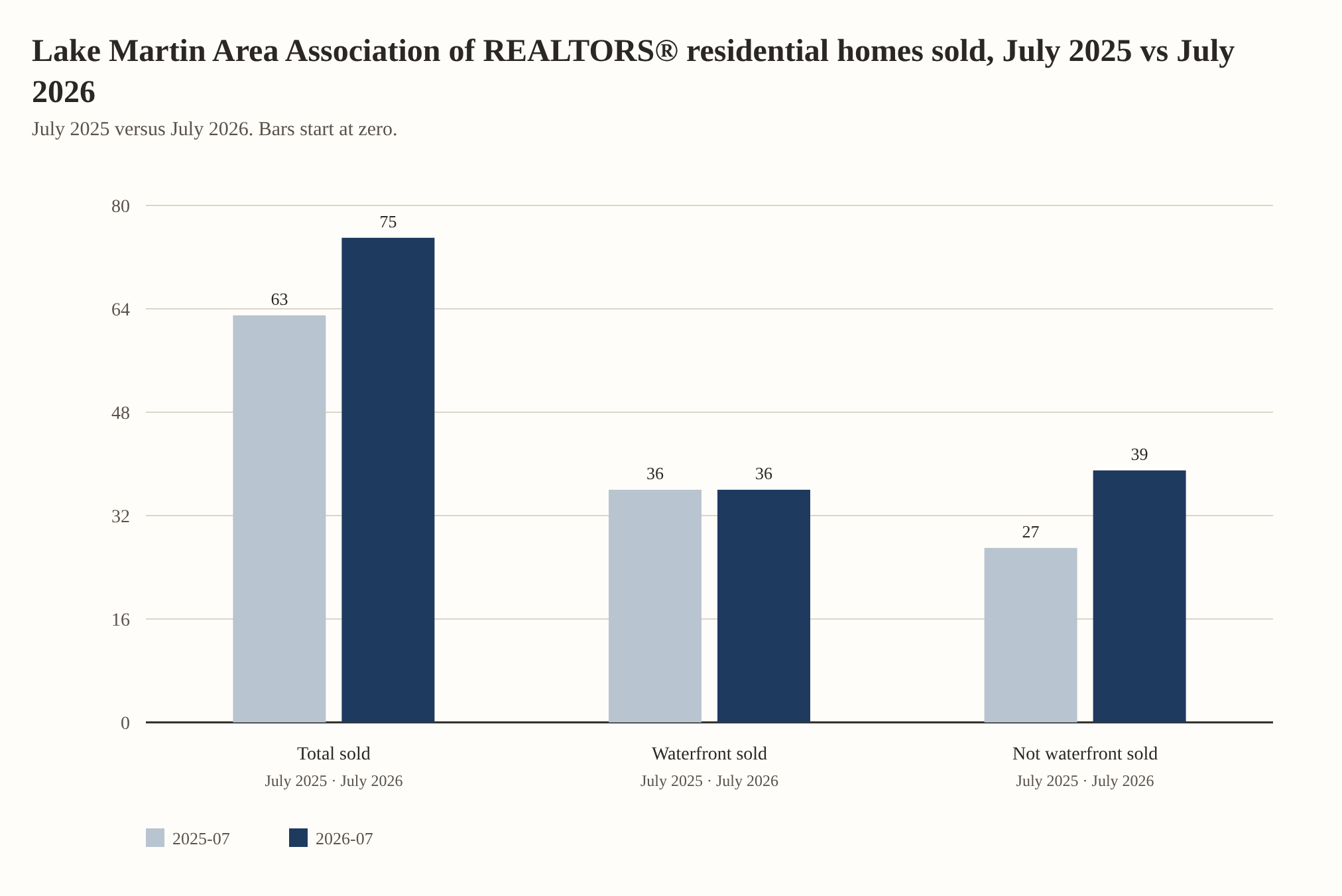
Chart 1. Lake Martin Area Association of REALTORS® residential homes sold, July 2025 vs July 2026. Source: Lake Martin Area Association of REALTORS®, July 2025; Lake Martin Area Association of REALTORS®, July 2026.
The chart compares sales counts, not the causes of price changes. The association's residential average sale price was $613,514 in July 2026, down from $967,054 in July 2025. A larger share of lower-priced not-waterfront sales can affect the overall average, but subgroup averages also fell. Waterfront averages were $1,462,465 in July 2025 and $983,549 in July 2026. Not-waterfront averages were $306,506 and $271,944. These monthly averages do not establish like-for-like appreciation or depreciation. They are averages, not medians, and not a value for your home.
Inventory was 500 residential listings in the association's July 2026 report, against 473 a year earlier. Average days on market was 123 in July 2026. These figures describe the lake market only, not Auburn or Opelika, and they're a July snapshot, so ask me for the latest month.
If you're thinking about the lake as your next chapter, start with my guide to moving to Lake Martin full time. If you're on the selling side, here's how I approach selling waterfront property on Lake Martin.
When giving up the rate makes sense
This part is my opinion, from a lot of these decisions. Giving up a low rate tends to make sense when:
- The house no longer fits your life, and a renovation can't fix it.
- The full new payment works at today's quoted rate, with room left for life.
- Your equity and net proceeds cover the down payment and closing costs without emptying your savings.
- You expect to stay in the new home long enough to make the move worth its costs.
Staying put tends to make sense when the reason to move is fuzzy, the payment jump would squeeze you, or a smaller fix (a renovation, a new office setup, a better commute plan) solves the same problem. If you're still sorting out the selling side, my Auburn home seller FAQ answers the questions I hear most.
There's no shame in either answer. The right one is the one that matches your numbers and your next chapter.
Let's run your numbers together
I'm Amy Cotney, REALTOR®, with Roots Real Estate - Investment Development in Auburn. When you're weighing a move like this, I'll pull a pricing analysis on your current home, connect you with a licensed lender for a real quote, and help you compare stay and move side by side. You can learn more about me and how I work. I build strong relationships that lead to sold homes and happy buyers, through communication, not automation.
Online home value estimates are a starting point only and are not a formal comparative market analysis or appraisal.
Nothing here is legal, tax, or lending advice. Rates shown are national weekly averages and are not a quote, an offer of credit, or a prediction. For terms on your own situation, talk to a licensed lender.
Figures are closed and listing data for the Lake Martin Area Association of REALTORS® as of July 2026, from the Lake Martin Area Association of REALTORS®. Market conditions change and past figures are not a prediction.
Sources
- Freddie Mac, Primary Mortgage Market Survey, release of October 1, 2026: https://www.freddiemac.com/pmms
- Freddie Mac, Primary Mortgage Market Survey, 2026 weekly archive: https://www.freddiemac.com/pmms/archive?year=2026
- Alabama Department of Revenue, Property Tax Assessment: https://www.revenue.alabama.gov/property-tax/property-tax-assessment/
- Alabama Department of Revenue, Homestead Exemptions: https://www.revenue.alabama.gov/property-tax/homestead-exemptions/
- Internal Revenue Service, Publication 523 (2025), Selling Your Home: https://www.irs.gov/publications/p523
- Internal Revenue Service, Publication 527 (2025), Residential Rental Property: https://www.irs.gov/publications/p527
- U.S. Department of Veterans Affairs, VA funding fee and loan closing costs: https://www.va.gov/housing-assistance/home-loans/funding-fee-and-closing-costs/
- Lake Martin Area Association of REALTORS®, July 2026
- Lake Martin Area Association of REALTORS®, July 2025