Updated October 2026
Fix what an inspector will find, freshen what a buyer will see, and think hard before you start a big remodel. That's the short version. If your Auburn house has a water problem, a safety issue, or a system that's clearly failing, deal with it first. Then put your money into paint, cleaning, and simple staging. A brand-new kitchen right before you list is usually the first thing I'd question.
Here's how I'd sort the list, room by room and dollar by dollar.
The Bottom Line
- Fix first: leaks, moisture, mold, and anything that affects how the house functions. Cosmetic work over an unfixed problem just hides it until inspection.
- Freshen next: paint, deep cleaning, decluttering, and staging the main rooms. These are the projects agents recommend most often.
- Question the big remodel: national estimates put the highest cost recovery on small projects like front doors, not full kitchen or bath renovations.
- Know your options: repairing, offering a credit, adjusting the price, and selling as-is are all real choices. Each has trade-offs.
- Check the rules: permits, licensed contractors, and federal lead paint disclosure for older homes all come into play.
Auburn in July 2026: More Homes for Buyers to Compare
Before you decide how much to fix, look at what buyers are choosing from. Per the Lee County Association of REALTORS®, Auburn had 320 residential homes on the market in July 2025 and 442 in July 2026. New listings went from 117 to 147 over the same two Julys. Residential sales went the other way, from 136 to 114.
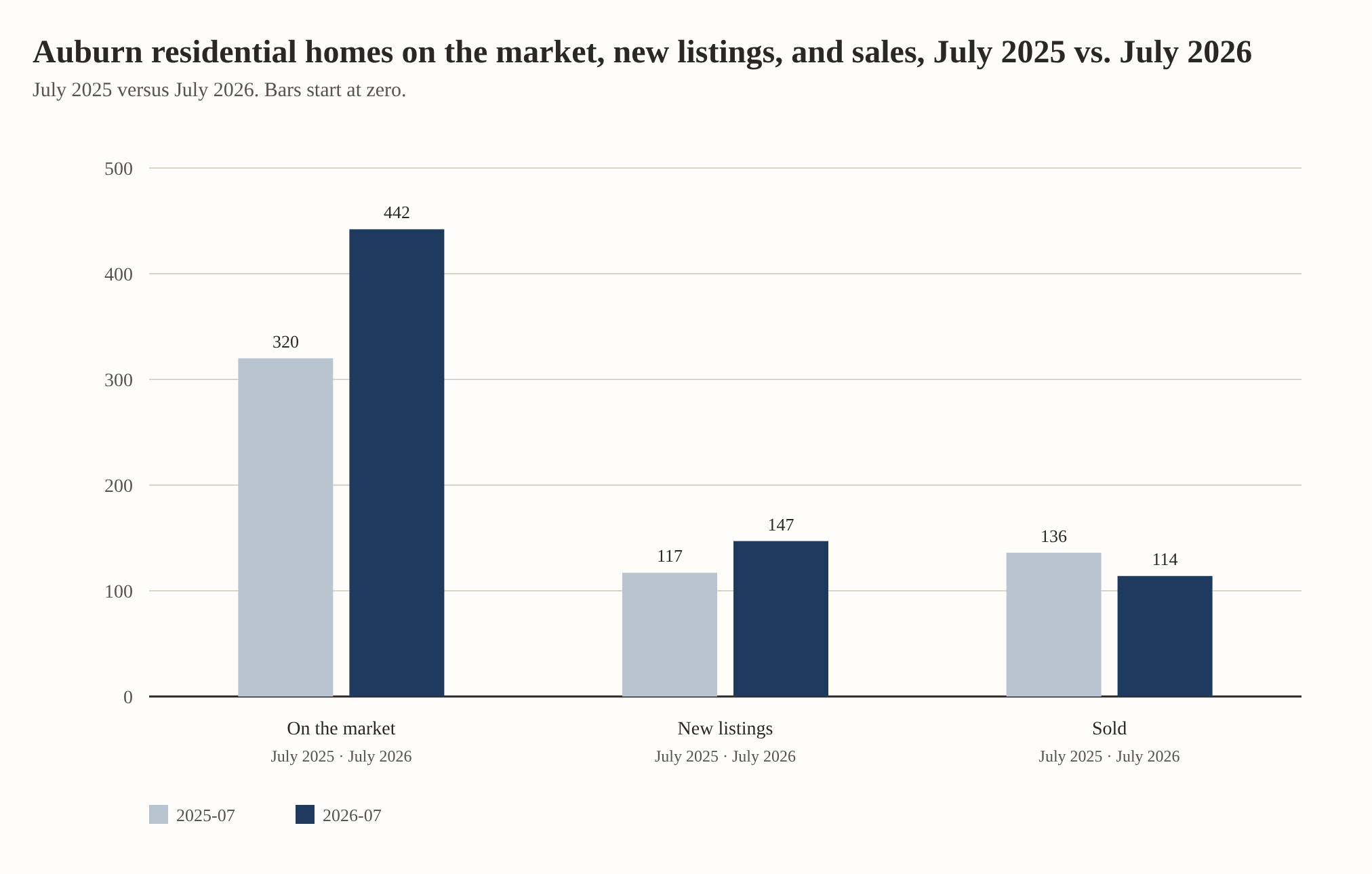
Chart 1. Auburn residential homes on the market, new listings, and sales, July 2025 vs. July 2026. Source: Lee County Association of REALTORS® monthly housing statistics, AUBURN column, July 2025; Lee County Association of REALTORS® monthly housing statistics, AUBURN column, July 2026.
Side by side, the bars show more homes on the market and more new listings in July 2026 than a year earlier, with fewer residential sales. The residential median sold price rose. The association reports a residential median sold price of $431,625 in July 2025 and $494,087 in July 2026.
Existing homes are the ones most sellers are prepping, so I watch that line closely. According to the Lee County Association of REALTORS®, existing-home sales in Auburn went from 80 in July 2025 to 68 in July 2026. Average days on market for existing homes barely moved, 46 days in July 2025 and 47 days in July 2026.
My read: more inventory means buyers can walk through your house and then three others the same afternoon. That raises the cost of obvious, unaddressed problems. These numbers don't show that any repair raises your price or shortens your time on market. They show the field you're competing in. And they're July figures, so treat them as a summer snapshot rather than a picture of this week. For how condition and competition feed into your list price, my guide on how to price your Auburn home walks through it.
Figures are listing and closed data for Auburn as of July 2026, from the Lee County Association of REALTORS® monthly housing statistics. Market conditions change and past figures are not a prediction.
Fix First: Water, Moisture, and Anything an Inspector Will Flag
The most expensive surprise in a sale is the one a buyer's inspector finds for you. Water is at the top of my list, because it rarely stays a small problem.
The U.S. Environmental Protection Agency says water-damaged areas and items should be dried within 24-48 hours to prevent mold growth. The EPA is also blunt about the order of operations: if you clean up mold but don't fix the water problem, the mold will most likely come back. So a fresh coat of paint over a ceiling stain isn't a repair. It's a delay. Find the leak, fix the cause, then make it pretty.
The same EPA guide says a moldy area smaller than about 10 square feet is usually a job a homeowner can handle. Bigger than that, bring in help. It also recommends keeping indoor humidity below 60 percent, which matters in an Alabama summer when a house has been closed up.
Beyond water, I'd walk the house the way an inspector would. Look at the roof, the HVAC, the water heater, the electrical panel, and any soft spots in floors. You don't have to fix everything you find. But you want to know before a buyer does, so you get to choose your response instead of reacting under a deadline.
In my experience, a pre-listing inspection is money well spent on an older house or one you haven't lived in for a while. It turns guesses into a list.
The Modest Prep That Earns Its Keep
Once the house works, make it look cared for. This is where I'd prioritize a modest prep budget.
Per the National Association of REALTORS® and the National Association of the Remodeling Industry, the projects REALTORS® most often recommend before selling are painting the entire home (50%), painting a single interior room (41%), and new roofing (37%). Paint shows up twice in the top three. That tracks with what I see when I walk a house: fresh, neutral walls make every room read cleaner and bigger.
Staging has support too, with a caveat. In the National Association of REALTORS® 2025 Profile of Home Staging, 83% of buyers' agents said staging made it easier for a buyer to picture the property as a future home. But 60% said staging affected some buyers and not always, and only 26% said it affected most buyers. Just 21% of sellers' agents said they stage every listing.
Those are agent opinions from a national survey, not a measured price bump in Auburn. I read them as "staging helps buyers imagine living there," which is exactly what you want from a first showing.
If you're staging on a budget, start where agents start. The same survey found the most commonly staged rooms were the living room (91%), the primary bedroom (83%), and the dining room (69%). Clear the counters, edit the furniture down, add good light, and make the beds look like a hotel. I'm a Certified Interior Decorator, and I'll admit the hardest part is never the pillows. It's convincing a seller the treadmill can live in the garage for a month.
Here's my practical prep list:
- Deep clean, including windows, baseboards, and grout
- Declutter every closet and cabinet, because buyers open them
- Touch up or repaint scuffed walls in a neutral color
- Replace burned-out bulbs and mismatched light temperatures
- Tidy the landscaping and the entry so the first look is a good one
What to Skip (or at Least Question Hard): The Big Remodel
This is where I'd be cautious about spending money you may not recover. A full kitchen or bathroom renovation right before listing is the project I push back on most.
The 2025 Remodeling Impact Report from the National Association of REALTORS® and the National Association of the Remodeling Industry estimated how much of each project's cost a seller might recover at resale. Remodelers estimated the cost. REALTORS® estimated the value added. The projects with the highest estimated cost recovery were a new steel front door (100%), a closet renovation (83%), and a new fiberglass front door (80%). Kitchen and bathroom remodels weren't in that top three.
Two cautions. First, these are national estimates for a hypothetical house, not Auburn sale results. Second, recovering your cost isn't profit. A project that "recovers 80%" still costs you money out of pocket.
Now the counterpoint, because it's real. The same report found REALTORS® seeing more buyer demand for kitchen upgrades (48%), new roofing (43%), and bathroom renovations (35%). The report also says 46% of surveyed REALTORS® reported that home buyers are less willing to compromise on the condition of the home. Buyers notice dated kitchens. But noticing isn't the same as paying you back for a remodel they didn't pick.
My read on how to split it:
- Usually worth it: fixing what's broken in a kitchen or bath (a leaking faucet, a cracked tile, a dead appliance), fresh caulk, new hardware, and paint
- Often worth a conversation: a new front door, new light fixtures, or replacing badly worn carpet
- Usually skip: gutting a kitchen or bath, moving walls, or adding a room right before you list
A heavily customized renovation can also make a house harder to compare with nearby sales, which complicates pricing. I wrote more about that in pricing a home with no comparable sales.
Repair, Credit, Price Cut, or As-Is?
You don't have to fix every item yourself. You have four basic paths, and the right one depends on the house, the buyer, and your timeline.
- Repair before listing. Best for problems a buyer will definitely find and that an inspector is likely to flag. You control the contractor and the quality.
- Offer a credit at closing. Useful when a buyer wants to choose their own finishes or contractor. Credits have limits, though. Ask the buyer's lender to confirm permitted credit use and whether property-condition issues must be repaired before closing; don't assume a credit can replace a necessary repair.
- Adjust the price. Works when the issue is visible and easy to understand, like an older roof or dated finishes.
- Sell as-is. Fine when you're short on time or cash. Expect buyers to price the risk in, and you still have disclosure duties.
On credits: if your buyer uses a conventional loan backed by Fannie Mae, there's a ceiling on what a seller can contribute. Fannie Mae's Selling Guide caps these interested party contributions on a principal residence at 3% for loan-to-value (LTV) or combined loan-to-value (CLTV) ratios over 90%, 6% for LTV/CLTV ratios of 75.01%–90%, and 9% for LTV/CLTV ratios of 75% or less. The cap is based on the lower of the sales price or the appraised value. Those limits apply only to Fannie Mae loans, and they're a ceiling, not a typical Auburn credit. Your buyer's lender decides how any credit actually applies to their loan.
Which path is right for you? It's a pricing question as much as a repair question. If you're weighing a credit against a price change, let's look at the numbers for your specific house together.
Permits, Inspections, and Who You Hire
Cosmetic work like paint and cleaning usually doesn't need a permit. Structural, electrical, plumbing, gas, and mechanical work is a different story. If your house sits inside Auburn city limits, the City of Auburn's Inspection Services department handles inspections. Confirm your address is actually in the city first, since some homes with an Auburn mailing address aren't.
Per the City of Auburn, required residential inspections include footing, rough-ins for electrical, HVAC, plumbing, and gas, plus framing, insulation, and a final inspection. All inspections must be requested 24 hours before the day you want them. That's a scheduling detail that can quietly push back a listing date.
Hire licensed, insured contractors and get the scope in writing. A permitted repair with a passed final inspection is a much easier conversation with a buyer than "my cousin did it."
Local rules change. Confirm current requirements with the City of Auburn before relying on anything here. This is not legal advice.
Older Auburn Homes: Lead Paint Before You Sand or Sell
Auburn has plenty of older homes with real character, and they come with two separate federal lead rules. One covers the work. The other covers the sale.
The work. Under the EPA's Renovation, Repair and Painting Rule, covered paid renovation work that disturbs painted surfaces in housing built before 1978 is subject to firm and renovator certification requirements, with applicable exemptions. In general, the rule doesn't apply to homeowners working on their own homes. Before hiring a painter to scrape and repaint an older house, consult EPA guidance on coverage and exemptions and check the contractor's firm certification and certified-renovator credentials.
The sale. For most housing built before 1978, the EPA requires sellers to disclose known lead-based paint and lead hazards. Sellers must give buyers the "Protect Your Family From Lead In Your Home" pamphlet and include a Lead Warning Statement in the contract. Buyers also get a 10-day period to conduct a paint inspection or risk assessment. Keep signed copies of everything.
Skipping a repair doesn't skip your disclosure duties. For questions about what Alabama law requires you to disclose on your specific property, talk with an Alabama real estate attorney. If you're handling a parent's older home, my post on what to do with Mom's house when she moves to assisted living covers more of that process.
Building a Budget and Schedule That Holds Up
There's no reliable public price list for Auburn contractors, so a real budget starts with your house, not a national average. Here's how I'd build one:
- Inspect first. A pre-listing inspection gives you a list to price.
- Get more than one written estimate. Each should describe the work, the materials, the completion date, and the price.
- Don't pay everything up front. Tie payments to finished work.
- Plan for re-inspections. The City of Auburn includes one inspection and one re-inspection per phase of permitted work. The third inspection costs $35.00, and each one after that costs $120.00. More important than the fee is the lost time.
- Leave a cushion before your list date. Schedule your photos after the last contractor leaves, not before.
If you're managing repairs from another city, this is where a local team on the ground matters most. I covered that in more detail in selling your home from out of state.
Let's Walk Through Your House Together
I'm Amy Cotney, a REALTOR® with Roots Real Estate - Investment Development in Auburn. I'm a Certified Interior Decorator (CID) who trained at The Finishing School in Atlanta, so I walk a house thinking about what a buyer will notice and what it's worth spending to change. Tell me what you're planning to fix, and I'll help you sort the must-dos from the skips. You can read more about me and how I work.
I build strong relationships that lead to sold homes and happy buyers, through communication, not automation.
Sources
- U.S. Environmental Protection Agency, A Brief Guide to Mold, Moisture and Your Home: https://www.epa.gov/mold/brief-guide-mold-moisture-and-your-home
- National Association of REALTORS®, 2025 Profile of Home Staging: https://www.nar.realtor/research-and-statistics/research-reports/profile-of-home-staging
- National Association of REALTORS®, "Top Remodeling Projects for Homeowner Satisfaction and Cost Recovery Revealed in NAR Report": https://www.nar.realtor/newsroom/top-remodeling-projects-for-homeowner-satisfaction-and-cost-recovery-revealed-in-nar-report
- National Association of REALTORS® and National Association of the Remodeling Industry, 2025 Remodeling Impact Report: https://cms.nar.realtor/sites/default/files/2025-04/2025-remodeling-impact-report_04-09-2025.pdf
- Fannie Mae Selling Guide, B3-4.1-02, Interested Party Contributions (IPCs): https://selling-guide.fanniemae.com/sel/b3-4.1-02/interested-party-contributions-ipcs
- City of Auburn Inspection Services, Required Inspections: https://www.auburnal.gov/inspection-services/services/required-inspections/
- U.S. Environmental Protection Agency, Lead Renovation, Repair and Painting Program: https://www.epa.gov/lead/renovation-repair-and-painting-program
- U.S. Environmental Protection Agency, Real Estate Disclosures About Potential Lead Hazards: https://www.epa.gov/lead/real-estate-disclosures-about-potential-lead-hazards
- Lee County Association of REALTORS® monthly housing statistics, AUBURN column, July 2025
- Lee County Association of REALTORS® monthly housing statistics, AUBURN column, July 2026