Updated October 2026
When Mom moves into assisted living, the house usually goes one of four ways: sell it, rent it, hold it empty for a while, or transfer it to family. The right answer depends less on the market than on four questions, asked in this order. What does Mom want? Who has the legal authority to act? What will her care cost each month? And how would each option affect her benefits and taxes?
Only after those are answered does the house itself, and what the Auburn-Opelika market is doing, decide the timing. In my experience, the families who feel best afterward are the ones who answered those four questions before anybody touched a paint brush.
The Bottom Line
- Start with Mom and the paperwork. Confirm who owns the house on the deed and who can legally sign for her (power of attorney or a court-appointed conservator) before you list, lease, or gift anything.
- Get the real monthly care number. A written quote from the facility she's choosing beats any average.
- Talk to an elder-law attorney before selling, renting, or transferring the house. How the house is handled can affect Medicaid eligibility and taxes.
- Selling sooner can protect a big tax break. The IRS has a specific rule for owners who move into a licensed care facility.
- LCAR All Areas had more choices for buyers in July 2026 than in July 2025. By our math, residential homes on the market in LCAR All Areas were up 28.3% in July 2026 from July 2025. These association-wide figures provide broad context for an Auburn-area decision, not a neighborhood pricing guide.
Start With What Mom Wants, Then Who Can Sign
This is her house. Even if you're the one making the calls and carrying boxes, the first conversation is with her: what she hopes happens to the home, which pieces she wants with her, and whether she sees this move as permanent.
Then come the legal questions, and they have to be settled before anyone lists, leases, or transfers the property:
- Who is on the deed? If Dad is still on title, or the house is in a trust, that changes who signs. The recorded deed lives with the Lee County Probate Court.
- Does a power of attorney cover real estate? Not every POA gives an agent the authority to sell or lease a home. The wording matters.
- Can Mom still make her own decisions? If she can't and there's no usable POA, the family may need a court-appointed conservator before a sale can close.
An Alabama elder-law attorney can read the documents and tell you exactly what's needed. If you want background on how the court side works here, my post on how Alabama probate works walks through the basics. In my experience, finding out a POA doesn't cover real estate after you have a buyer is the most painful version of this lesson.
Know the Monthly Care Number Before You Decide Anything
The house may be the biggest asset Mom has, and it may be what pays for her care. So the first number you need isn't a home value. It's the monthly bill.
Ask each assisted-living community you're considering for a written rate sheet that shows the base rent, care-level charges, any entrance or community fee, and how rates change if her needs grow. Then ask Mom's insurance plans, in writing, what they will and won't cover. Don't assume any one plan covers the monthly bill; know how it gets paid month after month. Calculate Mom's monthly care shortfall as her total monthly care costs minus reliable income available for care. That's the amount any rental plan needs to cover.
If Medicaid could be part of her long-term plan, talk to the Alabama Medicaid Agency or an elder-law attorney before selling, renting, gifting, or retitling the house. How a home is treated, and how sale proceeds, rental income, and transfers to family are counted, can affect eligibility. Those rules are specific enough that I always send families to a professional for them.
Compare the Four Options for Mom's House
Option 1: Sell the house
Selling turns the house into cash that can pay for care, and it ends the upkeep, insurance, and worry of an empty home.
There's also a tax angle worth knowing. Under IRS Publication 523, a qualifying seller can exclude up to $250,000 of gain from the sale of a main home, or $500,000 for a married couple filing jointly. To get it, the owner generally has to have owned and lived in the home for at least two of the last five years.
Here's the part that matters for assisted living. The IRS says that if an owner becomes physically or mentally unable to care for themselves, and used the home as their main home for at least 12 months in the five years before the sale, time spent in a care facility counts toward the residence requirement. That only applies if the facility holds a license from a state or other political entity to care for people with her condition.
My read: that rule is generous, but it isn't open-ended. The clock still runs on the five-year window. Have her CPA confirm how it applies to her dates before the family decides to wait.
Option 2: Rent it out
Renting keeps the house in the family and can bring in monthly income. It also makes someone a landlord, which means tenant screening, late-night repair calls, and a vacancy now and then. This is not investment or tax advice and no return is guaranteed.
Before you go this route, estimate monthly rental cash available for care: rent minus mortgage payments, property taxes, insurance, maintenance, a vacancy allowance, and management. Use property-specific quotes and records, with annual expenses converted to monthly amounts. Compare that net amount (not gross rent) with Mom's monthly care shortfall, and ask her CPA about any income tax due. Then run three checks:
- Taxes. IRS Publication 523 says depreciation allowed or allowable on a home that was rented generally can't be excluded when it sells; it has to be recaptured. Renting can also complicate the main-home exclusion. Ask a CPA to model both paths.
- Local rules and covenants. Check the city's zoning and rental requirements and the subdivision's recorded covenants before you sign a lease. Local rules change. Confirm current requirements with the City of Auburn or Lee County before relying on anything here. This is not legal advice.
- Benefits. Rental income can matter for Medicaid planning, so loop in the elder-law attorney.
If you're weighing the rental side seriously, my guide to the best areas for rental property near Auburn covers that side of the decision in more depth.
Option 3: Hold it empty for now
Sometimes families need a few months to sort belongings, let Mom settle in, or wait out a legal step. That's fine, as long as you treat the empty house as a project with a deadline.
Two things change when a house stops being someone's home:
- Insurance. Some homeowner policies treat a vacant or unoccupied house differently. Call the carrier, tell them Mom has moved, and get their answer in writing.
- Property taxes. Alabama's homestead exemptions are tied to a principal residence. The Alabama Department of Revenue's homestead page lists a principal-residence exemption for owners age 65 and over with no maximum assessed-value amount when combined taxable income on the federal tax return is not more than $12,000. Whether Mom keeps her exemption after moving to assisted living is a question for the Lee County Revenue Commissioner. Ask before the next bill, not after.
Keep the utilities on and the lawn cut, and arrange regular checks for leaks, maintenance needs, and security.
Option 4: Transfer it to family
Gifting or selling the house to a family member can feel like the simplest answer. It's often the most complicated one. A transfer can affect Medicaid eligibility, and the tax treatment of a gift can differ from an inheritance. Get the elder-law attorney and the CPA in the same conversation first.
If the family is also thinking ahead to what happens after Mom passes, my post on selling an inherited house in Alabama covers that path, which differs from selling while she's living.
LCAR All Areas: July 2025 and July 2026 Compared
If the family leans toward selling, market data can help inform the timing and the prep. Here's July 2026 next to July 2025, for the same area and the same month. It's not a snapshot of October 2026 conditions.
There were 834 residential homes on the market in LCAR All Areas in July 2026, per the Lee County Association of REALTORS®, compared with 650 in July 2025. Residential sales went the other way: 239 sold in July 2026 against 260 in July 2025, per the association's ALL AREAS column.
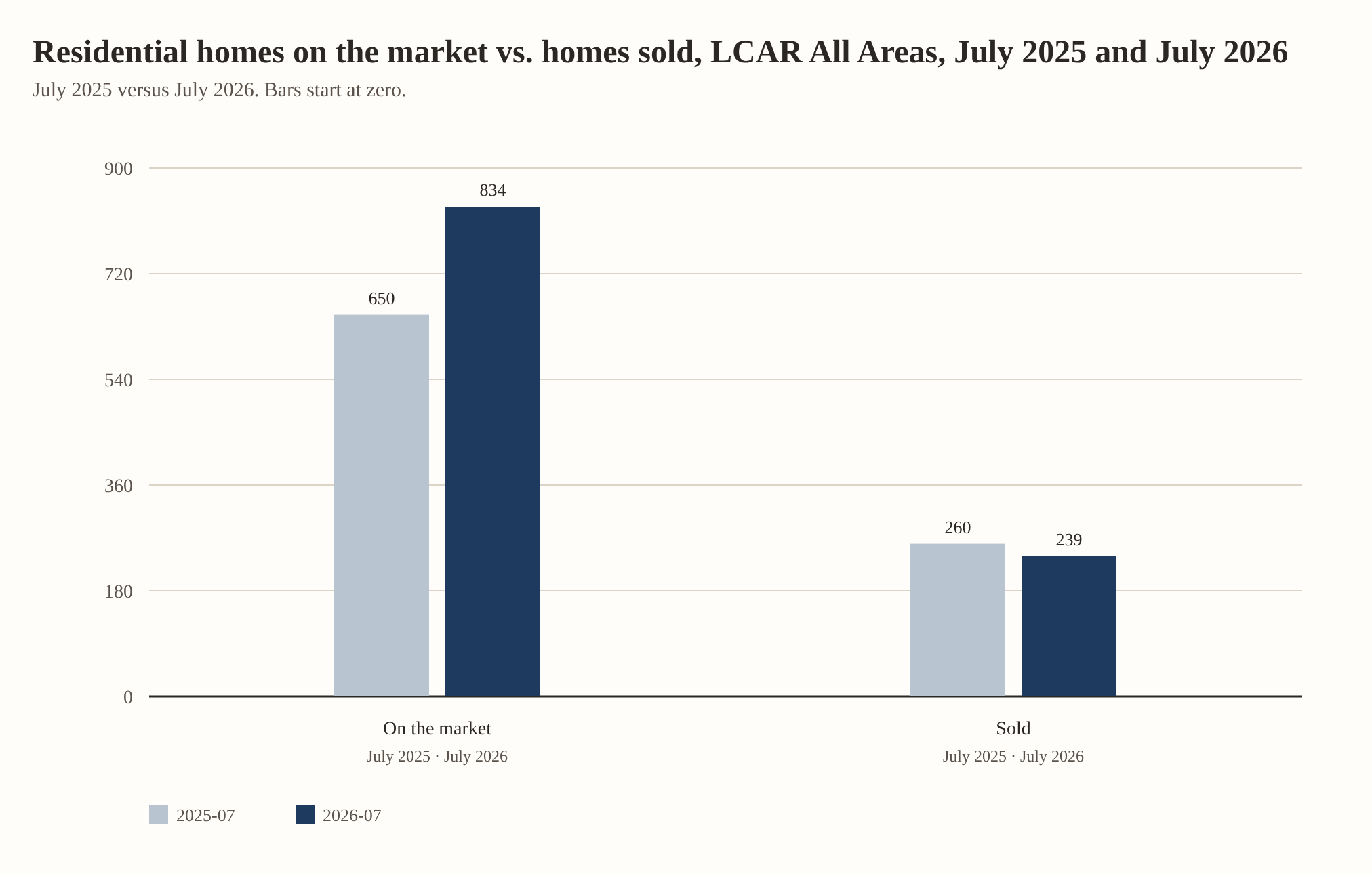
Chart 1. Residential homes on the market vs. homes sold, LCAR All Areas, July 2025 and July 2026. Source: Lee County Association of REALTORS® monthly housing statistics, ALL AREAS column, July 2025; Lee County Association of REALTORS® monthly housing statistics, ALL AREAS column, July 2026.
By our math, dividing homes on the market by homes sold, that works out to about 3.5 months of supply in July 2026, up from about 2.5 in July 2025. Buyers simply had more houses to pick from.
Prices held up. The residential median sold price in LCAR All Areas was $406,260 in July 2026, according to the Lee County Association of REALTORS®. In July 2025 it was $387,150, which by our math is a 4.9% rise.
Speed is the other piece. Average days on market for all residential homes in LCAR All Areas was 54 in July 2026 and 54 in July 2025. Split out, existing homes like Mom's averaged 41 days in July 2026 versus 50 in July 2025. New construction averaged 71 days in July 2026, compared with 59 a year earlier.
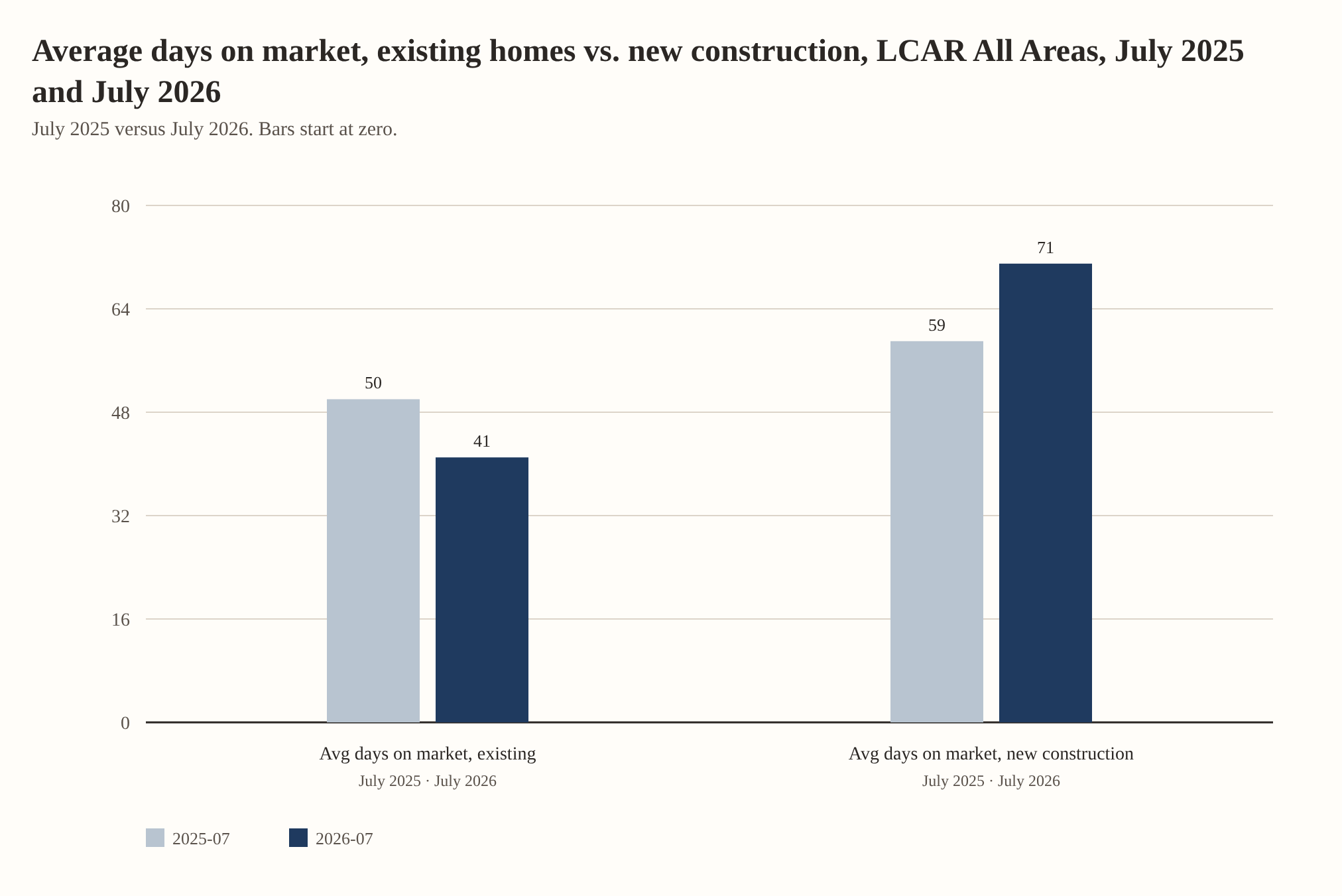
Chart 2. Average days on market, existing homes vs. new construction, LCAR All Areas, July 2025 and July 2026. Source: Lee County Association of REALTORS® monthly housing statistics, ALL AREAS column, July 2025; Lee County Association of REALTORS® monthly housing statistics, ALL AREAS column, July 2026.
My read: these are two snapshots of one month, not a forecast, and they cover a wide area rather than Mom's street. Average days on market also doesn't include the weeks you'll spend clearing out and prepping, or the time from contract to closing. With more homes competing in these snapshots, I'd recommend pricing against comparable nearby sales and presenting the house clearly. Start with decluttering before deciding whether a dated kitchen needs work; neither pricing nor presentation guarantees a sale or a timeline.
Figures are closed and listing data for LCAR All Areas as of July 2025 and July 2026, from the Lee County Association of REALTORS® monthly housing statistics. Market conditions change and past figures are not a prediction.
What Mom Will Actually Walk Away With
A sale price isn't a care budget. Before the family counts on a number, build a net-proceeds estimate from four pieces:
- A real valuation of her house. Online home value estimates are a starting point only and are not a formal comparative market analysis or appraisal. A pricing review built on recent nearby sales of homes like hers is what you want.
- A payoff statement from her lender, if there's a mortgage or home equity line. The amount on a recorded mortgage isn't the current balance.
- Repair and prep estimates. Get written bids for anything a buyer's inspector will flag.
- A written estimate of closing costs, so you know what comes out at the closing table. Before closing, the settlement paperwork will itemize it.
My Auburn home seller FAQ answers more of the practical questions that come up once you decide to sell.
A Simple Order of Operations
- Talk with Mom about what she wants.
- Pull the deed and the POA, and book an elder-law attorney.
- Get the written monthly cost from her assisted-living community.
- Ask a CPA how each option affects her taxes, including the care-facility rule.
- Call her insurance carrier and the Lee County Revenue Commissioner about the empty house.
- Get a pricing review and a net-proceeds estimate.
- Then choose: sell, rent, hold, or transfer.
Frequently Asked Questions About Mom's House
Can I sell Mom's house with a power of attorney in Alabama?
Sometimes. It depends on what her POA says about real estate and whether it's still valid for the decision. An Alabama elder-law attorney should review it before you list.
Does moving to assisted living cost Mom the home-sale tax exclusion?
Not automatically. Under IRS Publication 523, if she became unable to care for herself and lived in the home at least 12 months in the five years before the sale, her time in a licensed care facility can count toward the residence requirement. Her CPA should confirm her dates.
Should we rent Mom's house instead of selling it?
It depends on her care budget, her benefits, and whether someone in the family truly wants to be a landlord. Renting can bring in income, but it adds tax and management work. Run the numbers with a CPA and an elder-law attorney first.
Does Mom keep her homestead exemption after she moves?
Ask the Lee County Revenue Commissioner. Alabama's exemptions are tied to a principal residence, and the answer for her situation should come from them in writing.
Talk It Through With Someone Local
None of this is legal or tax advice, and every family's situation is a little different. What I can do is help you figure out what Mom's house is worth in today's market, what it needs before it sells, and how to time the sale around her move.
I'm Amy Cotney, a REALTOR® with Roots Real Estate - Investment Development here in Auburn. I studied broadcast journalism and public relations at Troy University, and I'm a Certified Interior Decorator, which comes in handy when a much-loved house needs to show its best to a new buyer. You can read more about me and how I work. When your family is ready to talk, call or text me. I'd be glad to help.
Sources
- Internal Revenue Service, Publication 523, Selling Your Home (for use in preparing 2025 returns): https://www.irs.gov/publications/p523
- Alabama Department of Revenue, Homestead Exemptions: https://www.revenue.alabama.gov/property-tax/homestead-exemptions/
- Lee County Association of REALTORS® monthly housing statistics, ALL AREAS column, July 2026
- Lee County Association of REALTORS® monthly housing statistics, ALL AREAS column, July 2025