Updated October 2026
You price a home with no comparable sales by widening the search on purpose: older sales, nearby competing areas, and similar homes with different designs. Then you adjust for each difference the market actually pays for, and let real buyer response test the range. "No comps" almost never means "no evidence." It usually means no twin sold down the street last month.
I get this question a lot in Auburn. Somebody owns the custom build on acreage, the mid-century house with the studio out back, or the renovated farmhouse that doesn't look like anything else on the road. The portal estimate is all over the place, and they want to know what's real. Here's how I'd work through it with you.
The Bottom Line
- "No comparable sales" usually means no near-identical recent sales. It rarely means there's no usable evidence.
- Widen the search in a set order: time first, then nearby competing areas, then similar homes with different designs. Write down why each sale made the cut.
- Adjust only for differences buyers actually pay for. A feature that cost a lot to build isn't automatically worth that to the next owner.
- Confirm a feature is legal before you price it.
- A comparative market analysis, an asking price and an appraisal are three different things. Treat them that way.
- Start with a range, not a single magic number, and let showings and offers tell you where it lands.
What "no comparable sales" actually means
Lenders have a standard for this, and it's a useful starting point even if your buyer pays cash. Fannie Mae's Selling Guide says "a minimum of three closed comparables must be reported" in an appraisal's sales comparison approach (Fannie Mae Selling Guide, Comparable Sales).
The same guidance says comparables that closed within the last 12 months should be used. It also says the best comparable sales "may not always be the most recent sales." An older sale can be the better pick when market conditions have limited recent sales.
Fannie Mae's guidance on unique homes goes one step further. If an appraiser "cannot locate recent comparable sales of the same design and appeal," the home can still be valued. The appraiser leans on sound adjustments plus older sales, sales in competing neighborhoods, similar homes in the area and other reliable market data (Fannie Mae Selling Guide, Improvements Section).
Those are lender rules for loans sold to Fannie Mae, not a law that covers every Alabama sale. But they describe the job well. When there are no perfect matches, you build the case from imperfect ones and explain your choices.
Widen the search in the right order
Here's the order I work in, and why.
Go back in time before you go far away
A sale of a similar home in your own part of Auburn from a while back often tells you more than a recent sale across town. The location matches, and you can account for how the market has moved since. Fannie Mae requires appraisers to look at changes in market conditions from each comparable's contract date to the appraisal date. They decide from there whether a time adjustment is warranted (Fannie Mae Selling Guide, Adjustments).
Then look at competing areas
Next I look at nearby areas where the same buyer would also shop. If someone looking at your home would realistically tour homes in a neighboring subdivision or out in the county, those sales belong in the conversation. Fannie Mae allows sales from competing neighborhoods, as long as the appraiser says so and addresses the differences.
Competing means similar homes, lot sizes, price points and commute. It never means anything about who lives there. Fannie Mae lists any valuation conclusion based "partially or completely on the sex, race, color, religion, disability, national origin, familial status" as an unacceptable practice. That includes "a reference to any protected class" (Fannie Mae Selling Guide, Unacceptable Appraisal Practices). Price the house, the land and the location features. That's it.
Then similar homes with a different design
If your home is a one-of-a-kind contemporary, a traditional home with similar size, age, lot and finish level may still be your best evidence. The design gets handled as an adjustment, not a reason to throw the sale out.
Use listings and pending sales as support only
Active listings and homes under contract tell you what you're competing against right now. They don't tell you what a buyer actually paid. Fannie Mae says contract offerings and current listings "can be used as supporting data, if appropriate." Closed sales carry the weight.
Adjust for what buyers pay for, not what it cost
This is where unusual homes get mispriced most often, in my experience. An owner spent a lot on a feature and wants every dollar back in the price. The market doesn't always cooperate.
Fannie Mae puts it plainly: adjustments "must reflect the market's reaction" to the difference between the properties. It also says it "does not have specific limitations or guidelines associated with net or gross adjustments" (Fannie Mae Selling Guide, Adjustments). So there's no magic cap. There's also no shortcut. Every adjustment needs a reason rooted in how buyers in this market behave.
When I'm building that case for a seller, I look for:
- Paired sales. Two otherwise similar homes where one has the feature and one doesn't.
- Repeat patterns. Whether homes with a pool, a guest suite or extra acreage tend to sell differently in that price range.
- Buyer feedback. What people say at showings about the feature, good and bad.
A heated saltwater pool with a pool house might be the thing a buyer falls in love with. A recording studio in the garage might be the thing they price a demolition for. Same money spent, very different reception.
Check that a feature is legal before you price it
Before a feature goes into the price, make sure it's allowed and documented. Fannie Mae's site guidance asks appraisers to report whether a property is "a legal conforming use, a legal non-conforming (grandfathered) use, an illegal use under the zoning regulations, or no local zoning." The appraiser must also report "the specific FEMA flood zone and the map number and its effective date" (Fannie Mae Selling Guide, Site Section).
A grandfathered use isn't a deal-killer under that guidance. The appraisal just has to reflect any adverse effect it has on value and marketability.
For an Auburn property, that means a few calls before you list:
- The City of Auburn Planning Department for zoning, accessory buildings and anything like a second living unit.
- The city's permit records for additions and conversions.
- FEMA's Map Service Center for the flood map panel that covers your parcel.
- Lee County Revenue Commissioner parcel records and Lee County Probate Court deed records for your parcel and any candidate comparables.
Local rules change. Confirm current requirements with the City of Auburn before relying on anything here. This is not legal advice.
When the cost or income approach helps
Most single-family pricing in Auburn rests on sales. But two other approaches can back it up for the right property.
Fannie Mae says it "does not require the cost approach to value except for the valuation of manufactured homes." The income approach "is required in the valuation of two-unit to four-unit properties." It "may be appropriate in neighborhoods that consist of one-unit properties when there is a substantial rental market" (Fannie Mae Selling Guide, Cost and Income Approach).
The important part: appraisals that rely solely on the cost approach aren't acceptable, and the same goes for the income approach on its own. They support the sales comparison. They don't replace it.
My read on when they earn a place in a pricing conversation:
- Cost approach: newer custom construction or a major renovation, where land value plus what it would take to build the home today, less depreciation, gives you a reasonableness check. Depreciation means lost value from wear, an outdated or impractical layout, or outside influences, not just the home's age.
- Income approach: a duplex or small multi-unit property, or a home in an area near campus where buyers are clearly weighing rent. If you're curious about that side, my post on the best areas for rental property near Auburn covers it.
A CMA, an asking price and an appraisal are three different things
People use these words like they mean the same thing. They don't.
- A comparative market analysis (CMA) is your agent's read of the evidence: closed sales, active competition, adjustments and judgment. It's the work that produces a recommended range.
- An asking price is a marketing decision. It's where you choose to start, informed by the CMA.
- An appraisal is an independent opinion of value, usually ordered for a buyer's lender. Fannie Mae says that regardless of how a reconsideration of value turns out, "the lender is responsible for ensuring the appraisal report and opinion of market value are reliable and adequately supported" (Fannie Mae Selling Guide, Quality Assurance).
Online home value estimates are a starting point only and are not a formal comparative market analysis or appraisal.
For a truly unusual home, some sellers order a pre-listing appraisal to get an independent second opinion before they set a price. If you do, you can check any Alabama appraiser's license through the Alabama Real Estate Appraisers Board's public license lookup.
Set a range, then let the market test it
When the evidence is thin, I'd rather you start with an honest range than a single number we pretend is precise.
Appraisers don't just average their comparables, and you shouldn't either. Fannie Mae says reconciliation "must never be an averaging technique," except for a weighted average with proper explanation (Fannie Mae Selling Guide, Reconciliation). Give more weight to the sales that need the fewest, best-supported adjustments.
Evidence worksheet: For each selected closed sale, record why it fits, its sale price and contract date, each adjustment and the evidence supporting it, the resulting adjusted price indication, and confidence in that indication. Compare the completed rows: use the lower and upper indications from the strongest, most relevant sales to frame a working range. If a weaker sale falls outside that range, explain its lower weight and the differences driving it rather than averaging it in. If strong indications disagree, investigate the adjustments or widen the range to reflect the uncertainty.
From there, here's how I think about testing it (my opinion, from experience, not a formula):
- Agree on what "working" looks like before you list. Showing traffic, the quality of feedback and whether serious buyers come back for a second look.
- Listen for the same objection twice. One buyer hating the layout is taste. Several buyers flagging the same thing is information.
- Watch the competition, not just your listing. If a similar home lists or goes under contract while you're on the market, it changes the picture.
- Revisit the range with fresh evidence, not frustration. Any price change should come from what buyers are telling you.
Timing matters too. If you're also buying your next home, my post on whether to sell before you buy walks through how that sequencing affects your pricing flexibility.
Financing risk on a hard-to-support price
If a buyer needs a loan, an appraisal below the contract price can affect how much the lender will finance. Depending on lender requirements and the contract, the parties may consider additional cash, a changed loan structure, renegotiated price or other revised terms, or a contract-dependent exit. The buyer needs lender review of financing options and review of the contract's contingencies and deadlines before deciding how to proceed; no outcome is guaranteed.
Unusual doesn't mean unfinanceable. Fannie Mae says unique types such as "earth houses, geodesic domes, and log houses" are eligible when the appraiser has enough information to develop a reliable opinion of market value. A property becomes a problem when the appraiser "is not able to find any evidence of market acceptance." The home also has to be so different that no reliable opinion of value is possible (Fannie Mae Selling Guide, Improvements Section).
That's why the paper trail matters. When I list an unusual home, I want the comparables I relied on and the reasons behind each adjustment ready to share. Permits and improvement records belong in that file too. An appraiser can use what you hand them. They can't use what's sitting in your head.
If your home is higher-end as well as unusual, my guide to selling a luxury home in Auburn and Lake Martin goes deeper on marketing at that level.
What the broader LCAR market looked like in July 2026
Aggregate numbers can't price your specific home. These figures provide broad July market context for LCAR All Areas, not a measurement of an unusual Auburn home's competition or its buyers' behavior. Its competitive set must be identified using relevant property-level sales, listings and pending-sale evidence.
For LCAR All Areas, the widest cut in its monthly report, the residential median sold price was $406,260 in July 2026, per the Lee County Association of REALTORS®, compared with $387,150 in July 2025. That's up about 4.9% by our math. The residential average sold price in that same LCAR All Areas column was $453,087 in July 2026 and $438,686 in July 2025.
The bigger shift was in supply. LCAR All Areas counted 834 residential homes on the market in July 2026, up from 650 in July 2025. By our math, that's a rise of about 28.3%. Residential sales went the other way, with 239 sold in July 2026 against 260 in July 2025.
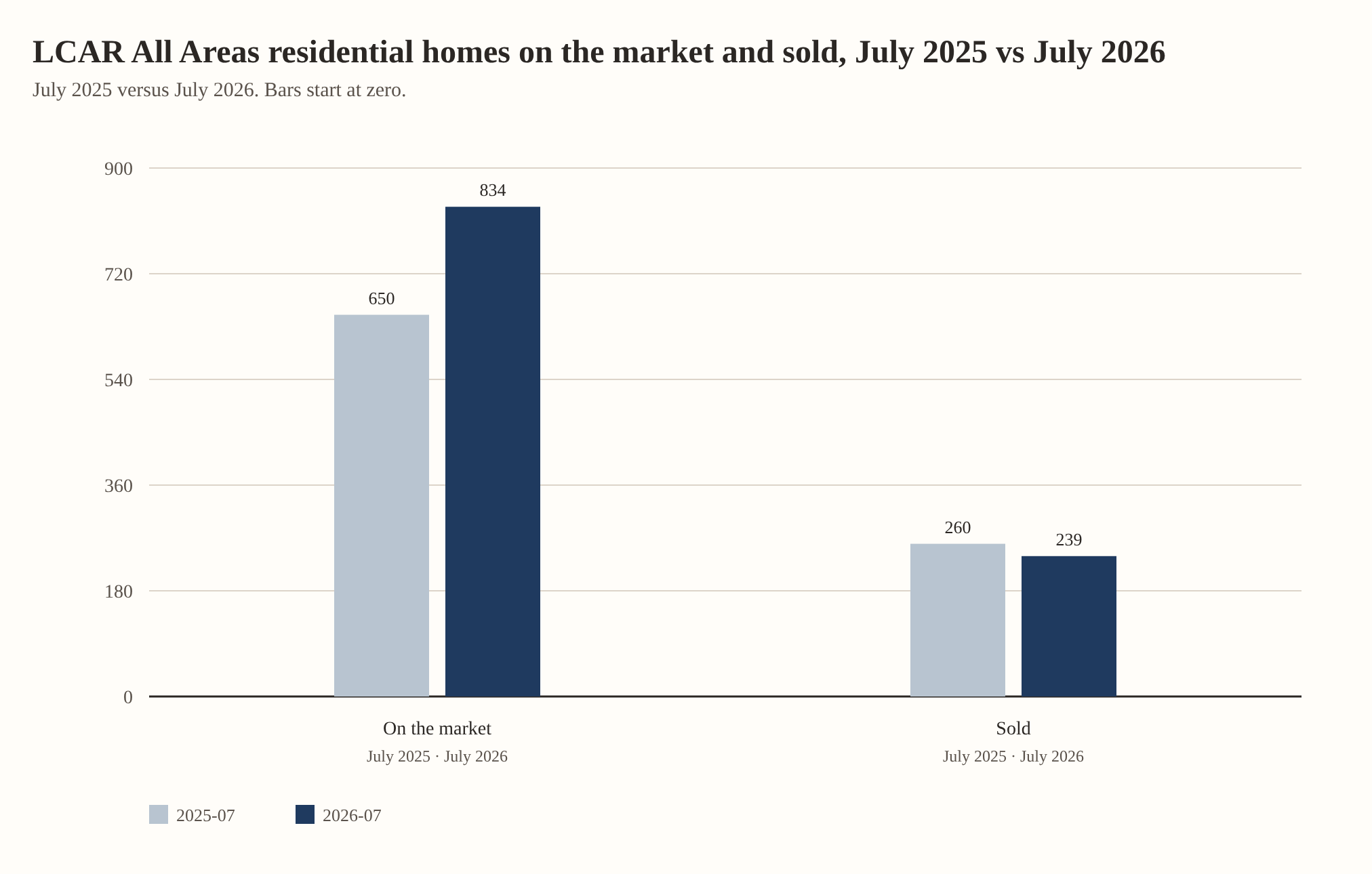
Chart 1. LCAR All Areas residential homes on the market and sold, July 2025 vs July 2026. Source: Lee County Association of REALTORS® monthly housing statistics, ALL AREAS column, July 2025; Lee County Association of REALTORS® monthly housing statistics, ALL AREAS column, July 2026.
Average days on market for LCAR All Areas residential sales held steady, at 54 days in July 2026 and 54 days in July 2025.
My read: the higher on-market count shows more residential listings across LCAR All Areas, but it doesn't establish which homes compete with yours. For an unusual home, a well-documented price still depends on identifying relevant alternatives and evaluating property-level evidence.
Figures are listing and closed data for LCAR All Areas as of July 2025 and July 2026, from the Lee County Association of REALTORS®. Market conditions change and past figures are not a prediction.
Frequently asked questions about pricing an unusual home
Should I just price high and come down?
My read is that starting well above what the evidence supports tends to cost you your best audience. That's the buyers who see the listing in its first days. With an unusual home, you want those buyers paying attention from day one. Start where you can defend the number.
Does an unusual feature always add value?
No. Some features add value, some are neutral and some turn buyers off. The test is buyer behavior in your market, not what the feature cost. My Auburn home seller FAQ covers more of the questions sellers ask before listing.
What if the house came to me through an estate?
Pricing works the same way, but you may also be juggling probate timing and co-owners who disagree. My post on selling an inherited house in Alabama covers that side.
Sources
- Fannie Mae Selling Guide, Comparable Sales
- Fannie Mae Selling Guide, Adjustments to Comparable Sales
- Fannie Mae Selling Guide, Improvements Section of the Appraisal Report
- Fannie Mae Selling Guide, Site Section of the Appraisal Report
- Fannie Mae Selling Guide, Cost and Income Approach to Value
- Fannie Mae Selling Guide, Valuation Analysis and Reconciliation
- Fannie Mae Selling Guide, Quality Assurance
- Fannie Mae Selling Guide, Unacceptable Appraisal Practices
- Lee County Association of REALTORS® monthly housing statistics, ALL AREAS column, July 2026
- Lee County Association of REALTORS® monthly housing statistics, ALL AREAS column, July 2025
I'm Amy Cotney, a REALTOR® and licensed real estate salesperson with Roots Real Estate - Investment Development in Auburn. My training as a Certified Interior Decorator shapes how I look at a one-of-a-kind home and how I present it to buyers. You can learn more about me here. I build strong relationships that lead to sold homes and happy buyers, through communication, not automation.