Updated October 2026
Your closing costs as an Alabama buyer are the fees for getting your mortgage and transferring ownership. That includes lender charges, title and settlement services, state recording taxes, county recording fees, and prepaid items like insurance and escrow. They're separate from your down payment. The most reliable number you'll get is the one on your own Loan Estimate, which a lender gives you after you apply.
"What will closing actually cost me?" is one of the first questions first-time buyers in Auburn ask me. So here are the questions I hear most, answered in plain English, with the Alabama and Lee County specifics filled in.
The Bottom Line
- Closing costs and your down payment are two different buckets. Your cash to close combines them, minus what you've already paid.
- Alabama charges a recording tax on the deed and on the mortgage, and Lee County Probate adds its own recording and index fees.
- Seller credits and lender credits can lower what you bring to closing, but each one has limits and tradeoffs.
- Alabama's Step Up program offers eligible buyers down-payment assistance that may reduce their overall upfront cash burden.
- Your Loan Estimate and your Closing Disclosure are the documents that tell you your real numbers.
What are typical closing costs for a buyer in Alabama?
There's no single statewide average that fits every Alabama buyer, because the biggest pieces depend on your loan, your lender, your purchase price and your contract. The Consumer Financial Protection Bureau describes closing costs as the upfront costs of getting your loan and transferring ownership of the home. The down payment isn't part of them.
So here's my honest advice. Get preapproved, apply with a couple of lenders, and line up the Loan Estimates side by side. That gives you a real number for your loan on your house, which beats any rule of thumb. Budget separately for your down payment, closing costs (including prepaids and initial escrow), and expenses paid before closing. Use the cash-to-close worksheet below to separate money already paid from money still due.
What's actually in my closing costs?
The CFPB's Loan Estimate explainer walks through the second page of the form, and that page is where your closing costs live. The sections are:
- Origination charges. What the lender charges to make the loan, including any points you choose to pay.
- Services you cannot shop for. Items the lender picks, like the appraisal and credit report.
- Services you can shop for. Items like title services and the settlement or closing provider, where you're allowed to choose your own.
- Taxes and other government fees. Alabama's recording taxes and the county's recording fees land here.
- Prepaids. Things you pay ahead, like your first year of homeowners insurance and some prepaid interest.
- Initial escrow payment at closing. The cushion your lender collects to start your escrow account for taxes and insurance.
When you compare lenders, compare Loan Estimates for the same loan terms. A lower rate with higher origination charges isn't automatically the better deal, and that's the comparison the form was built for.
What Alabama taxes and Lee County fees show up at closing?
Alabama charges a recording tax when the deed and the mortgage are recorded. According to the Alabama Department of Revenue, the deed tax is $.50 per $500 of value or fraction thereof. The mortgage tax is $.15 per $100 of indebtedness or fraction thereof. By my math, that works out to about $100 per $100,000 of value conveyed and $150 per $100,000 borrowed.
Lee County Probate collects those taxes when your documents are recorded in the county, and it publishes its own recording fee schedule:
- $3.00 per page to record
- $5.00 index fee
- $8.00 total for a basic one-page document
- $1.00 per additional name
- Deed tax figured at $.50 per $500 on the value of property conveyed, charged in increments of $500
- Mortgage tax figured at $1.50 per thousand, charged in increments of $100
Two things I always tell buyers here. First, Alabama law has specific rules for how the deed tax applies when a deed and a purchase-money mortgage are recorded together, so ask your closing attorney or title company to run the exact figure for your purchase. Second, your purchase contract decides who pays which of these, so read that section before you sign.
Are closing costs the same as cash to close?
No, and this is the one that trips people up. A simplified formula is your down payment plus closing costs, minus deposits you've already paid (like earnest money) and seller credits. The CFPB's Closing Disclosure explainer also accounts for closing costs paid before closing, any closing costs financed, and other transaction adjustments and credits, such as tax prorations. Costs already paid still belong in your overall purchase budget, but aren't due again at closing. Lender credits reduce the disclosed Total Closing Costs, so don't subtract them again when using that net total.
Fill in this worksheet first from your Loan Estimate, then update it from the Calculating Cash to Close table on your Closing Disclosure, using each line's stated sign:
- Down payment/funds from borrower: $____
- Total Closing Costs (after lender credits): $____
- Less closing costs paid before closing: $____
- Less closing costs financed: $____
- Less deposit/earnest money: $____
- Less seller credits: $____
- Adjustments and other credits (add or subtract as shown): $____
- Cash to close: $____
Reconcile the result with your lender's disclosed cash-to-close total. Separately record expenses paid before closing: $____, including any expenses outside the disclosure, so your overall upfront budget doesn't overlook them.
That means your earnest money isn't an extra cost on top. It's money you already handed over, and it gets credited back to you in the math. Don't count it twice when you're budgeting. Cash to close is usually paid by cashier's check or wire transfer. Before you wire anything, call your closing attorney or title company at a number you already know is real to confirm the instructions.
Can the seller pay some of my closing costs?
Often, yes, but there are limits. For a conventional loan sold to Fannie Mae, the Selling Guide on interested party contributions caps what a seller can contribute on a principal residence based on your combined loan-to-value ratio:
- Greater than 90%: up to 3%
- 75.01% to 90%: up to 6%
- 75% or less: up to 9%
These are percentage maximums, not guaranteed credits. Your lender applies the Selling Guide's purchase-price/appraised-value basis, using the lower of the two, and usable contributions cannot exceed eligible actual costs. Those contributions can cover closing costs, including prepaids. They can also cover HOA dues for up to 12 months after closing. Anything above the cap gets treated as a sales concession and comes off the price for loan purposes, so it doesn't turn into extra cash in your pocket.
To make that concrete, take Auburn's residential median sold price of $494,087 in July 2026, per the Lee County Association of REALTORS®. By my math, if the purchase price is $494,087, the appraised value is at least that amount, and the buyer's combined loan-to-value is greater than 90%, the 3% tier produces a percentage ceiling of $14,822.61. That's an illustration, not a quote or an assured benefit. Usable contributions are limited to eligible actual costs if those are lower. Your actual limit depends on your purchase price, appraised value, eligible costs, loan and lender. FHA, VA and other programs set their own rules, so ask your lender which limit applies to you.
My read: seller credits are a negotiating tool, not free money. A seller who agrees to pay toward your closing costs is weighing that against your offer price, and sometimes asking for a lower price is the cleaner move. We'll look at both before you write an offer.
What about lender credits?
A lender credit lowers what you pay at closing in exchange for a higher interest rate. Points work the other way: you pay more up front to get a lower rate. The CFPB lays out the tradeoff in its explainer on lender credits and points. Credits help if cash is tight right now, but you'll pay for them in a higher monthly payment for as long as you keep the loan. If you think you'll sell or refinance in a few years, that math can look very different than if you plan to stay put.
Is there Alabama help for first-time buyers with closing costs?
Down-payment assistance may reduce your overall upfront cash burden, but that isn't the same as direct closing-cost coverage. The Alabama Housing Finance Authority's Step Up program offers down payment assistance of 4% of the sales price up to $10,000. It comes as a repayable 10-year second mortgage paired with a 30-year fixed first mortgage, not a grant. AHFA lists these requirements:
- Household income of $172,800 or less
- Minimum credit score of 640
- Debt-to-income ratio of 45% or lower
- Completion of homebuyer education
By my math, the 4% reaches the $10,000 cap at a $250,000 sales price, so on any home priced above that, the assistance tops out at $10,000. I break down how Step Up and other options work in my guide to Alabama first-time home buyer programs.
How much do mortgage rates matter right now?
A lot, because your rate drives your monthly payment for years after closing. Freddie Mac's Primary Mortgage Market Survey shows the 30-year fixed averaged 7.28% as of October 1, 2026, compared with 6.34% a year earlier. That's up 0.94 percentage point by my math. The 15-year fixed averaged 6.60%. Those are national weekly averages, so your own rate will depend on your credit, your down payment and your loan type.
Your mortgage payment includes principal and interest, plus escrowed property taxes and homeowners insurance when applicable, and mortgage insurance when required. Budget separately for HOA dues if the neighborhood has them; they are generally a separate obligation, but still part of your total monthly housing costs.
Nothing here is legal, tax, or lending advice. Rates shown are national weekly averages and are not a quote, an offer of credit, or a prediction. For terms on your own situation, talk to a licensed lender.
What about property taxes and homeowners insurance?
Both depend on the specific house. Before you make an offer, look up the parcel with the Lee County Revenue Commissioner. Check the assessed value, which taxing districts it sits in, and whether the current owner has a homestead exemption. A seller's tax bill with an exemption you haven't applied for yet may not match what you'll pay. For insurance, get quotes on the actual address early, because they feed straight into your escrow and your monthly payment. If you're also weighing where to live, my comparison of Auburn vs. Opelika covers the practical differences between the two cities.
What are homes selling for in Auburn?
Per the Lee County Association of REALTORS®, Auburn's residential median sold price was $494,087 in July 2026, up from $431,625 in July 2025. That's a clear year-over-year increase, and the bar chart below compares the two months side by side.
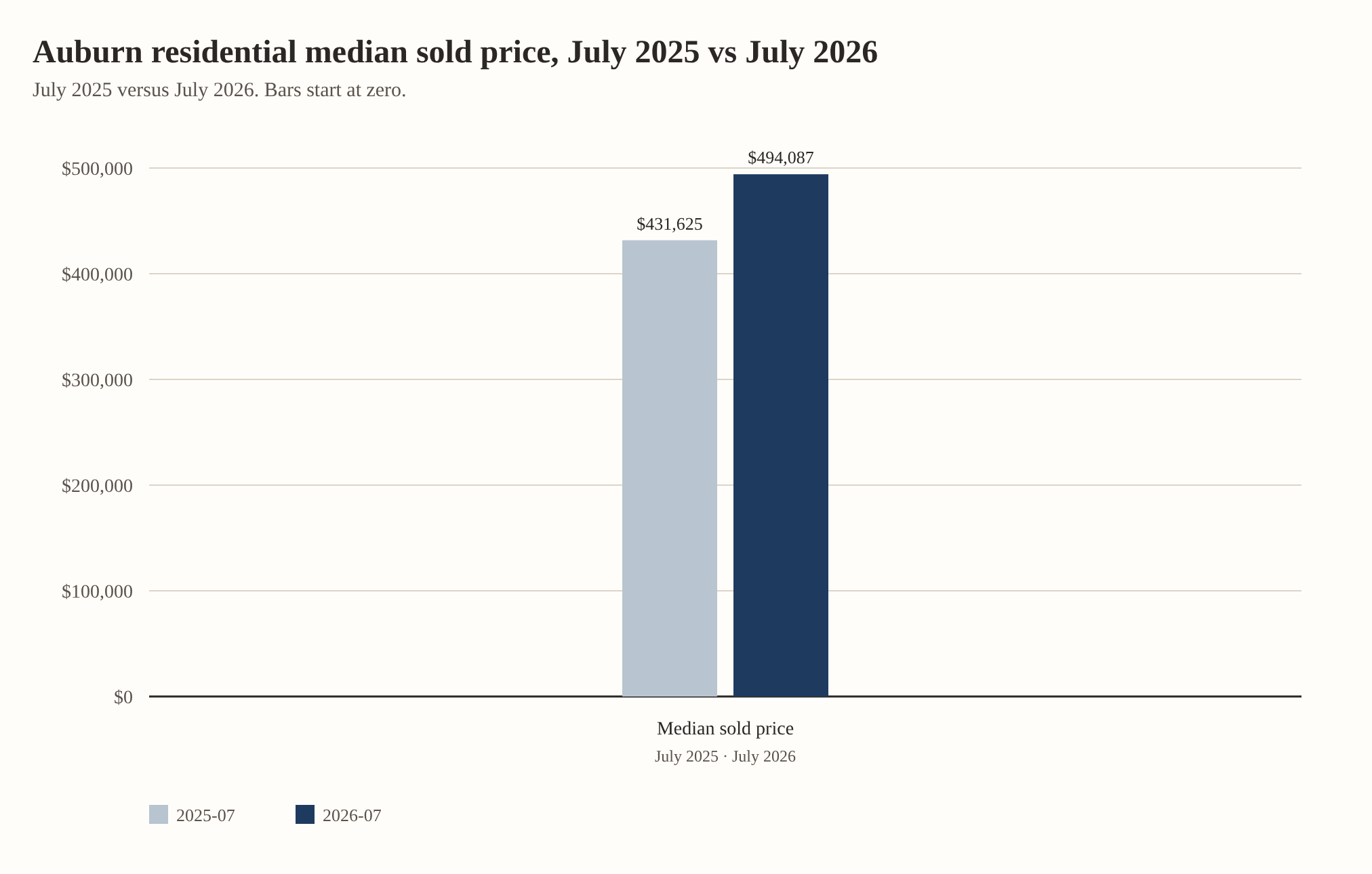
Chart 1. Auburn residential median sold price, July 2025 vs July 2026. Source: Lee County Association of REALTORS® monthly housing statistics, AUBURN column, July 2025; Lee County Association of REALTORS® monthly housing statistics, AUBURN column, July 2026.
The Lee County Association of REALTORS® figures also show 442 Auburn homes on the market in July 2026, compared with 320 in July 2025. Auburn closed 114 residential sales in July 2026 versus 136 a year earlier. Average days on market came in at 54, compared with 49 in July 2025.
My read: more homes on the market and fewer closed sales mean a buyer in Auburn has more listings to compare than a year ago. That can give you room to ask about repairs or closing-cost help, but it doesn't guarantee a seller will say yes. The residential median sold price increased between July 2025 and July 2026; that doesn't establish appreciation for every home or current October prices. Build your budget around the specific home's price and your lender's current estimates. You can browse what's available now on my Auburn home search.
Figures are listing and closed data for Auburn as of July 2026, from the Lee County Association of REALTORS®. The comparison period is July 2025. Market conditions change and past figures are not a prediction.
What happens after my offer is accepted?
Your earnest money goes in, your inspection period starts, and your lender orders the appraisal and works your loan toward approval. Your contract sets the deadlines, so keep a copy handy and know your dates.
For most mortgages, your lender has to give you a Closing Disclosure at least three business days before closing, according to the CFPB. Compare it line by line with your Loan Estimate. Nobody frames their Closing Disclosure, but it's worth reading every word, and if something moved, ask why before closing day. Then comes the final walk-through, signing, and keys.
If you're buying from out of town, I wrote about how cost of living in Auburn compares with Atlanta and Birmingham, which helps when you're building the monthly side of your budget.
Where should a first-time buyer in Auburn start?
Start with a lender conversation and a preapproval, then line up your Loan Estimate, your assistance options and your target neighborhoods. My step-by-step guide for first-time home buyers in Auburn walks through the whole process in order, and this FAQ fills in the money questions along the way.
I'm Amy Cotney, a licensed real estate salesperson with Roots Real Estate - Investment Development here in Auburn, and helping first-time buyers make sense of these numbers is a big part of what I do. You can read more about me and how I work, or reach out with your questions about your own purchase. I build strong relationships that lead to sold homes and happy buyers, through communication, not automation.
Sources
- Consumer Financial Protection Bureau, "Figure out how much you want to spend," Buying a House, accessed October 7, 2026: https://www.consumerfinance.gov/owning-a-home/prepare/figure-out-how-much-you-want-to-spend/
- Consumer Financial Protection Bureau, Loan Estimate explainer, accessed October 7, 2026: https://www.consumerfinance.gov/owning-a-home/loan-estimate/
- Consumer Financial Protection Bureau, Closing Disclosure explainer, accessed October 7, 2026: https://www.consumerfinance.gov/owning-a-home/closing-disclosure/
- Consumer Financial Protection Bureau, "How should I use lender credits and points (also called discount points)?", accessed October 7, 2026: https://www.consumerfinance.gov/ask-cfpb/how-should-i-use-lender-credits-and-points-also-called-discount-points-en-136/
- Alabama Department of Revenue, Recordation Tax, accessed October 7, 2026: https://www.revenue.alabama.gov/tax-types/recordation-tax/
- Lee County Probate Judge, Recording Fees, accessed October 7, 2026: https://www.leecountyal.gov/government/probate_judge/recording/fees.php
- Fannie Mae Selling Guide, Interested Party Contributions (IPCs), accessed October 7, 2026: https://selling-guide.fanniemae.com/sel/b3-4.1-02/interested-party-contributions-ipcs
- Alabama Housing Finance Authority, Step Up program, accessed October 7, 2026: https://www.ahfa.com/programs/homeownership/available-programs/step-up
- Freddie Mac, Primary Mortgage Market Survey, release of October 1, 2026: https://www.freddiemac.com/pmms
- Lee County Association of REALTORS® monthly housing statistics, AUBURN column, July 2026
- Lee County Association of REALTORS® monthly housing statistics, AUBURN column, July 2025