If you're buying your first home in Alabama, here's the most useful thing to know. The state's two main down payment assistance programs each cover 4% of your sales price, up to $10,000. And you don't have to be a first-time buyer to use either one.
Those are the Alabama Housing Finance Authority's Step Up and First Step programs, and they're the first thing to look at if you're short on cash to close.
I sell homes in Auburn, Opelika, and around Lee County. A lot of buyers talk themselves out of a house because they think they need 20% down. You don't. Below is what's actually available in Alabama right now, what the money looks like at real Lee County price points, and where the programs quietly stop being generous.
The bottom line
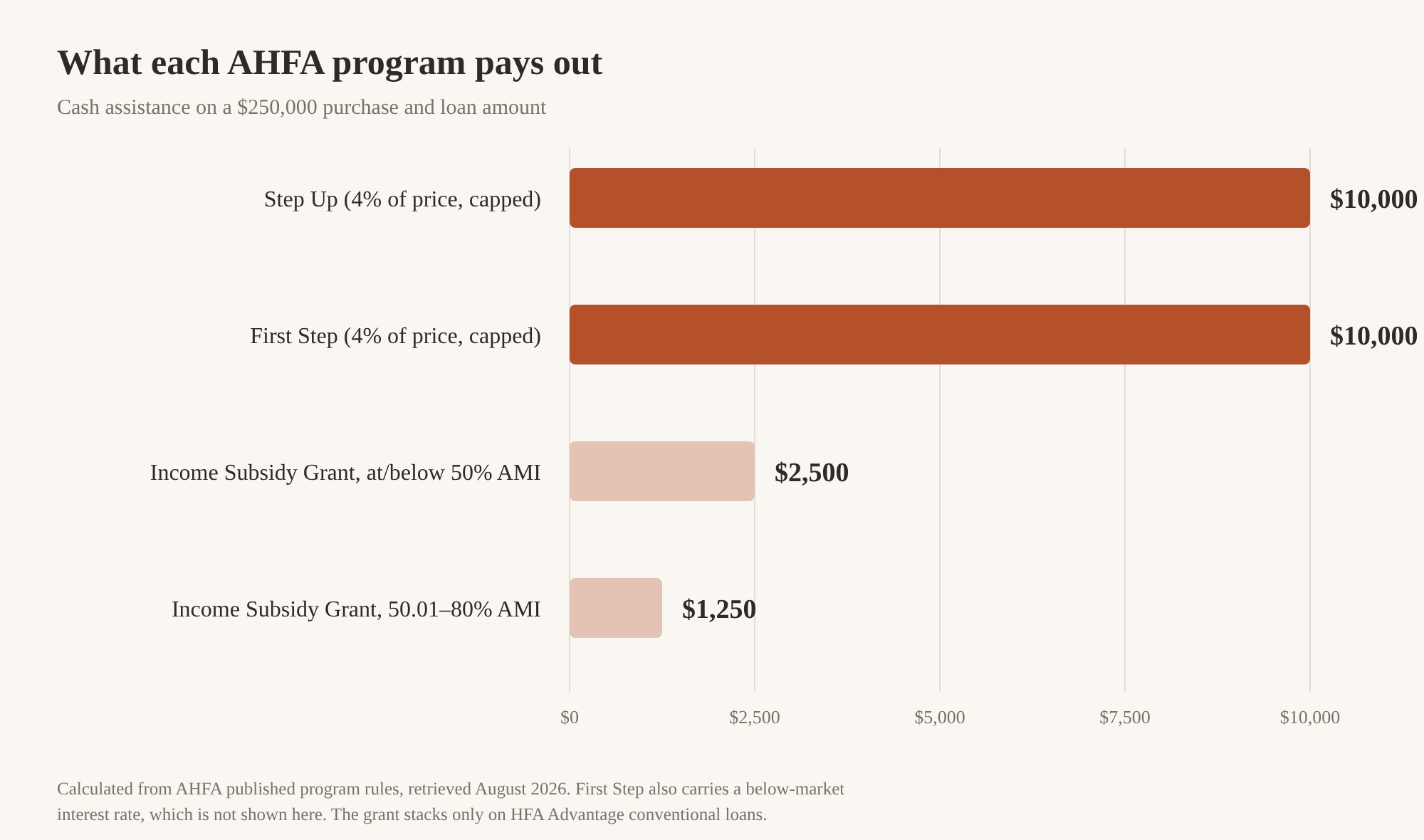
- Step Up and First Step both pay down payment assistance of 4% of the sales price, capped at $10,000, as a 10-year second mortgage you pay back.
- First Step adds a below-market interest rate on top of that assistance, funded through mortgage revenue bonds.
- You don't have to be a first-time buyer. AHFA opens First Step to "first-time or repeat homebuyers," and Step Up lists no first-time requirement at all.
- The Affordable Income Subsidy Grant adds 0.5% to 1% of your loan amount as an actual grant, money you don't repay, if your income is at or below 80% of your county's area median.
- The $10,000 cap starts binding at a $250,000 sale price. Above that, your assistance stops growing while your down payment keeps growing.
- Alabama also has a tax deduction for money you save toward a first home: up to $5,000 a year filing single, $10,000 filing jointly.
All AHFA figures here are current as of August 2026. AHFA doesn't print effective dates on its program pages, so confirm the numbers with a participating lender before you write an offer.
You don't have to be a first-time buyer
This is the part that gets buried on every national mortgage site, and it costs people money.
AHFA's Step Up page lists a credit score minimum, a debt-to-income maximum, an income ceiling, and an education requirement. What it doesn't list is a first-time-buyer requirement. The First Step page is even more explicit. AHFA says it serves "first-time or repeat homebuyers," and that nearly 50,000 Alabama households have benefitted from it since it started.
So if you sold a house in 2019, rented for a few years, and assumed you'd aged out of the help, you probably haven't. Plenty of people in that spot find out from a lender rather than a website, after they've already stretched to cover a bigger down payment.
The three AHFA programs, in plain English
AHFA's current program list has three homeownership programs. Here's what each one actually does.
Step Up
Step Up is the straightforward cash-at-closing program. You get 4% of the sales price, capped at $10,000, structured as a 10-year second mortgage that sits behind your main loan. It's assistance, not a gift. You're repaying it on a 10-year schedule while your first mortgage runs 30 years at a fixed rate.
To qualify, you need a credit score of at least 640, a debt-to-income ratio no higher than 45%, and household income of $172,800 or less. You'll also complete a homeownership education course. Step Up pairs with an HFA Advantage conventional loan, FHA, VA, or USDA, and it works on new or existing homes anywhere in Alabama.
Source: AHFA Step Up program page, retrieved August 2026.
First Step
First Step is the one people misunderstand, including plenty of articles about it. It's funded through mortgage revenue bonds, and its headline feature is a special low interest rate on FHA, VA, USDA, and Freddie Mac HFA Advantage conventional loans.
But it isn't rate-only. AHFA states that all First Step borrowers are eligible for down payment assistance up to $10,000 or 4% of the sales price, whichever is lower, secured by a 10-year second mortgage paired with a 30-year fixed First Step first mortgage. Same assistance math as Step Up, with a cheaper rate underneath it.
The tradeoff is the limits. First Step borrowers have to meet federally established sales price and income limits tied to their area's median income, and you have to live in the home. It can't be used for business, commercial, or rental purposes. Step Up's income ceiling is a flat $172,800, which is a good deal higher than most federal area-median-based limits.
So the real question isn't "cash or rate." It's whether your income and price point fit inside First Step's federal limits, because if they do, you can get the assistance and the better rate. Any AHFA-participating lender can run both and show you the difference.
Affordable Income Subsidy Grant
This is the one that's free money, and the one most buyers have never heard of. If your income is at or below 50% of the area median for the county where you're buying, you get 1% of your loan amount as a grant. If you're between 50.01% and 80% of area median, you get 0.5%. You don't pay it back.
Two catches. It only attaches to HFA Advantage conventional loans, not FHA or VA. And per AHFA's grant page, the income limits are set county by county, so the number that matters is the Lee County figure, not a statewide average.
Program | What you get | Repay it? | Main limit to watch |
|---|---|---|---|
Step Up | 4% of sales price, max $10,000 | Yes, 10-year second mortgage | Income at or below $172,800 |
First Step | Below-market rate, plus 4% of sales price, max $10,000 | Yes, 10-year second mortgage | Federal sales price and income limits by area |
Affordable Income Subsidy Grant | 1% of loan amount at or below 50% AMI; 0.5% at 50.01–80% AMI | No, it's a grant | HFA Advantage conventional loans only |
Source: Alabama Housing Finance Authority program pages, retrieved August 2026. All three require a 640 credit score, a debt-to-income ratio at or below 45%, homeownership education, and a participating lender.
One more thing worth saying plainly. You may run across older Alabama pages promoting an AHFA Mortgage Credit Certificate. An MCC isn't on AHFA's current program list, and the old program page no longer resolves. If a lender or an article tells you to count on one, ask AHFA directly before you build it into your budget.
Where the $10,000 cap starts to bite in Lee County
Here's the math that usually doesn't get spelled out.
Both programs give you 4% of the sales price, but only until 4% hits $10,000. That happens at exactly $250,000. Below that number, the assistance scales with the house. Above it, your assistance flatlines while your down payment requirement keeps climbing.
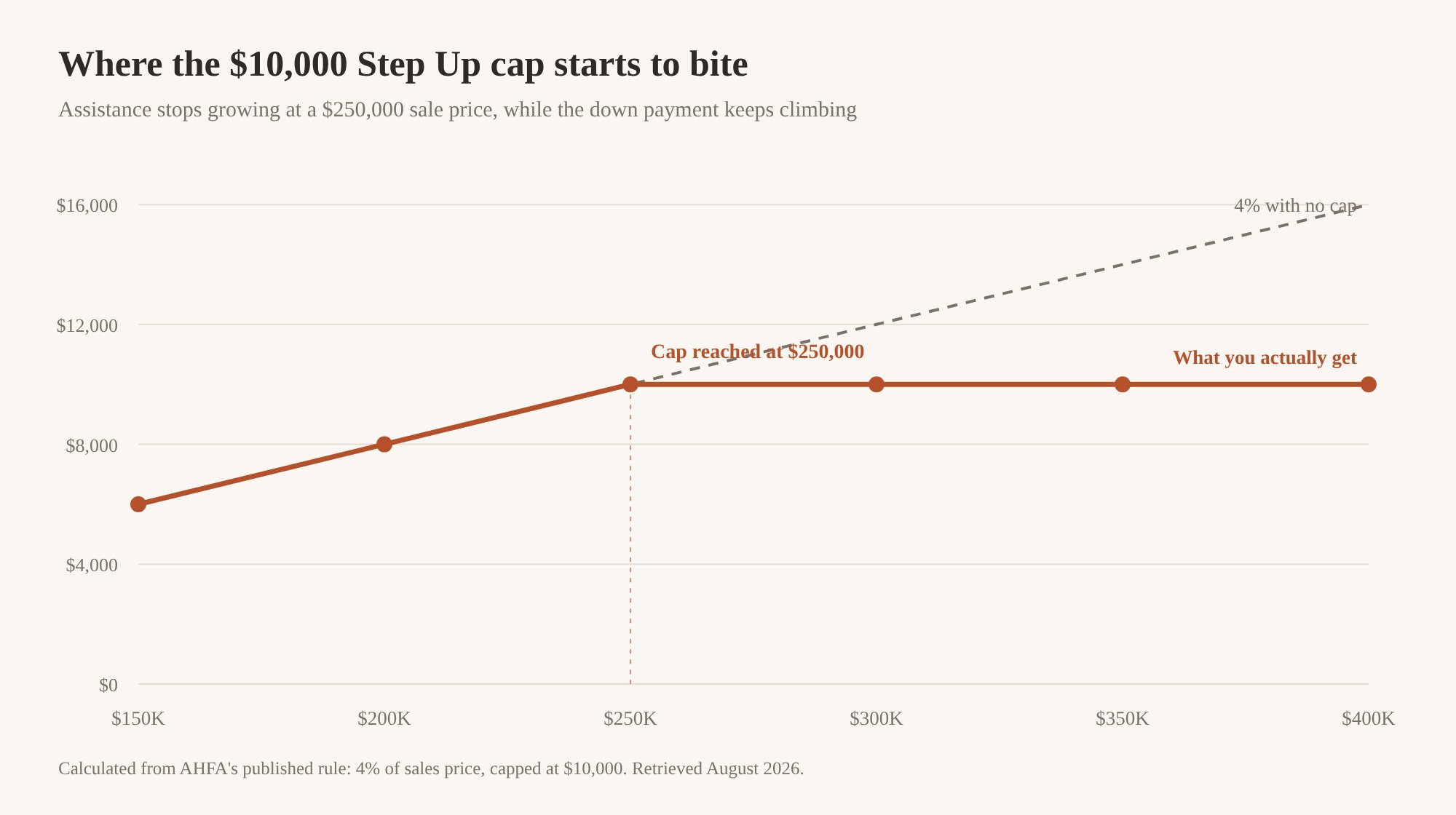
Sale price | 4% of price | Assistance you actually get | Cap binding? |
|---|---|---|---|
$150,000 | $6,000 | $6,000 | No |
$200,000 | $8,000 | $8,000 | No |
$250,000 | $10,000 | $10,000 | Right at the cap |
$300,000 | $12,000 | $10,000 | Yes |
$350,000 | $14,000 | $10,000 | Yes |
$400,000 | $16,000 | $10,000 | Yes |
Calculated from AHFA's published rule: 4% of sales price, capped at $10,000.
Why this matters: the cap is a flat dollar amount, so the higher your price point, the smaller a share of your purchase it covers. At $200,000 the assistance is the full 4%. At $400,000 it works out to 2.5%. The dollars stop moving. The house doesn't.
That's not a reason to skip the program at a higher price point. It's a reason to know, before you start touring, that $10,000 is the ceiling, and to plan the rest of your cash around it. If you're not sure what your price point looks like here, start with a local valuation or a look at what's actually on the market.
The loan behind the assistance
AHFA assistance isn't a mortgage on its own. It rides on top of one. Which loan you pick underneath it changes your down payment more than the assistance does.
VA loans are the strongest deal in the country if you've served. The VA states there's no down payment required as long as the sales price isn't higher than the appraised value, and no private mortgage insurance or mortgage insurance premium. If you've served, price this route before anything else.
USDA loans are the other route buyers ask about when they have nothing saved, and AHFA assistance works with them. The catch is that eligibility is decided by address, not by city name, and the boundary lines around Auburn and Opelika don't follow anything intuitive. Check your specific address on the USDA eligibility map before you assume either way. The line can fall between two houses across the street from each other.
FHA is the standard lower-down-payment federal option, and it pairs with both AHFA programs. The exact minimum down payment depends on your credit score, so have your lender quote it rather than trusting a number off a national article. HFA Advantage is the conventional loan AHFA prefers, and it's the only one the Affordable Income Subsidy Grant attaches to.
One practical shortcut on credit. Whatever minimum score your loan type allows, AHFA sets its own floor at 640 across its programs. If you're sitting at 615 and hoping to use Step Up, the useful project for the next few months isn't house hunting. It's getting to 640.
The Alabama tax break almost nobody mentions
This one isn't a loan product, which is exactly why it's missing from most mortgage articles.
Alabama has a First-Time and Second Chance Home Buyer Savings Account. According to the Alabama Department of Revenue, you can deduct up to $5,000 a year in contributions if you file single, or up to $10,000 filing jointly, for five years in which you made deposits. Earnings in the account are tax-free if you meet the requirements, and the money goes toward the down payment and closing costs on a first home in Alabama.
Eighteen months out from buying? That's real money. Talk to a tax professional about the filing mechanics, because I sell houses, not tax returns.
What I tell first-time buyers here before they apply
A few things worth knowing, in the order they usually matter.
Get the homeownership education done early. Every AHFA program requires it. It's not hard, but it's one more thing standing between you and a closing date, and it always seems to surface the week everyone's in a hurry.
Talk to a lender who actually does AHFA loans. Not every lender is an AHFA participating lender. A loan officer who runs these monthly will structure yours faster and cleaner than one figuring it out on your file. Ask directly: how many AHFA loans did you close last year?
Watch your debt-to-income before you buy anything else. The 45% DTI ceiling is real. A new truck payment three weeks before closing can knock a buyer out of a program they'd already qualified for. If you're under contract, buy nothing.
Budget past the down payment. Assistance covers the down payment. It doesn't cover your inspection, your appraisal, your insurance escrow, or the moving truck. In this market, closing costs are the surprise, not the down payment.
Common questions
Can I use down payment assistance and the Affordable Income Subsidy Grant together?
Only if you're on an HFA Advantage conventional loan, since that's the only loan the grant attaches to, and only if your income is at or below 80% of your county's area median. Have your lender check both against the Lee County figures.
What's the actual difference between Step Up and First Step?
Both pay the same 4%, capped at $10,000. First Step adds a below-market interest rate but holds you to federally established sales price and income limits based on area median income. Step Up uses a flat $172,800 income ceiling instead. Your income and price point usually decide it for you.
Does the second mortgage have to be paid off when I sell?
It's a 10-year second mortgage, so it's a lien on the property and gets settled at closing like any other. Ask your lender for the exact payoff terms in writing before you sign.
Is there a purchase price limit?
First Step has one, set federally by area. AHFA's public Step Up page doesn't state a price limit, so that's a question for AHFA or a participating lender rather than a number I'm willing to guess at for you.
What if my credit score is under 640?
Then that's the project. AHFA's floor is 640 across its programs, and the gap between 615 and 640 is often a few months of paying down revolving balances, not years.
Where to start
Trying to figure out whether you can buy in Lee County this year? The honest sequence is short:
- Check your credit and find out how far you are from 640.
- Talk to an AHFA participating lender and ask them to price Step Up and First Step side by side.
- Find out what your actual price range is before you fall in love with a listing.
Then we go look at houses.
The thing that surprises most first-time buyers is how much of this is solvable. Short on down payment isn't the same as not ready.
Buying in Auburn, Opelika, or anywhere around Lee County? Reach out. I'd love to help. Amy Cotney and the Roots Real Estate - Investment Development team are right here in Auburn, and I'm happy to answer a question even if you're still a year out.
Amy Cotney, REALTOR®, is a licensed real estate salesperson (Alabama license #108235) with Roots Real Estate - Investment Development, 235 N Gay St, Auburn, AL 36830. Call or text (334) 332-4002. Equal Housing Opportunity.
This article is general information about publicly available programs, not lending, legal, or tax advice. Program terms are current as of August 2026 and change; verify details with AHFA, a participating lender, or a tax professional before making a decision.